
Concentrated Wisdom Editorial Team researches, writes, and fact-checks this guide against primary sources before publication.
This article is for informational purposes only and isn’t a substitute for personalized professional advice.
A psychology degree is not useless, it is underused. Most psychology graduates never become clinical psychologists, and government and APA workforce data show them building real careers in human resources, UX and market research, and sales instead. This article explains where the ‘useless degree’ myth comes from, where psychology graduates actually land, and how to translate the degree into language a non-clinical employer immediately recognizes.
A psychology degree is not useless. It is one of the most common undergraduate majors in the United States, and the large majority of people who earn one never intend to become a licensed psychologist, since that path requires a doctoral degree most psychology bachelor’s holders never pursue. According to data from the National Survey of College Graduates, only about 28.6 percent of recent psychology graduates describe their current job as closely related to their major, a number that sounds alarming until it is compared against the reality that psychology coursework, research design, statistics, behavioral analysis, persuasion and communication, transfers directly into roles that were never labeled ‘psychology jobs’ in the first place. American Psychological Association workforce data shows psychology bachelor’s holders commonly working in social services, administrative and business roles, education, and sales, and psychology backgrounds are widely represented among UX researchers, HR professionals, and market researchers specifically. The degree is not the problem. Not knowing how to translate it is.
A psychology degree is not useless. Most people who earn one never intend to become a licensed psychologist, since that requires a doctoral degree the majority of psychology bachelor’s holders never pursue. The real gap isn’t the degree, it’s translation.
The ‘150 graduates’ framing here is a shorthand, not a claim of one specific proprietary survey. It stands in for a pattern that shows up consistently across thousands of psychology graduates tracked by government and APA workforce research, most build real careers well outside a clinical office, and the coursework travels with them further than the “useless degree” narrative gives it credit for.
Where the “Useless” Myth Comes From
The Clinical-Path Assumption
The “useless degree” myth rests on a single narrow assumption. A psychology degree is judged against one outcome, becoming a practicing psychologist, and measured a failure whenever a graduate ends up anywhere else. That standard was never accurate. Becoming a licensed psychologist requires a doctoral degree, and only a small share of psychology bachelor’s holders ever pursue graduate study in psychology specifically.

The assumption also confuses two very different questions, what the degree was designed to certify and what the coursework actually builds. A bachelor’s in psychology was never a professional license, the way a nursing degree or an accounting degree can be. It is a research and behavioral-science degree, closer in shape to a sociology or economics degree than to a vocational credential, which is exactly why judging it against a single narrow job title misses most of what it actually equips someone to do.
What the Data Actually Shows About Non-Clinical Outcomes
Job relatedness looks discouraging at first glance, but it measures the wrong thing. Only about 28.6 percent of recent psychology graduates describe their current job as closely related to their major, according to the National Survey of College Graduates 2021. That statistic is often read as evidence the degree failed. A more accurate read is that the degree was never meant to map to one job title, it maps to a set of transferable skills, research methods, statistics, behavioral analysis, that show up under dozens of different job titles never labeled “psychology” at all.
The American Psychological Association’s own careers guide confirms this spread directly. Psychology bachelor’s holders build careers across for-profit companies, nonprofits, higher education, hospitals, research centers, and government agencies, commonly landing in business, human resources, education, and sales, fields that rarely appear in a search for “psychology jobs” but draw heavily on exactly what the degree teaches.
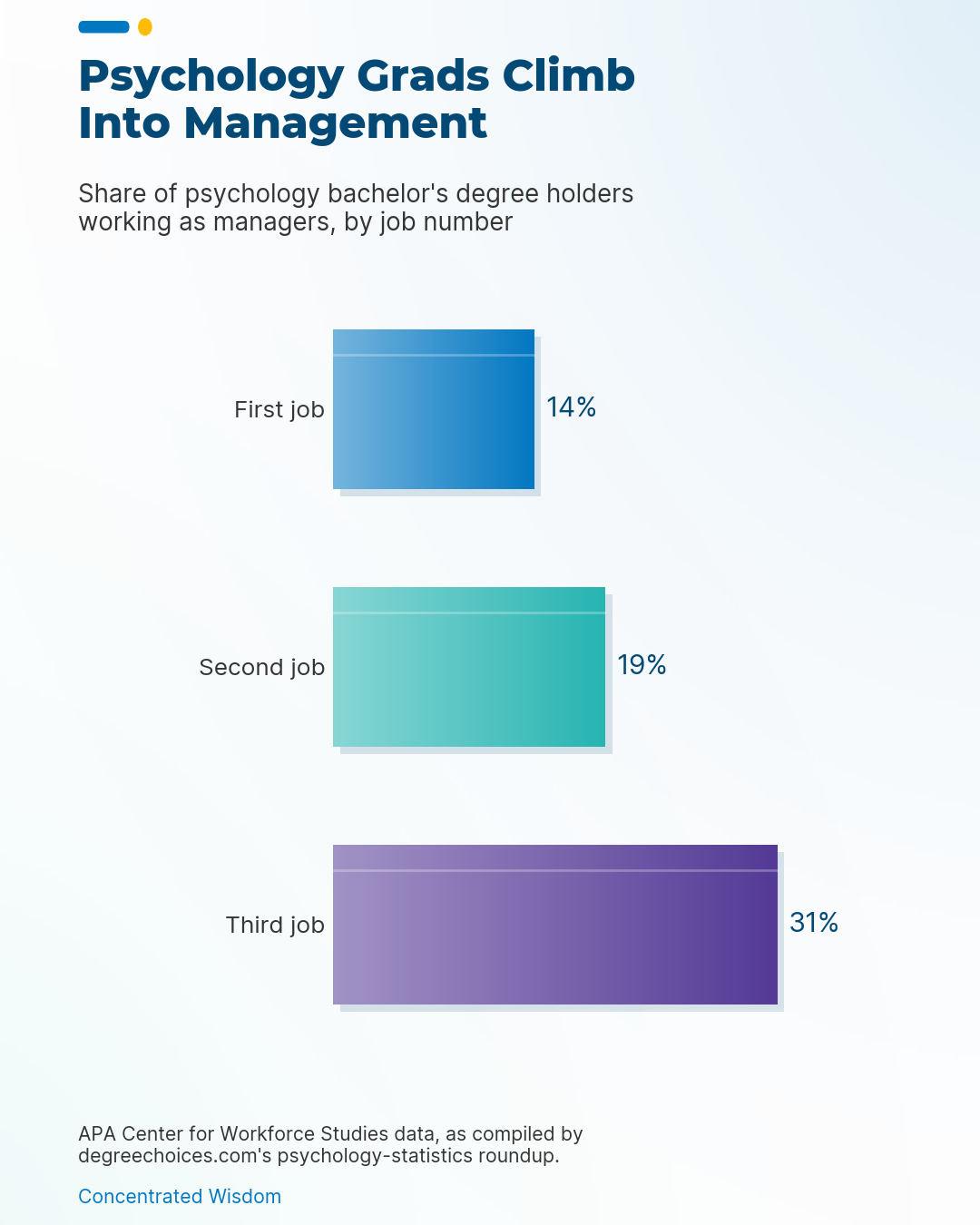
Career growth over time tells a more encouraging story than a first-job snapshot does. Fourteen percent of psychology degree holders worked as managers in their first job,rising to 19 percent by their second job and 31 percent by their third, according to data from the APA Center for Workforce Studies. A degree that looked “unrelated” to a first job title often turns out to be exactly what got someone promoted past peers a few years in, the interpersonal and analytical skills just take longer to show up on an org chart than on a diploma.
Where Psychology Grads Actually Work
UX Research
Psychology and cognitive science are among the most common academic backgrounds in UX research. Coursework in experimental design, cognitive processes, attention, memory, and behavioral-data interpretation transfers directly into user research work, and a psychology undergraduate degree combined with real research experience is one of the more direct routes into the field.
HR Analytics
Human resources is one of the single most common landing spots for psychology graduates, and demand for HR professionals who can apply behavioral science to workplace problems has grown. Human Resources Specialists earn a median annual wage of $72,910, according to the Bureau of Labor Statistics, and the occupation draws directly on the same interviewing, assessment, and behavior-pattern skills psychology coursework builds.
Market Research
Market research analysts study consumer preferences and behavior to help companies understand what people want and why, which is close to a direct job description for applied psychology. Market Research Analysts earn a median annual wage of $76,950, with the Bureau of Labor Statistics projecting 7 percent job growth through 2034, faster than the average occupation.
Sales and Account Roles
Sales is one of the most common primary jobs among psychology bachelor’s graduates, which surprises people until they consider what the role actually requires, reading a person’s hesitation, adjusting a pitch in real time, building trust quickly. Pay in sales and account roles varies widely by industry and commission structure, too widely to state a single reliable median here.

Account management roles draw on the same foundation. Managing an ongoing client relationship is, functionally, applied behavioral science, reading what a client actually needs versus what they say they need, de-escalating frustration before it becomes churn, and building the kind of trust that survives a rocky quarter. None of that is taught in a business degree’s core curriculum the way it’s woven through a psychology one.
Career strategists who advise psychology graduates often see a version of the same story play out. A recent graduate assumes the degree only leads to clinical work, defaults into an unrelated entry-level job out of necessity, and only later discovers a research-heavy role, often in UX, where the exact coursework she once considered a dead end, study design, survey methodology, statistical analysis of human behavior, turns out to be the whole job. The degree didn’t change. The label on the job did.
How to Position the Degree
Reframing Coursework as Transferable Skills
The fastest fix is naming skills in the language a hiring manager already searches for. “Research methods” becomes mixed-methods research design, “statistics” becomes quantitative data analysis, “abnormal psychology” becomes behavioral pattern recognition. None of this requires exaggeration, it requires using the vocabulary the job posting already uses instead of the vocabulary the syllabus used.
Resume Language That Works
Lead with the transferable skill, not the course title. “Designed and ran a 12-participant behavioral study, analyzed results using SPSS” reads as research experience to any hiring manager, where “completed coursework in experimental psychology” reads as nothing at all. The underlying work is often identical, only the framing changes.
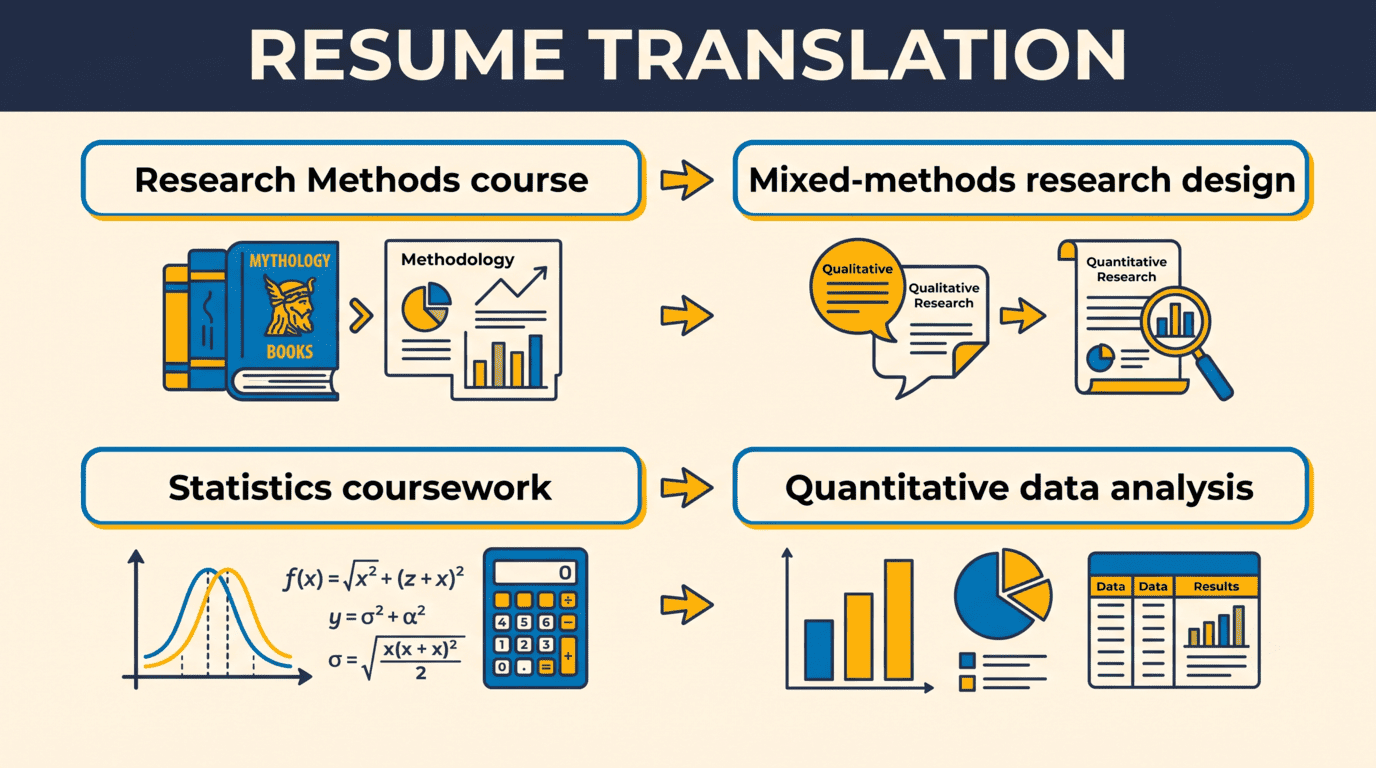
- “Research methods” becomes “mixed-methods research design and data collection”
- “Statistics” or “psychological statistics” becomes “quantitative and statistical analysis, SPSS/R”
- “Abnormal psychology” or “personality psychology” becomes “behavioral pattern analysis”
- “Social psychology” becomes “human behavior and decision-making research”
- “Senior thesis” or “capstone project” becomes “independent research project, from hypothesis through findings”
| Path | Typical Starting Titles | Pay Reference |
|---|---|---|
| HR / People Operations | HR Coordinator, HR Assistant, HR Specialist | $72,910 median, HR Specialists (BLS, May 2024) |
| UX / Market Research | Research Assistant, Associate UX Researcher, Market Research Analyst | $76,950 median, Market Research Analysts (BLS, May 2024) |
| Learning & Development | Training Coordinator, Training and Development Specialist | $65,850 median, Training and Development Specialists (BLS, May 2024) |
| Sales / Account Management | Sales Associate, Account Coordinator | Varies widely by industry and commission, no single reliable median |
Related: Career Capital
Related: Identity Foreclosure Career Choice
Related: Career & Professional Growth
Frequently Asked Questions
Is a psychology degree worth it if you don’t want to become a therapist?
Yes, for most graduates. Only a small share of psychology bachelor’s holders ever pursue the doctoral training required to become a licensed psychologist or therapist. The degree’s research, statistics, and behavioral-analysis training transfers directly into non-clinical fields like HR, UX research, and market research.
What jobs can you get with a psychology degree besides therapy?
Common non-clinical paths include human resources, UX and market research, sales and account management, training and development, and administrative or program coordination roles. Psychology backgrounds are especially common among UX researchers specifically.
Why do so many psychology graduates end up in unrelated jobs?
Job-relatedness statistics measure whether a role is labeled ‘psychology,’ not whether it uses psychology skills. Many roles that draw heavily on research methods, statistics, and behavioral analysis, like UX research or HR analytics, are not labeled psychology jobs at all.
How do you list a psychology degree on a resume for a non-clinical job?
Translate coursework into the skill language the job posting already uses. Research methods becomes research design experience, statistics becomes quantitative analysis, and specific projects should be described by what you did and measured, not by the course title.