

Concentrated Wisdom Editorial Team researches, writes, and fact-checks this guide against primary sources before publication.
This article is for informational purposes only and isn’t a substitute for personalized professional advice.
Most leadership book lists rank by popularity, not by what a reader actually walks away able to do. This guide picks six books, each built around one specific, practicable skill, giving difficult feedback, balancing task versus people focus, matching your style to a person’s readiness, holding two opposing truths at once, so a reader can pick the one book that addresses their actual current gap instead of reading a general philosophy of leadership for the fourth time.
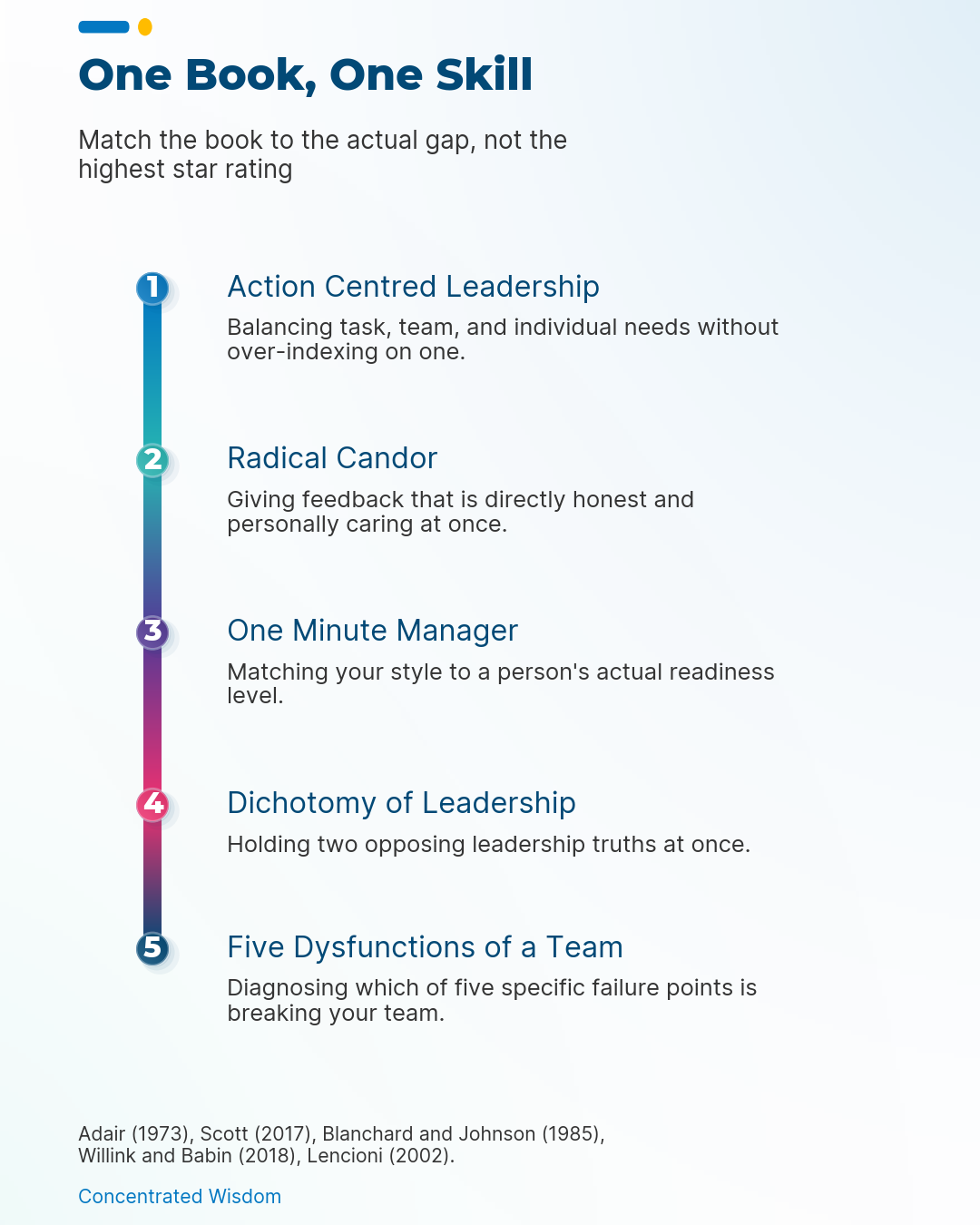
The most practically useful books on leadership skills are ones built around a single, specific, teachable skill rather than a general philosophy of leadership. John Adair’s Action Centred Leadership (1973) teaches the skill of balancing task, team, and individual needs. Kim Scott’s Radical Candor (2017) teaches the specific skill of giving feedback that is both direct and caring at once. Paul Hersey and Kenneth Blanchard’s Situational Leadership work teaches the skill of matching a directing, coaching, supporting, or delegating style to a person’s actual competence and commitment level. Jocko Willink and Leif Babin’s The Dichotomy of Leadership (2018) teaches the skill of holding two opposing leadership truths at once, such as caring for people while still accomplishing the mission. Patrick Lencioni’s The Five Dysfunctions of a Team (2002) teaches the skill of diagnosing which of five specific failure points, absence of trust, fear of conflict, lack of commitment, avoidance of accountability, or inattention to results, is actually breaking a given team.
Most lists of books on leadership skills are really lists of leadership philosophy books, inspiring but hard to turn into Monday morning behavior. The six below were chosen for the opposite reason, each one teaches exactly one specific, nameable skill you can practice this week.
The Six Books, and the One Skill Each One Teaches
| Book | Author(s), Year | The One Skill It Teaches |
|---|---|---|
| Action Centred Leadership | John Adair, 1973 | Balancing task, team, and individual needs without over-indexing on one. |
| Radical Candor | Kim Scott, 2017 | Giving feedback that is both directly honest and personally caring at the same time. |
| Leadership and the One Minute Manager | Ken Blanchard and Spencer Johnson, 1985 | Matching a directing, coaching, supporting, or delegating style to a person’s actual readiness. |
| The Dichotomy of Leadership | Jocko Willink and Leif Babin, 2018 | Holding two opposing leadership truths at once instead of picking a single fixed style. |
| The Five Dysfunctions of a Team | Patrick Lencioni, 2002 | Diagnosing which of five specific failure points is actually breaking a team. |
| Crucial Conversations | Kerry Patterson, Joseph Grenny, Ron McMillan, Al Switzler, 2002 | Staying in a high-stakes conversation productively instead of going silent or going aggressive. |
Related: Dichotomy of Leadership Summary
Why the Skill-First Filter Matters
A philosophy book changes how you think about leadership in general. A skill book changes what you specifically do in your next difficult one-on-one, your next team retro, or your next moment deciding whether to give a struggling employee more direction or more autonomy. Both have real value, but a reader who has already absorbed the philosophy (most working professionals have, by osmosis, at this point) gets more marginal benefit from the second kind.
Kim Scott’s Radical Candor is the clearest example. Its entire framework fits on a single two-by-two grid, Care Personally on one axis, Challenge Directly on the other, and the book’s real value is a specific diagnostic question: which quadrant did my last piece of feedback actually land in. That is a skill you can check today, not a philosophy you slowly absorb over a career.
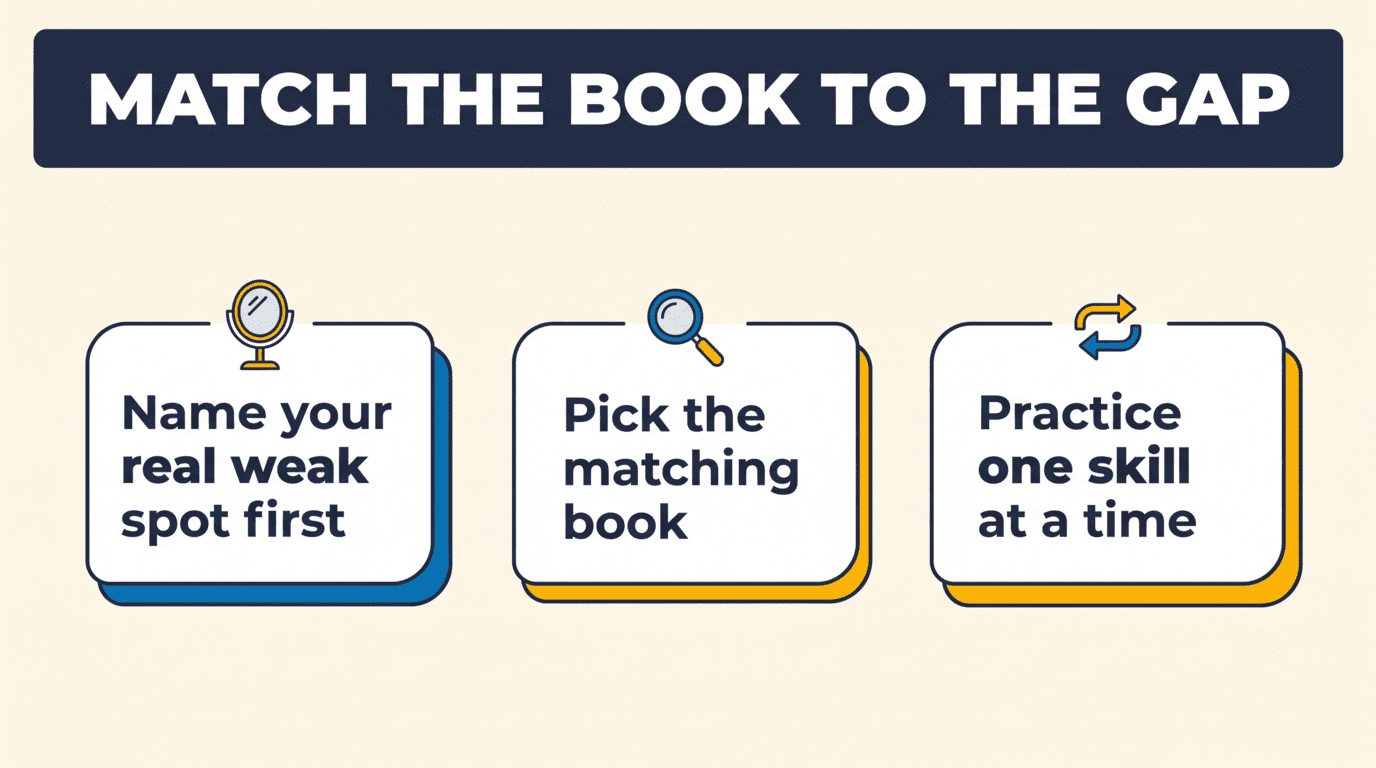
How to Pick the Right One for Your Actual Gap
- If feedback conversations feel either too harsh or too soft, start with Radical Candor.
- If you manage people at very different skill levels the same way, start with Leadership and the One Minute Manager (situational styles).
- If your team avoids conflict and misses deadlines quietly, start with The Five Dysfunctions of a Team.
- If you feel torn between two seemingly opposite instincts as a leader, start with The Dichotomy of Leadership.
- If you tend to over-focus on either the task or the people and never both, start with Action Centred Leadership.
Related: Entrepreneurship & Leadership
Quick Summary
The most useful books on leadership skills are the ones built around one specific, nameable skill rather than a general philosophy of leading. Action Centred Leadership teaches balance across task, team, and individual, Radical Candor teaches direct and caring feedback, situational leadership teaches matching your style to a person’s readiness, The Dichotomy of Leadership teaches holding two truths at once, and The Five Dysfunctions of a Team teaches diagnosing a team’s actual failure point. Pick the one that matches your current real gap, not the one with the most five-star reviews.
Related: Skills Approach to Leadership
Frequently Asked Questions
What is the best book to build practical leadership skills?
It depends on the specific skill gap. For feedback, Kim Scott’s Radical Candor is the most practical. For balancing task and people focus, John Adair’s Action Centred Leadership is the clearest. For matching your style to a person’s competence level, Leadership and the One Minute Manager by Ken Blanchard and Spencer Johnson is the standard reference.
Is The Dichotomy of Leadership a good leadership skills book?
Yes, for a specific skill: holding two opposing leadership instincts at once, such as caring for people while still driving results. Written by Jocko Willink and Leif Babin in 2018, it works best for a reader who already understands basic leadership concepts and wants to handle the tension between them, not as a first leadership book.
What leadership book teaches how to give feedback?
Kim Scott’s Radical Candor (2017) is built specifically around this skill. Its core framework plots feedback on two axes, Care Personally and Challenge Directly, and gives a reader a concrete way to diagnose whether their last piece of feedback was too harsh, too soft, or genuinely both caring and direct.
What is the difference between a leadership philosophy book and a leadership skills book?
A philosophy book changes how you think about leadership broadly, while a skills book gives you one specific, practicable behavior you can apply immediately, such as a feedback framework, a diagnostic model, or a style-matching system. Both have value, but a skills book produces a more immediate change in Monday morning behavior.