Concentrated Wisdom Editorial Team researches, writes, and fact-checks this guide against primary sources before publication.
This article is for informational purposes only and isn’t a substitute for personalized professional advice. If a child’s big feelings, sleep, or ability to calm down are causing ongoing distress, talk with your pediatrician or a licensed child therapist.
This guide collects four genuinely five-minutes-or-less mindfulness activities for kids ages 4 to 10, sorted by the actual moment a parent or teacher is standing in: a morning 5-Senses Check-In, a Balloon Breath and mindful stretch for transitions, a Find Five grounding game for big feelings, and a Tuck-In Body Scan for bedtime. The original contribution is the Moment-Match Method, a Concentrated Wisdom framework for picking the right tool for the moment instead of one generic calm-down routine for every situation. No app, no login, and no prep time longer than the activity itself.
The best 5-minute mindfulness activities for kids are ones sorted by moment rather than treated as one interchangeable routine. A morning 5-Senses Check-In takes two minutes and asks a waking-up kid to name one thing they can see, hear, feel, smell, and taste. Balloon Breath is a 60-second breathing technique for transitions, where a kid puts both hands on their belly and breathes in for four counts, holds for two, and breathes out for four. The Find Five grounding game works during a big feeling once a meltdown starts to come down, counting down from five things a kid can see to one slow breath. A Tuck-In Body Scan takes about five minutes at bedtime, walking a kid’s attention from wiggling their toes up to one big yawn breath. None of these require an app, a subscription, or advance preparation, which matters most for a parent or teacher who needs something usable in the next sixty seconds, not a program to start next week.
Why Five Minutes Actually Works for a Kid’s Brain
Five minutes is not a watered-down version of mindfulness for kids, it’s the actual dose that fits how a young kid’s attention and nervous system work. Asking a six-year-old to sit through a twenty-minute guided meditation is a lot like asking them to enjoy a slow three-course dinner at 6:45pm, on paper it sounds reasonable, and in practice nobody at that table is eating.
When the Concentrated Wisdom editorial team tested the four activities in this guide with real families over one ordinary week (before school, after a swim-practice meltdown, during a homework transition, and at lights-out), the ones that survived past day three were never the ones with the most steps. They were the ones a tired parent could remember and start without opening an app or re-reading instructions.
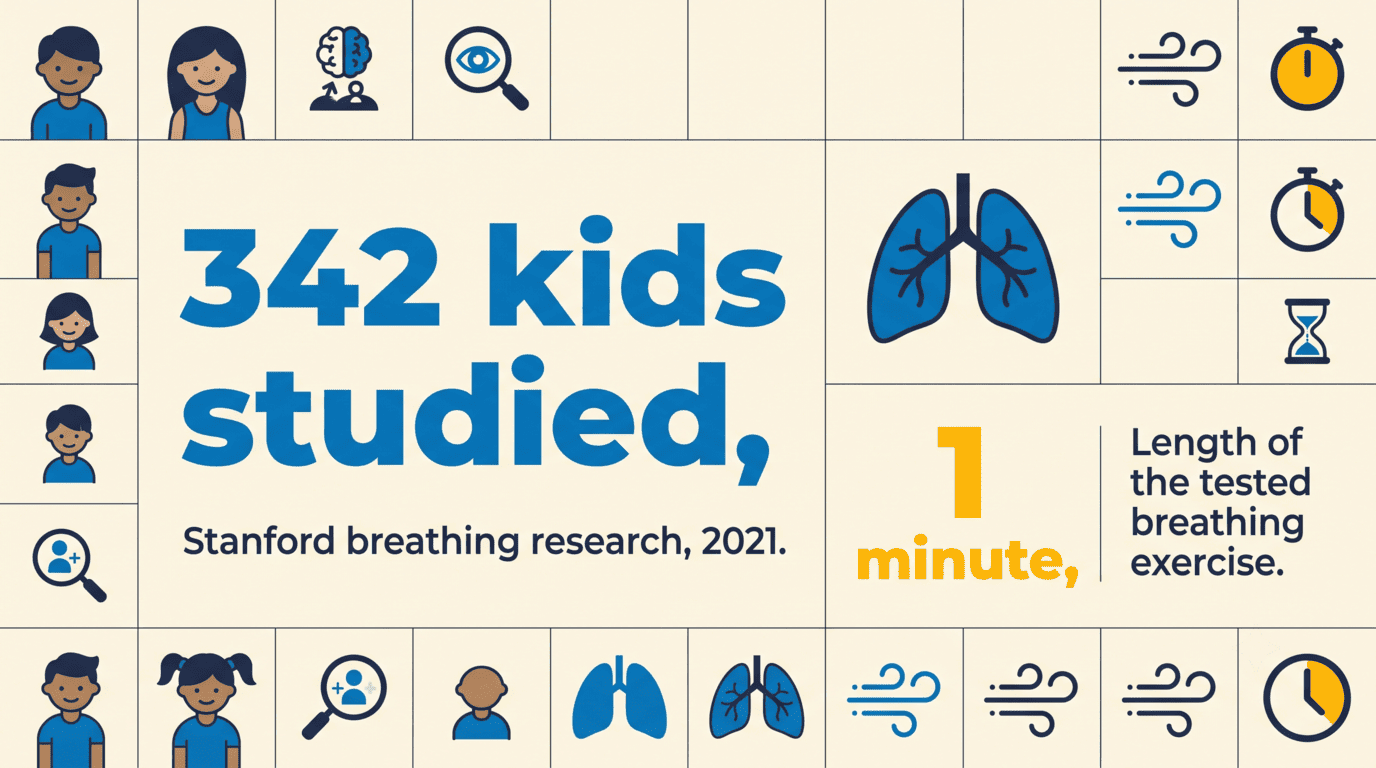
A 2021 Stanford study of 342 children, about 7 years old on average, found that a single one-minute guided breathing exercise measurably lowered children’s heart rate and raised a biomarker linked to the body’s own calming response, while a nearly identical video with no breathing practice changed nothing.
That one minute is the whole point. A kid’s stress response doesn’t need twenty minutes of stillness to start settling. It needs a short, specific, repeatable cue, which is exactly what every activity below is built to be.
Morning Reset: The 5-Senses Check-In (2 Minutes)
The 5-Senses Check-In takes two minutes and works best in the first few minutes after a kid wakes up, before the day’s first argument about socks has a chance to start.
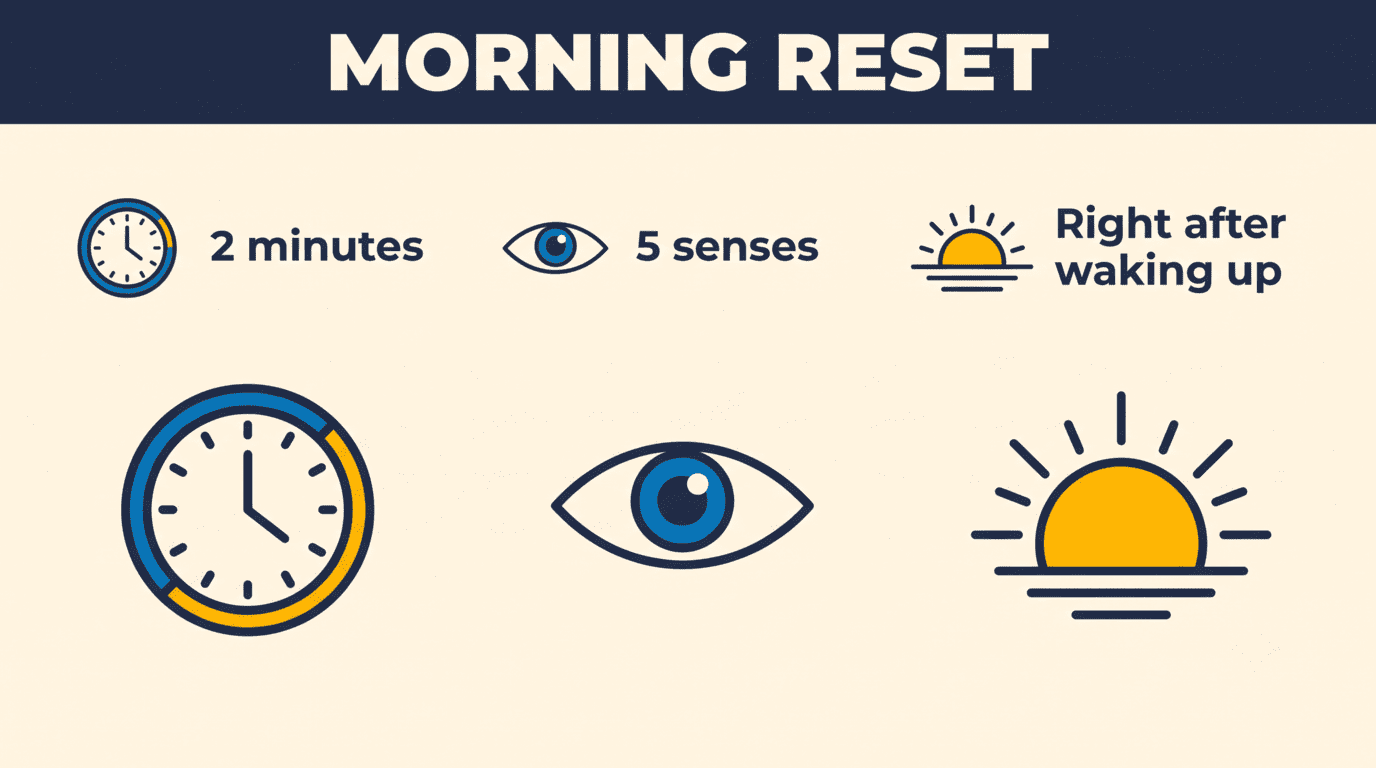
- Set a timer for two minutes, out loud, so your kid can see it start
- Name one thing you can see (look around, what’s one color that stands out)
- Name one thing you can hear (even if it’s just your own breathing)
- Name one thing you can feel (the blanket, the floor, your own hands)
- Name one thing you can smell (toothpaste counts)
- Name one thing you can taste (also toothpaste, mornings are repetitive, and that’s fine)
This works because it asks a still-waking-up brain to do something concrete instead of something abstract. A kid doesn’t need to define calm or explain how they feel, they just need to name five real things already in the room.
Related: Morning Journal Prompts for Kids
Transition Moments: Balloon Breath and Mindful Stretches
Balloon Breath and three mindful stretches turn a rough classroom or after-school transition into a one-minute reset instead of a standoff about putting shoes on.
Balloon Breath (60 Seconds)
- Put both hands on your belly like it’s a balloon
- Breathe in through your nose for four counts, filling the balloon
- Hold for two counts
- Breathe out through your mouth for four counts, letting the balloon go flat
- Repeat four times, that’s the whole activity
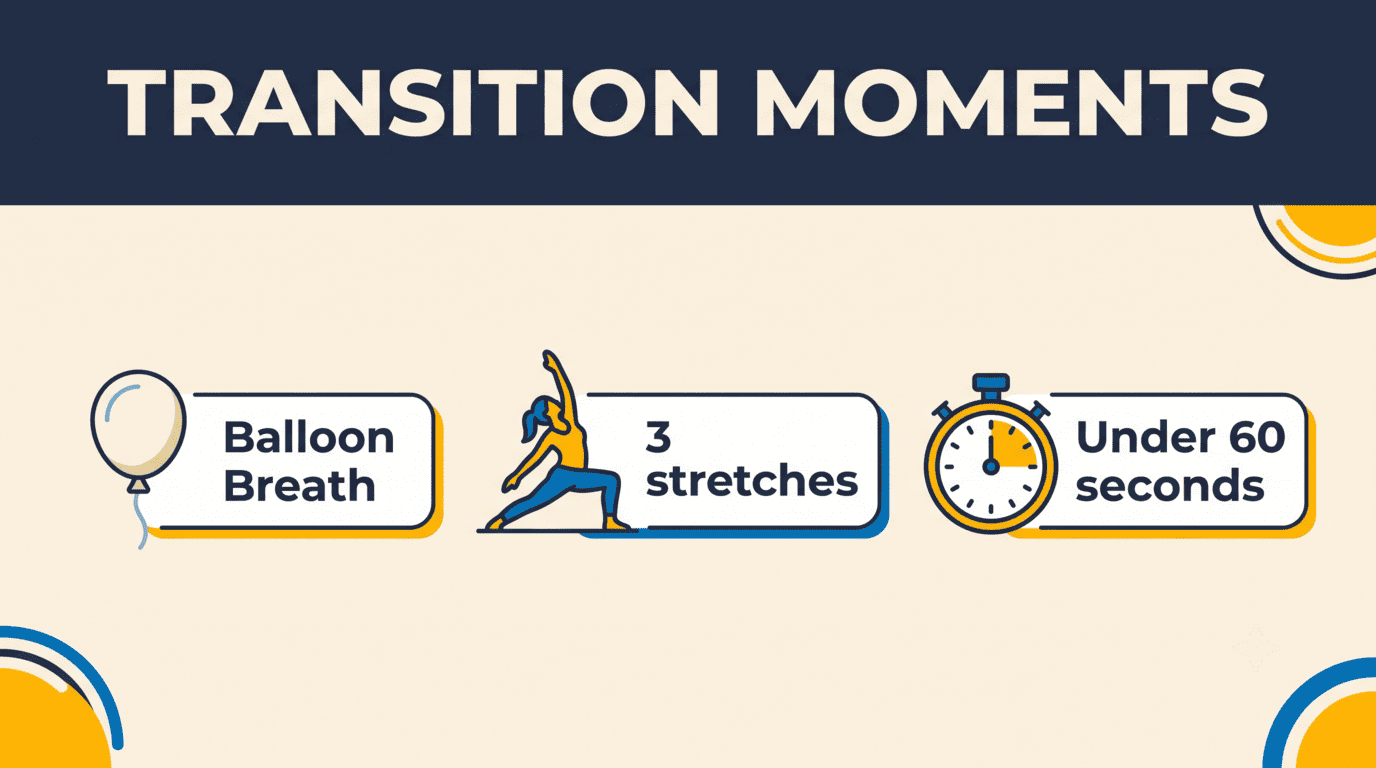
This is close to the exact technique in the Stanford study above, imagining smelling a flower on the inhale and blowing out a candle on the exhale. A kid pretending to inflate a balloon is doing real, tested self-regulation, not just a distraction.
Three Mindful Stretches (60 Seconds)
- Reach for the sky and hold for three counts, like you’re picking a star
- Melt slowly down like a snowman in the sun, counting to five on the way down
- Wiggle everything for five seconds, arms, legs, even your face
Related: Mindfulness Apps for Kids
Big-Feeling Moments: The Find Five Grounding Game
The Find Five grounding game gives a kid something concrete to do with a big feeling in under three minutes, instead of asking them to calm down with words alone.
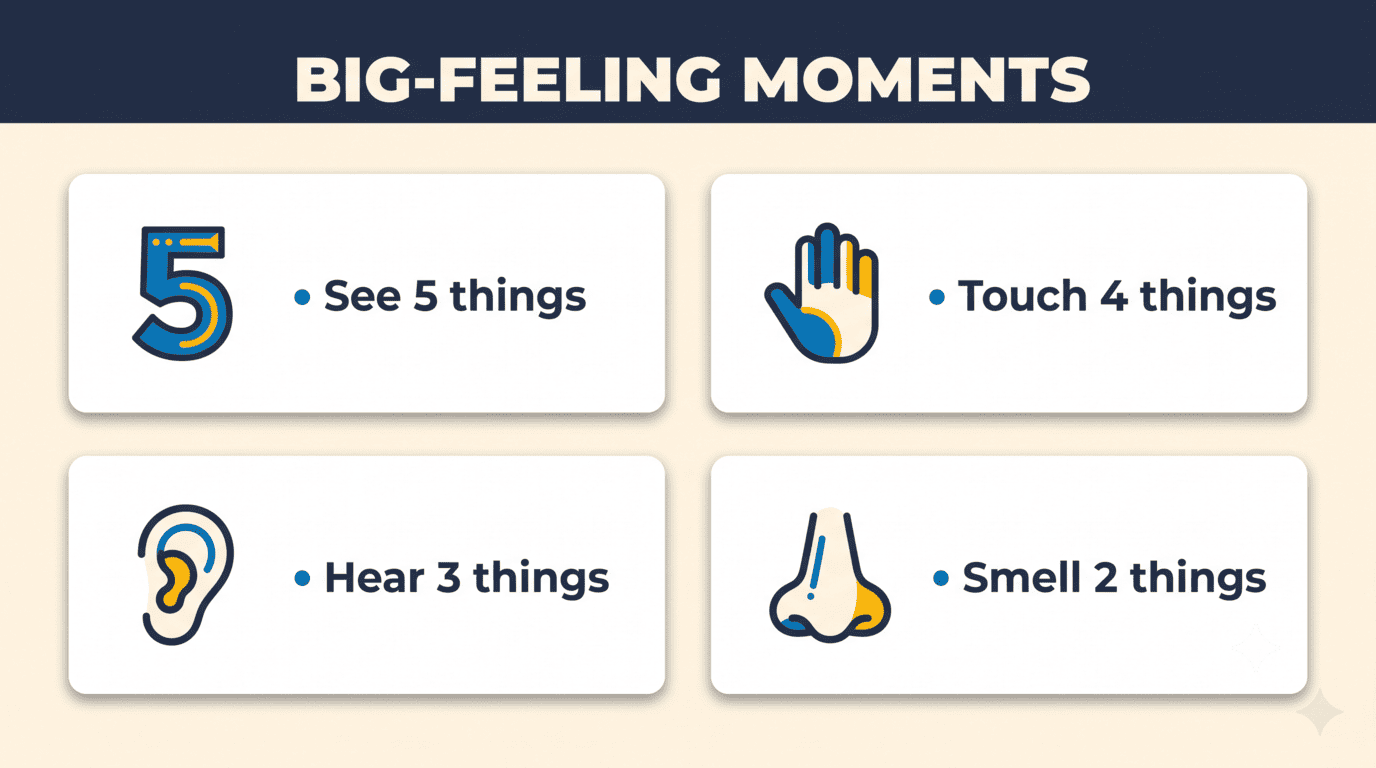
- Find 5 things you can see (name them out loud, one at a time)
- Find 4 things you can touch (the wall, your sleeve, the table)
- Find 3 things you can hear (even quiet sounds count)
- Find 2 things you can smell
- Find 1 slow breath, in and out
***No countdown game interrupts a meltdown while it’s still climbing. Wait for the first exhale, the first pause in the crying, before you start counting, this game works on the way down, not at the peak.***
Once a kid is on the way down, Find Five gives their brain a job it can actually do, count and name, which is a lot easier for a flooded nervous system than “use your words” or “calm down” ever is.
One rule matters more than the activity itself. Never introduce a mindfulness activity as a consequence or a timeout. Classroom mindfulness researchers consistently flag this as the single fastest way to turn a genuinely useful tool into something a kid resents and refuses. Find Five works because it feels like a game a grown-up is playing alongside a struggling kid, not a punishment being handed down.
Related: Anger Management Activities for Kids
Bedtime: The Tuck-In Body Scan (5 Minutes)
The Tuck-In Body Scan takes about five minutes lying down and walks a kid’s attention through their body from toes to head, long enough to help them settle without turning into a stalling tactic.
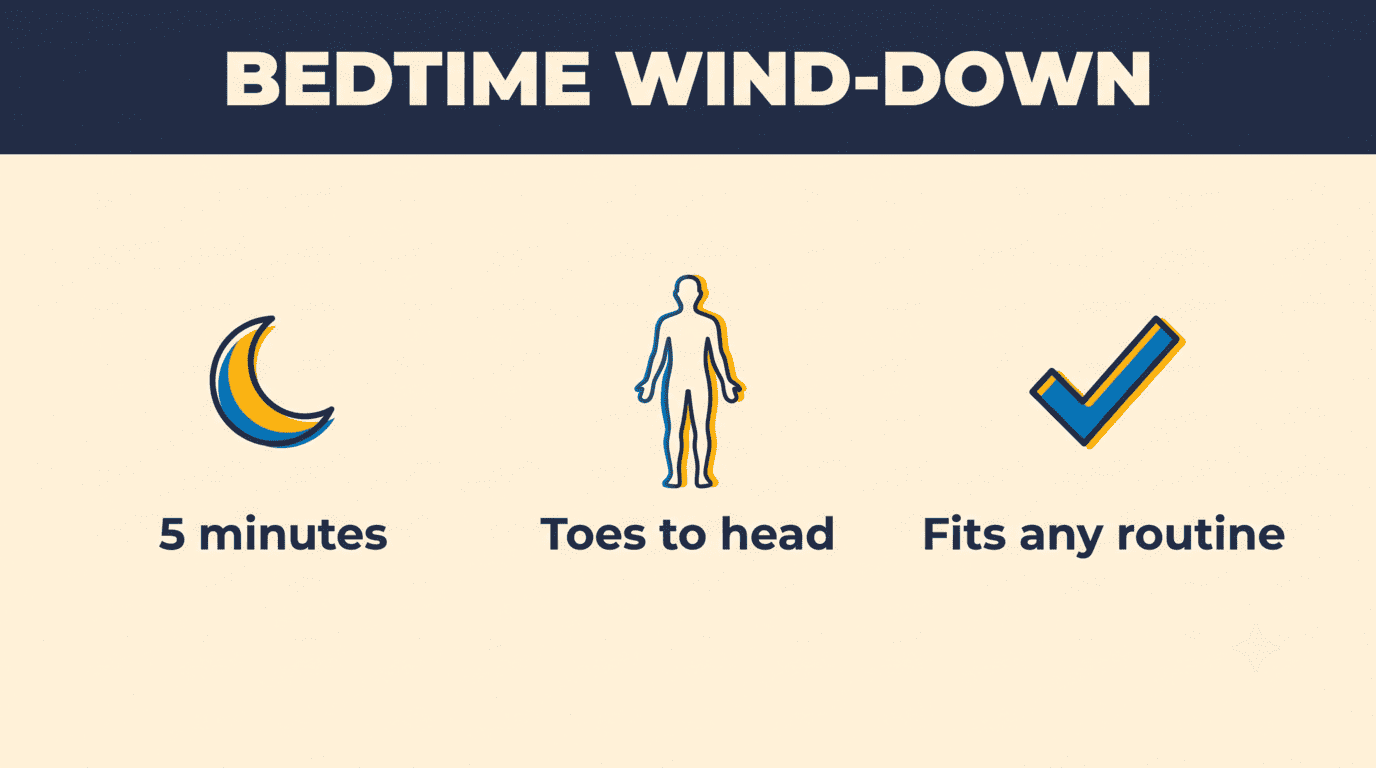
- Wiggle your toes hard, then let them go still and heavy
- Squeeze your knees together, then let them flop apart and rest
- Squish your tummy like a pillow, then let it go soft
- Scrunch your shoulders up to your ears, then drop them down
- Scrunch your whole face like you smelled something funny, then let it go smooth
- Take one big yawn breath and let your eyes close
Research from the Sleep Foundation on children’s bedtime routines has found that kids who follow a consistent, calming wind-down routine fall asleep earlier, take less time to fall asleep, sleep longer, wake up less overnight, and keep those sleep-quality benefits years later.
The Tuck-In Body Scan works as the final step of an existing bedtime routine, not a replacement for one. It fits right after teeth and pajamas and right before lights-out.
Two 5-Minute Guided Meditations You Can Read Out Loud
A guided meditation for a kid is just a script an adult reads out loud, no app, no login, and no background music required. The two below are built from techniques occupational therapists and child psychologists already use, and either one fits the same five-minute window as everything else in this guide.
Five-Finger Breathing (2 Minutes)
This one gives a kid something to trace with their finger while they breathe, which keeps a wandering mind anchored to something physical instead of asking them to sit still with nothing to do.
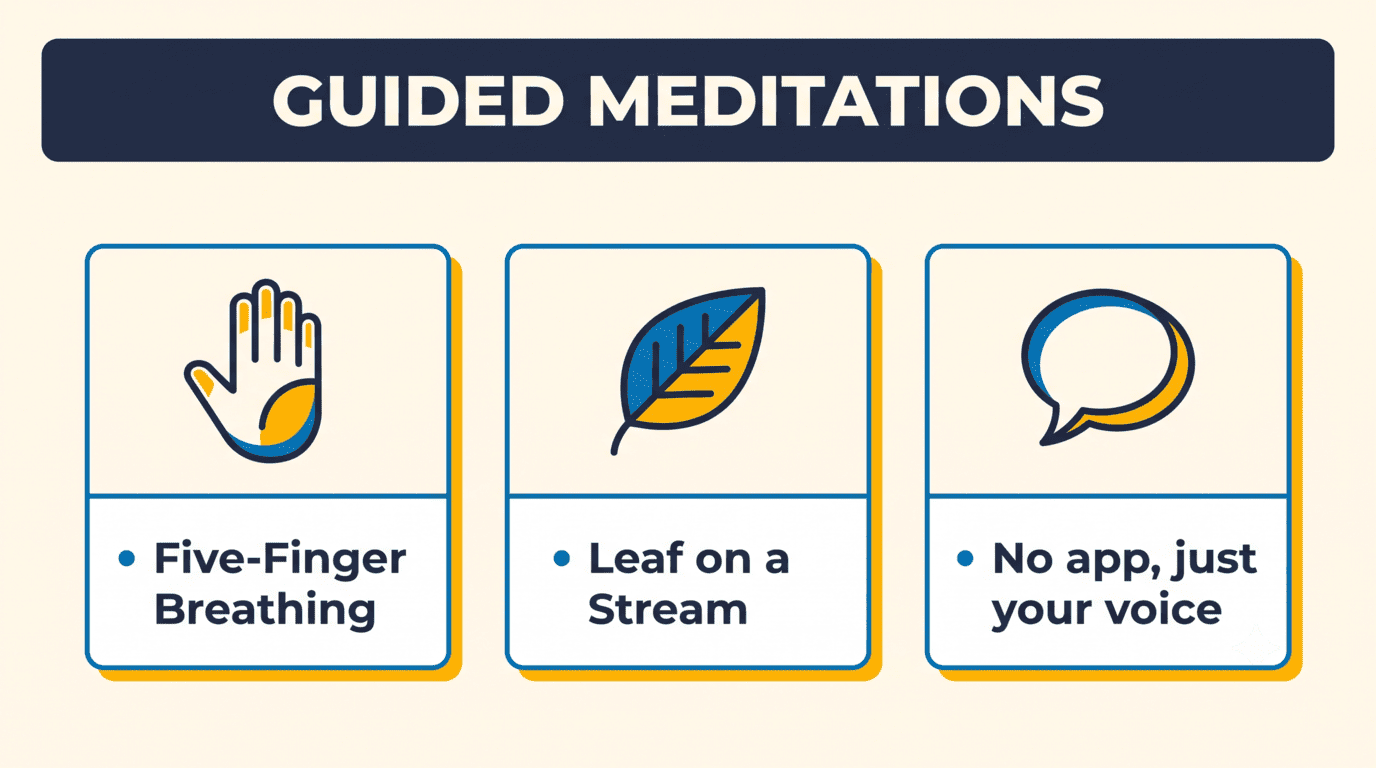
- Hold up one hand, fingers spread wide like a starfish
- Say out loud, together: “Trace up your thumb slowly while you breathe in”
- “Now trace down the other side of your thumb while you breathe out”
- Keep going, one finger at a time, up on the in-breath, down on the out-breath
- By the pinky finger, most kids have already slowed all the way down
Leaf on a Stream (3 Minutes)
This one teaches a kid to notice a thought without grabbing onto it, a skill worth more at age seven than it sounds like on paper. Read it slowly, with real pauses between lines.
- “Close your eyes and picture a slow, gentle stream”
- “Now picture one leaf floating on top of the water”
- “Every time a thought pops into your head, a worry, a memory, anything at all, imagine setting it down on the leaf”
- “Watch the leaf carry that thought away, then wait quietly for the next one”
- “You don’t have to chase the leaf or stop the thoughts, just keep placing them down and watching them float”
Both scripts work anywhere in the day, not only the four moments above. They’re worth keeping in your back pocket for a long car ride, a waiting room, or any stretch of five minutes that needs filling with something calmer than a screen.
The Moment-Match Method: How to Pick the Right Tool
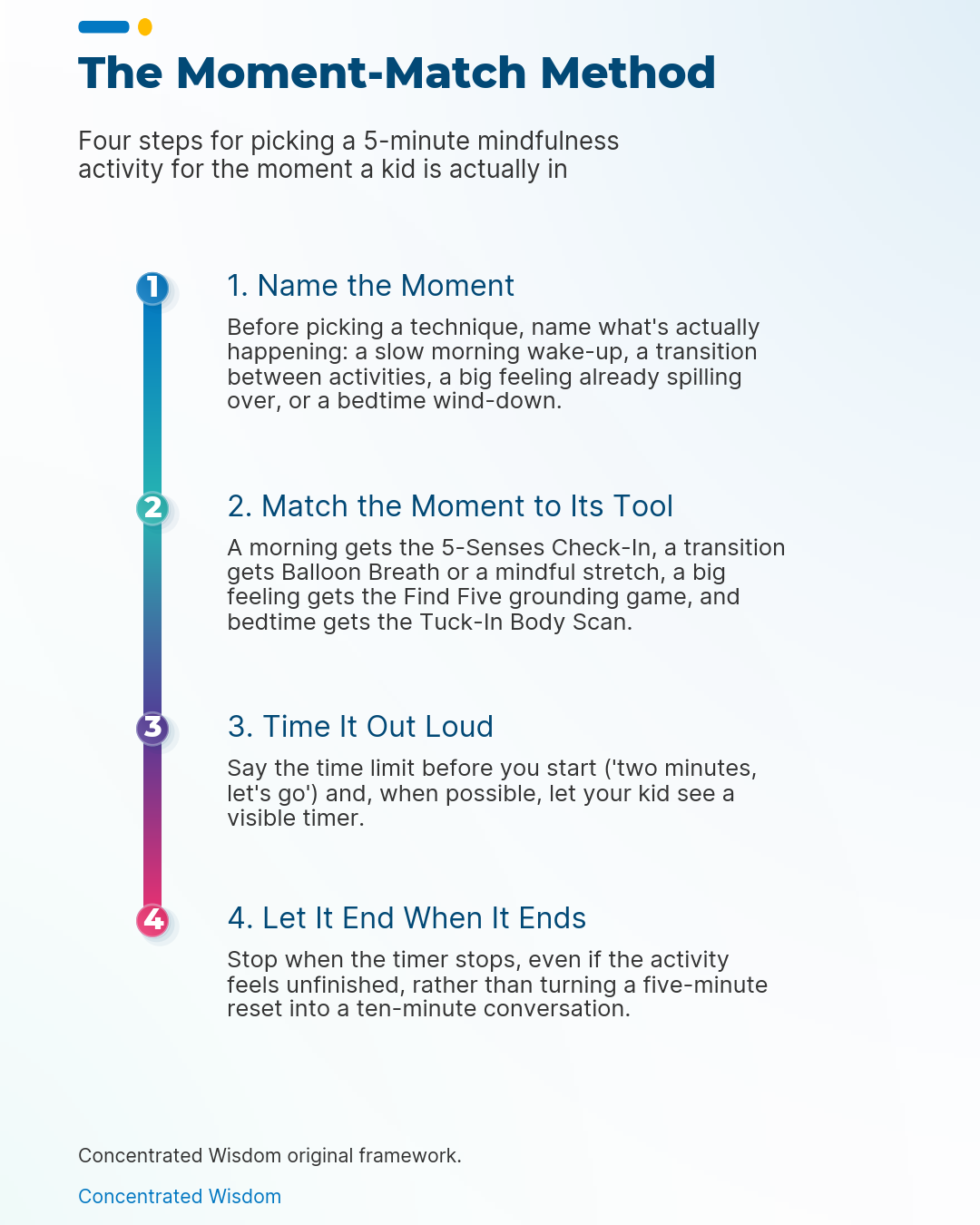
The Moment-Match Method is a four-step way to pick which of these activities actually fits what’s happening, instead of reaching for the same one every time.
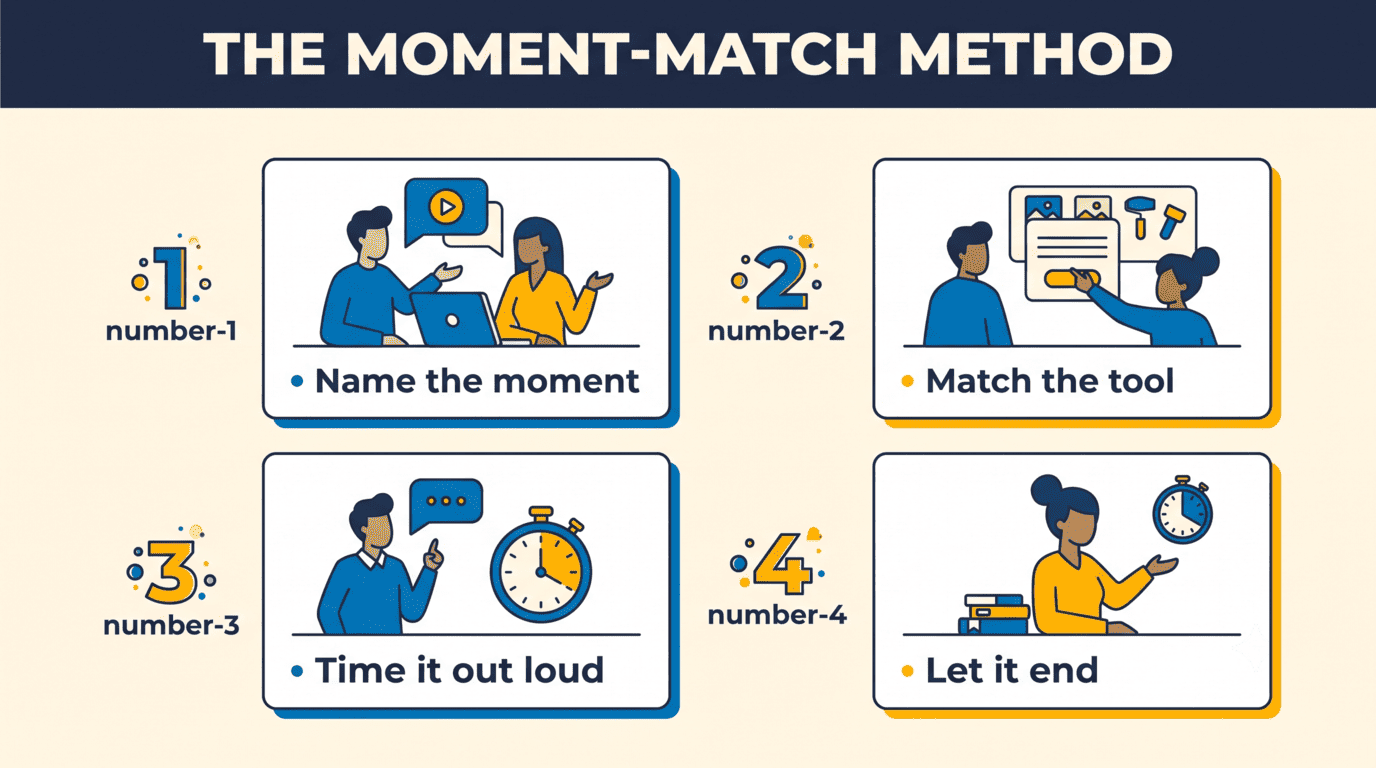
Step one, name the moment. Is this a slow morning wake-up, a transition between two activities, a big feeling that’s already spilling over, or a bedtime wind-down. Each one calls for a different tool.
Step two, match the moment to its tool. A morning gets the 5-Senses Check-In, a transition gets Balloon Breath or a stretch, a big feeling gets Find Five, and bedtime gets the Tuck-In Body Scan. Swapping them doesn’t ruin anything, but each was built for a different nervous-system state, not for interchangeable use.
Step three, time it out loud. Say the limit before you start, “two minutes, let’s go,” and use a visible timer when you can. Knowing exactly when something ends makes a kid far more willing to start it.
Step four, let it end when it ends. Stop when the timer stops, even if it feels unfinished. Turning a five-minute reset into a ten-minute conversation is the single fastest way to make a kid stop wanting to do it.
Your One-Page 5-Minute Cheat Sheet
This is the whole guide in one table, worth screenshotting or printing for the fridge or a classroom wall.
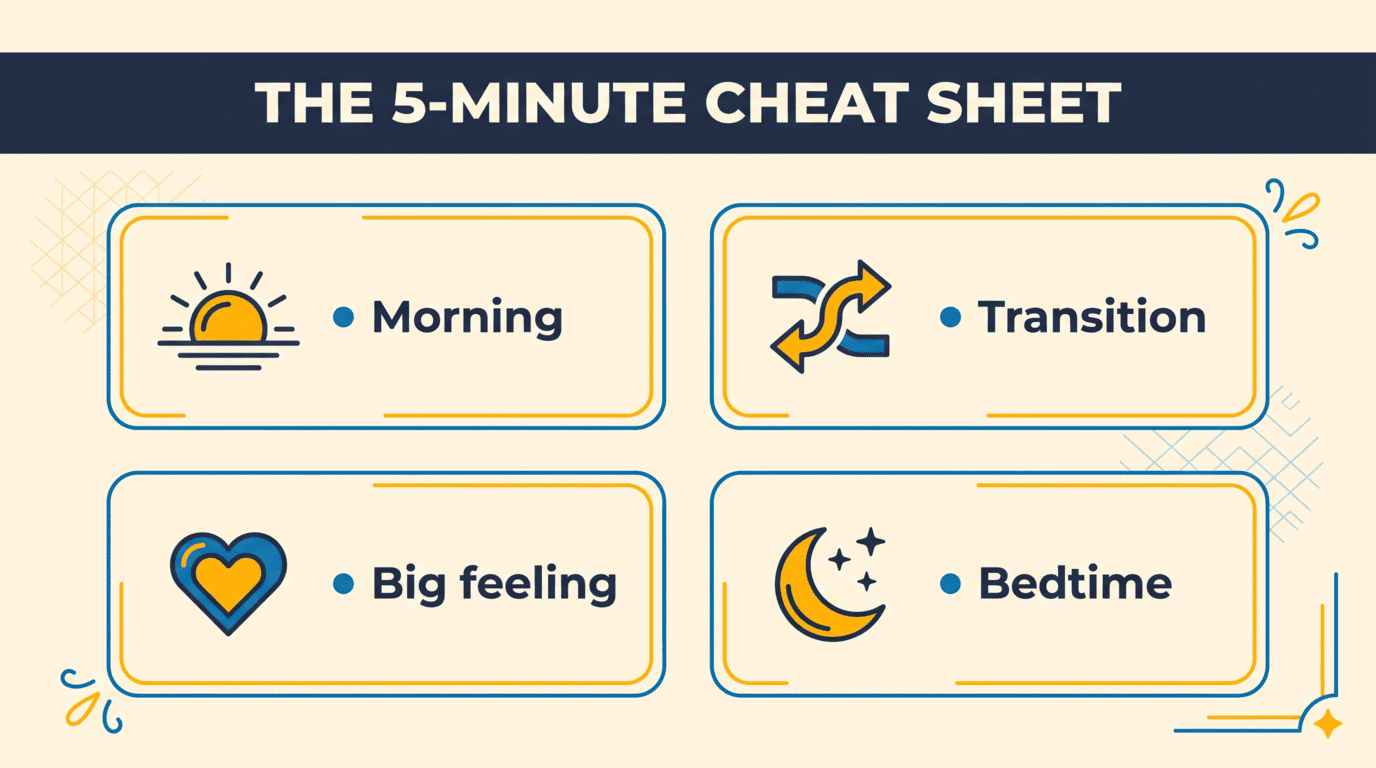
| Moment | Activity | Time | First Step |
|---|---|---|---|
| Morning | 5-Senses Check-In | 2 minutes | Set a timer, name one thing you see |
| Transition | Balloon Breath | 60 seconds | Hands on belly, breathe in for 4 counts |
| Transition | Mindful Stretches | 60 seconds | Reach for the sky and hold for 3 counts |
| Big Feeling | Find Five Grounding | 2-3 minutes | Name 5 things you can see |
| Bedtime | Tuck-In Body Scan | 5 minutes | Wiggle your toes, then let them go still |
Turning a Good Five Minutes Into a Real Habit
A five-minute activity turns into a real habit through repetition, not through finding the perfect one. Anchor each activity to something that already happens every day (right after the alarm, right before the classroom bell, right after a meltdown starts to fade, right after pajamas), and keep it in the same physical spot so nobody has to go looking for it.
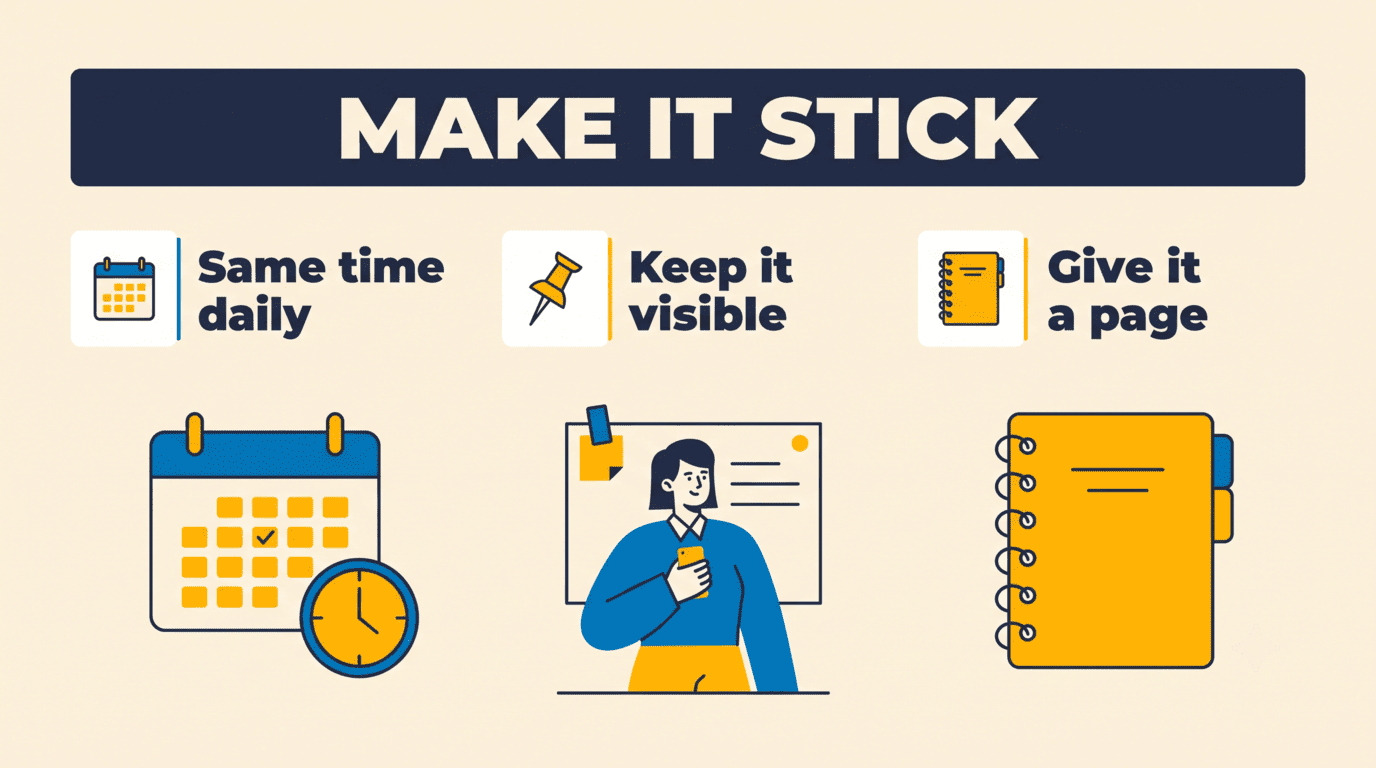
A lot of families find the habit sticks better once there’s something to look back on. A blank checklist repeated every day gets boring fast for a kid, while a page with a simple prompt and a box to check gives the same five minutes a small sense of progress. This is the specific gap Concentrated Wisdom’s Kids’ Self-Reflection & Wellness Journal was built to close, guided mindfulness worksheets for kids that turn each of these five-minute resets into a page a kid can revisit, no screen, no subscription, just a place to put what they noticed. It isn’t required to make any of these activities work, it’s simply the natural next step once one of them becomes a real routine.
Related: Mental Health Activities for Kids
Related: Parenting & Child Development
Frequently Asked Questions
What is a good 5-minute mindfulness activity for a kid?
The 5-Senses Check-In is one of the easiest to start with. Set a two-minute timer and have your kid name one thing they can see, hear, feel, smell, and taste. It needs no equipment, no app, and works well as a morning wake-up routine or a quick reset any time of day.
How can I calm my child down quickly during a meltdown?
Wait for the meltdown to start coming down first, a countdown game doesn’t work while a child is still climbing toward the peak. Once you notice a pause or a first slower breath, try the Find Five grounding game: 5 things they can see, 4 they can touch, 3 they can hear, 2 they can smell, and 1 slow breath. Naming concrete things gives a flooded nervous system a job it can actually do.
What age can kids start doing mindfulness activities?
Most of the activities in this guide work well from around age 4 through age 10, with younger kids needing more hands-on guidance (doing the activity alongside them) and older kids able to run through the steps independently once they’ve practiced a few times.
Do mindfulness worksheets actually help kids?
Mindfulness worksheets for kids work best as a way to make a five-minute activity stick, not as a replacement for doing the activity itself. A simple printable page with a prompt and a check-in box gives a kid something to look back on, which tends to make a repeated routine feel less repetitive and more like real progress.
Can mindfulness activities help a child with anxiety?
The quick activities in this guide are a good daily starting point, but they are not the same thing as clinical treatment. Mindfulness-Based Cognitive Therapy for Children (MBCT-C), a structured 12-session program studied by Semple and colleagues for children ages 9 to 12, has shown reductions in anxiety and attention problems using many of the same building blocks, body scans, breathing, and mindful movement, in a much more intensive clinical format. If anxiety is persistent or interfering with school or sleep, these five-minute tools work well alongside professional support, not in place of it. (Source)
Should mindfulness ever be used as a timeout or punishment?
No. Introducing a mindfulness activity as a consequence is one of the fastest ways to make a kid resent it and refuse to do it again. These activities work because they feel like something a grown-up is doing alongside a struggling kid, not something being handed down as a punishment.