Concentrated Wisdom Editorial Team researches, writes, and fact-checks this guide against primary sources before publication.
This article is for informational purposes only and isn’t a substitute for personalized professional advice.
Setting boundaries is hard because it requires overriding real conditioning, not because most people lack the right words. This article names the four specific internal blockers, fear of conflict, guilt and fawning conditioning, fear of abandonment, and an identity built around being easy, that make a boundary catch in the throat, plus a short self-check for each one and how to move through the freeze instead of trying to script around it.
Setting boundaries is difficult mainly because it requires overriding conditioning that once served a real protective function, not because a person lacks assertiveness vocabulary. Four internal blockers explain most boundary paralysis, fear of conflict, guilt tied to fawning conditioning from childhood, fear that a boundary will cost the relationship, and an identity organized around being the easy, low-maintenance person. Therapist Nedra Glover Tawwab’s work frames boundary guilt as a taught response rather than proof of wrongdoing, and the fawn trauma response named by therapist Pete Walker traces conflict avoidance back to childhood environments where protest was unsafe. The way through is not a better script, it is deliberately practicing on low-stakes boundaries first and treating the discomfort that follows as a sign the old conditioning is loosening, not proof that something has gone wrong.
Setting boundaries is hard mainly because it requires overriding conditioning that once served a real protective function, not because most people are missing the right words. The words are rarely the problem. Someone can know exactly what they want to say, rehearse it in the shower, and still feel their throat close the moment the actual conversation starts. That gap between knowing and doing points to something underneath the language, four specific internal blockers that explain most of the freeze.
The Four Internal Blockers Behind Boundary-Setting
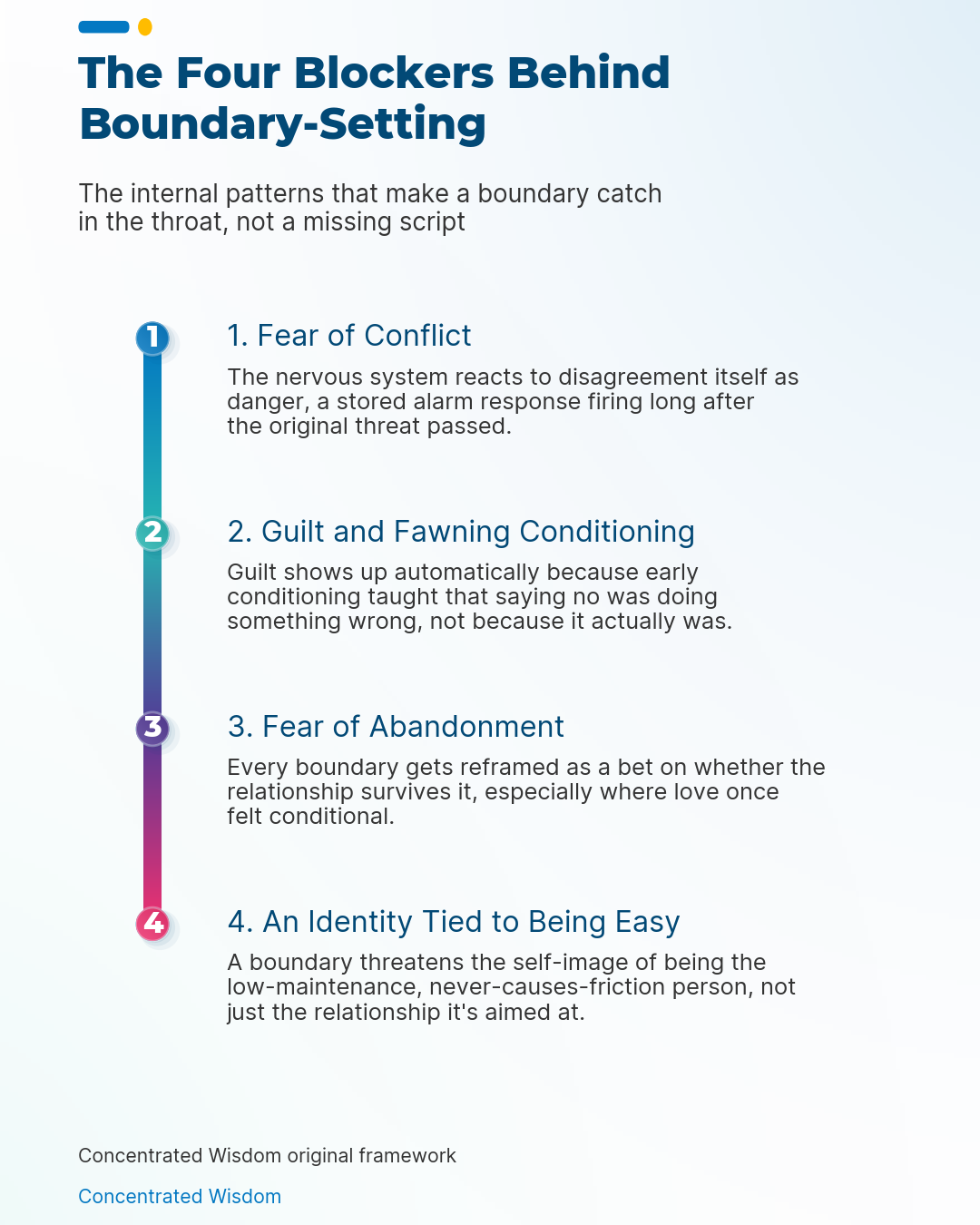
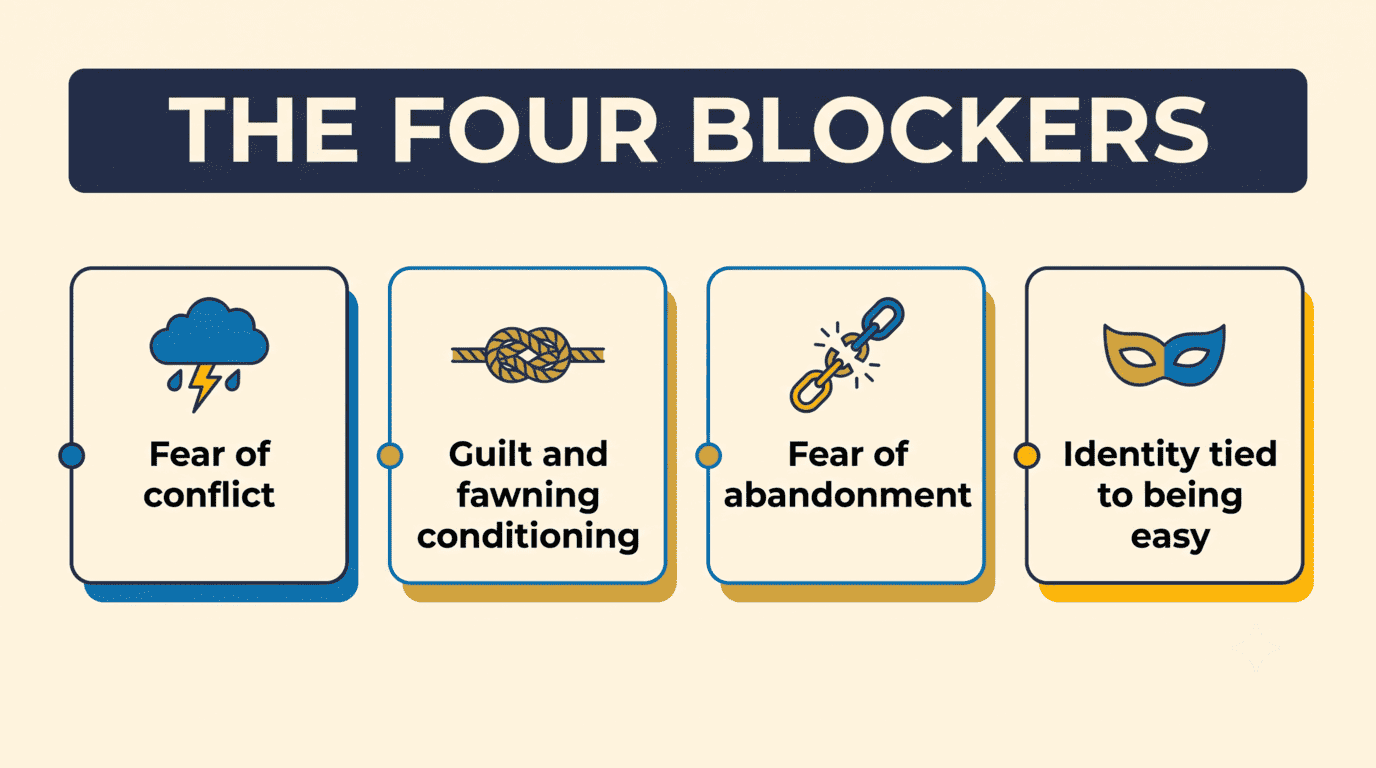
Boundary-setting difficulty almost always traces back to one or more of four internal blockers, not a lack of information about what a healthy boundary sounds like. Most people already know the sentence. What stops them is one of these four things happening underneath it.
Blocker One, Fear of Conflict
Fear of conflict treats disagreement itself as the danger, not the actual outcome of the disagreement. The nervous system reacts to a raised eyebrow or a slightly cooler tone the same way it would react to a real threat, because for many people, somewhere earlier in life, conflict genuinely was unsafe. The body kept the alarm setting long after the original danger passed.
This is why a boundary conversation can feel disproportionately terrifying even when the other person is reasonable and the stakes are objectively low. The fear isn’t really about this specific conversation, it’s a stored response firing on a delay.
Blocker Two, Guilt and Fawning Conditioning
Guilt shows up almost automatically the moment a boundary is stated, often before the other person has even reacted. Communication and trauma researchers describe this as fawning, a survival pattern the therapist Pete Walker named as a fourth trauma response alongside fight, flight, and freeze, one built from childhood environments where protesting or saying no led to real consequences.
Author and therapist Nedra Glover Tawwab‘s work on boundaries frames this guilt directly, most boundary guilt reflects early conditioning to treat saying no as doing something wrong, not actual evidence of wrongdoing. The feeling is real. What it’s reporting on usually isn’t.
Communication coaches who work on boundary-setting often see a specific version of this pattern. Someone comes in able to state, word for word, the exact boundary they want to set with a parent or partner, and can explain calmly why it matters. The freeze happens the moment they imagine actually saying it out loud, not while planning it. Tracing that freeze back usually lands on one specific memory, a household where disagreement was met with withdrawal, silence, or punishment rather than discussion, which taught the nervous system that a boundary equals a lost relationship long before the person had the vocabulary to question it.
Blocker Three, Fear of Abandonment
Fear of abandonment reframes every boundary as a bet on whether the relationship survives it. The underlying belief is rarely stated out loud, it usually sounds more like a vague dread that comes before the conversation rather than a specific, nameable thought.
This blocker is especially common in relationships where love was conditional growing up, tied to compliance or performance rather than given freely. A boundary starts to feel like a test the relationship might fail, so avoiding the boundary feels safer than finding out.
Fear of abandonment often gets stronger, not weaker, in relationships that already feel shaky. The more uncertain a relationship already feels, the more a boundary can seem like it might tip the whole thing over, even when the boundary itself is small and reasonable. That math rarely holds up under closer inspection, but it feels true in the moment, which is exactly why this blocker is so hard to reason a person out of.
Blocker Four, An Identity Tied to Being Easy
Some people build an entire sense of self around being the low-maintenance one, the flexible one, the person who never causes friction. A boundary threatens that identity directly, not just the relationship it’s aimed at, because saying no means becoming, even briefly, someone who isn’t easy anymore.
This blocker often hides behind genuine-sounding reasons, “I just don’t want to make a big deal out of it” or “it’s not worth the fight.” Sometimes that’s true. Often it’s the identity talking, not a clear-eyed read of the situation.
This blocker is also the hardest to notice from the inside, because it rarely announces itself as fear. It shows up as a preference, a quiet sense of pride in being the one who doesn’t need much or ask for much. Naming it as a blocker rather than a personality trait is often the first real step, since a preference doesn’t need examining, but a fear that has been mistaken for a preference does.
A Short Self-Check for Each Blocker
These questions are a starting point for reflection, not a diagnosis. The point is to notice which blocker is loudest right now, since the way through tends to differ depending on which one is actually running the show.

| Blocker | Ask Yourself |
|---|---|
| Fear of Conflict | Does my body react to the idea of disagreement itself, before I even know how the other person might respond? |
| Guilt and Fawning Conditioning | Whose voice does the guilt sound like? Is it mine, or does it sound like something I was taught to feel? |
| Fear of Abandonment | Am I avoiding this boundary because of what it might actually cost, or because of a vague dread I can’t fully name? |
| Identity Tied to Being Easy | If I said this boundary out loud, what would I be afraid it made me, not just what it might cost the relationship? |
Related: Setting Boundaries With Parents
Moving Through the Block, Not Around It
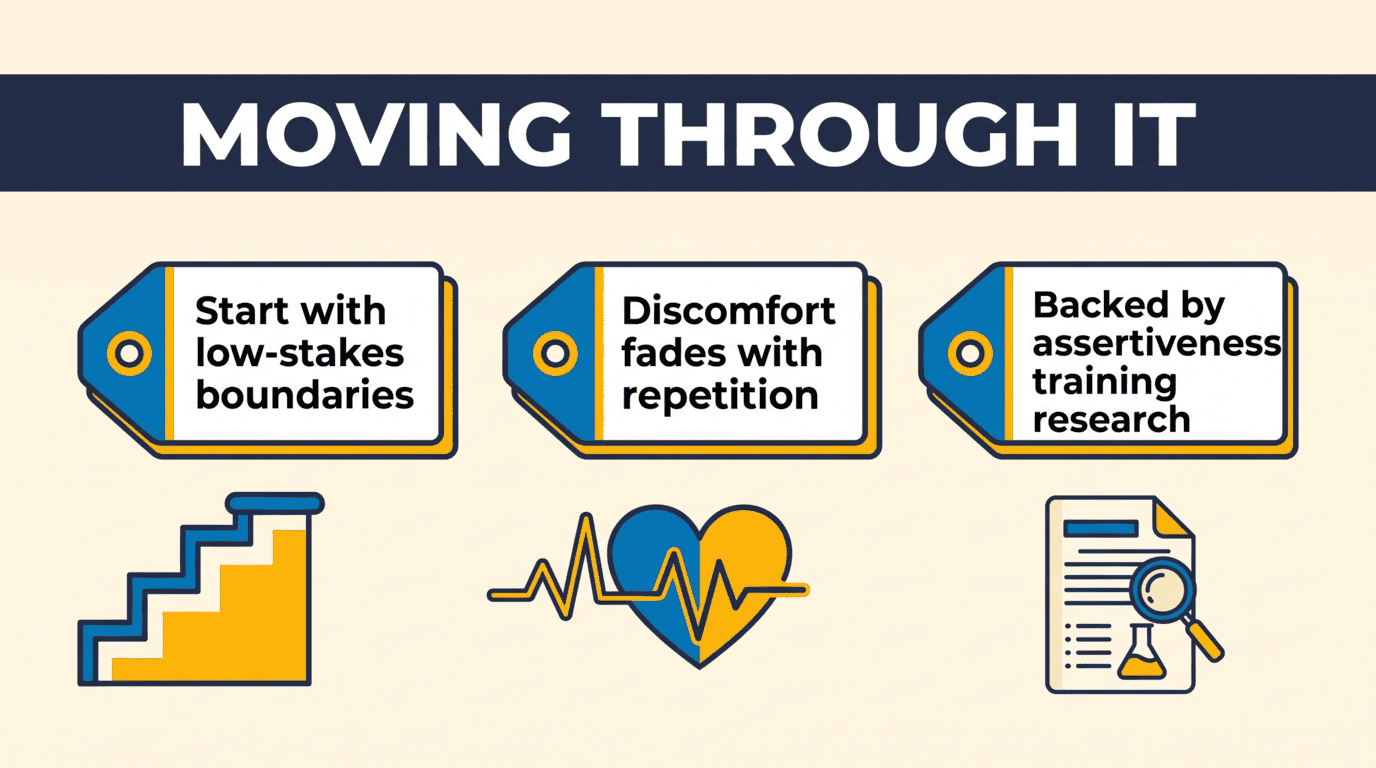
Start With Low-Stakes Boundaries
The fastest way through any of the four blockers is practicing on something that barely matters before attempting the boundary that matters most. A low-stakes boundary might be telling a coworker you can’t take a call right now, or declining a second helping of food without an excuse attached. Small reps build the same nervous system evidence a big boundary would, without the same amount of exposure to whatever the loudest blocker predicts will happen.
A useful low-stakes list to draw from, telling a server you’d like a few more minutes with the menu, asking a friend to text instead of call, saying you’d rather not discuss a topic right now, or leaving a group chat that’s no longer useful to you. None of these carry real relationship risk, which makes them ideal practice ground for whichever blocker tends to show up first.
Expect Discomfort as a Signal, Not a Failure
Discomfort after setting a boundary is common enough that it should be expected rather than treated as proof the boundary was a mistake. A review of assertiveness training research found it genuinely effective at reducing the anxiety tied to confrontation, even though it’s rarely used compared to other approaches, which matches what practicing boundaries in real life tends to show, the discomfort fades with repetition, it doesn’t disappear before the first attempt.
A boundary that feels easy on the first try was probably already low stakes. Guilt or dread right after stating a boundary is the old conditioning protesting, not new evidence that the boundary was wrong. Judging a boundary by how it feels ten minutes later is a much less reliable test than judging it by whether it was honest and reasonable to ask for.
Related: Setting Boundaries With Toxic People
Related: Communication & Social Skills
Frequently Asked Questions
Why do I feel guilty every time I set a boundary?
Boundary guilt usually reflects early conditioning that taught you to associate saying no with doing something wrong, not actual proof that you did something wrong. Therapist Nedra Glover Tawwab’s work on boundaries treats this guilt as an expected, temporary part of the process, not a sign to stop.
Is it normal to feel anxious before setting a boundary?
Yes. Anxiety before a boundary conversation is one of the most common reactions there is, especially for anyone whose nervous system learned early on that conflict was unsafe. Assertiveness training research shows this anxiety responds well to practice, it tends to shrink with repeated, low-stakes attempts rather than disappearing before the first one.
How long does it take to get more comfortable setting boundaries?
There’s no fixed timeline, but most people notice a real shift after several rounds of practicing on low-stakes boundaries before attempting the one that matters most. The goal isn’t reaching zero discomfort, it’s reaching a point where the discomfort no longer stops the boundary from being stated.
What is the fawn response and how does it relate to boundaries?
The fawn response is a trauma pattern named by therapist Pete Walker, where a person appeases or people-pleases to avoid conflict rather than fighting, fleeing, or freezing. It often traces back to childhood environments where protesting or saying no led to real consequences, which is why boundary-setting can trigger it strongly in adulthood.