Concentrated Wisdom Editorial Team researches, writes, and fact-checks this guide against primary sources before publication.
This article is for informational purposes only and isn’t a substitute for personalized professional advice.
With someone who repeatedly ignores a stated boundary, the goal shifts from communication to protection, more talking rarely changes the outcome. This article lays out a three-tier framework, the script that states the boundary once, the consequence that gets stated and actually enforced, and disengagement, including low-contact and no-contact, as legitimate options once the first two tiers are exhausted.
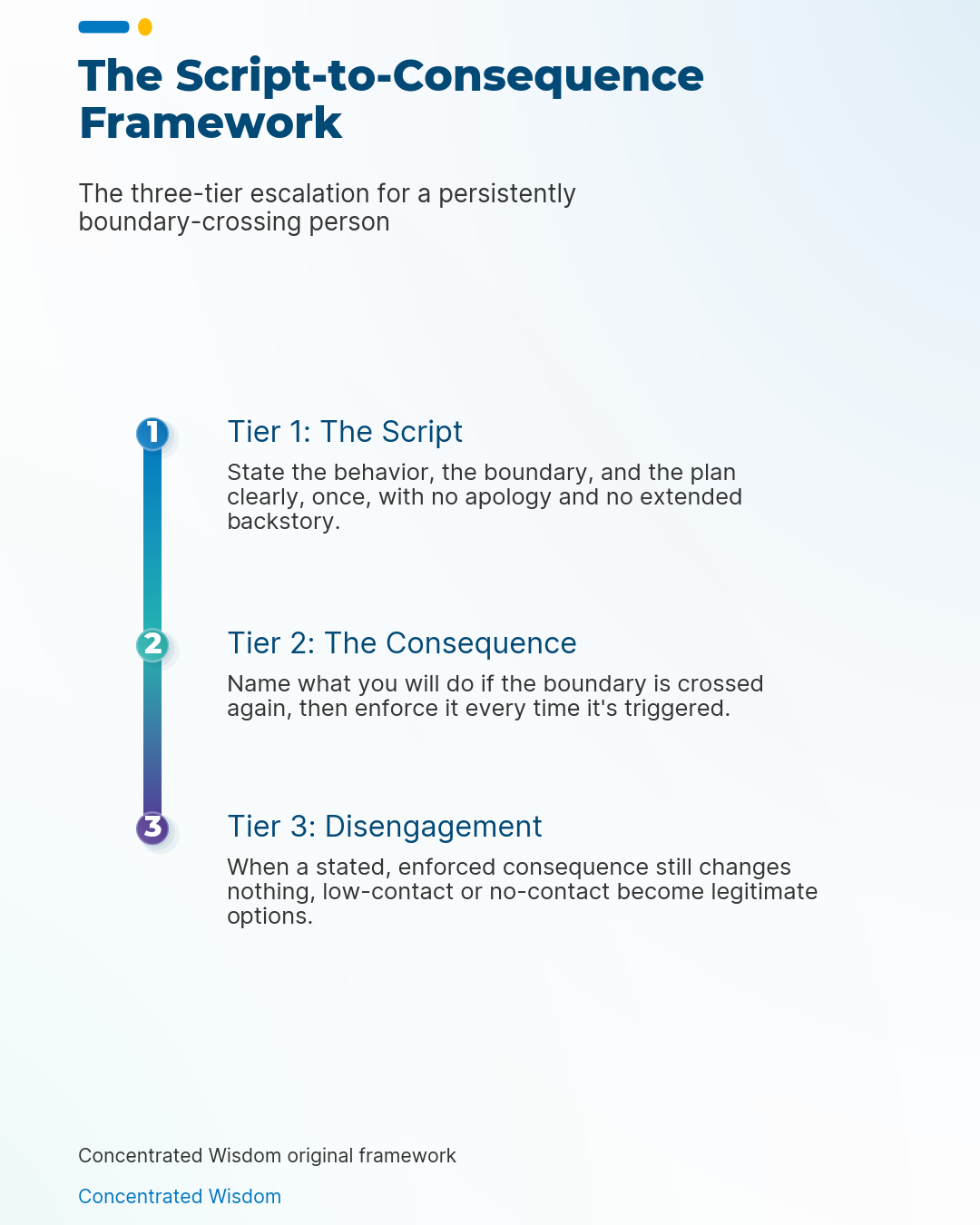
Setting boundaries with toxic people works differently than boundary setting in a healthy relationship, because the assumption that clear communication will be respected doesn’t hold. The goal shifts from getting a person to understand a boundary to protecting yourself whether they understand it or not. A three-tier framework covers this, a Tier 1 script that states the boundary clearly and once without over-explaining, a Tier 2 consequence that names and follows through on what happens if the boundary is crossed again, and Tier 3 disengagement, recognizing when a relationship requires distance rather than another script. Research on family estrangement, including work by Cornell sociologist Karl Pillemer and social work researcher Kylie Agllias, finds that low-contact and no-contact arrangements are far more common, and far less dramatic in practice, than they’re usually portrayed.
With someone who repeatedly ignores a boundary, the goal shifts from communication to protection, because the assumption a normal boundary conversation relies on, that being understood changes behavior, doesn’t hold here. More explaining rarely produces more respect. What actually changes the situation is a structure that doesn’t depend on the other person agreeing with it at all.
Tier 1, The Script
The Tier 1 script states the boundary clearly, once, and without a defense attached to it. A boundary is a statement about your own behavior, not a request for the other person’s agreement, which is why over-explaining tends to backfire here specifically. Every added justification is another thing for a person who ignores boundaries to argue with instead of the boundary itself.
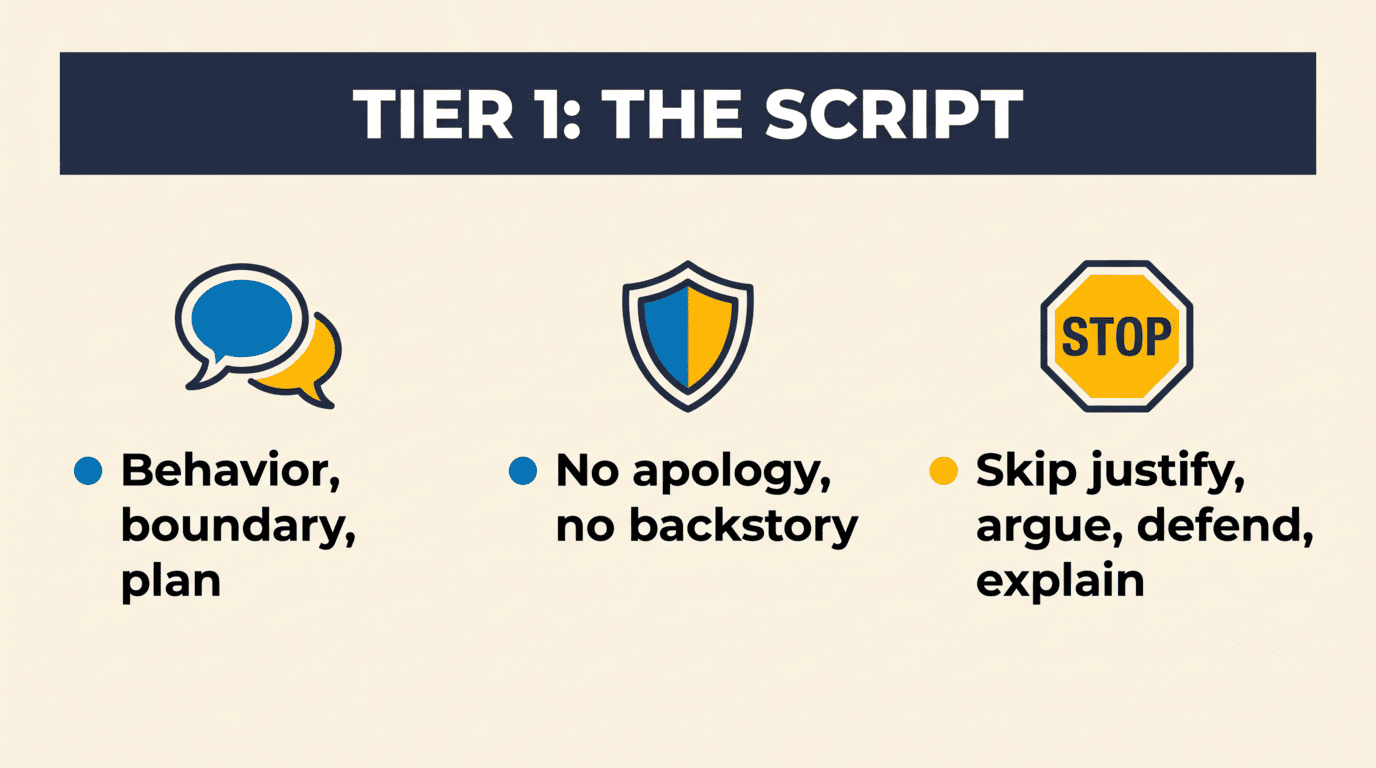
A working script has three parts, the behavior, the boundary, and the plan, with no apology and no extended backstory. “When you comment on my weight, I’m going to end the call. I’m not asking you to agree, I’m telling you what happens next.” That’s the whole script. Anything longer starts inviting a debate that was never the point.
Delivery matters less than most people expect. A calm tone is preferable, but a slightly shaky voice doesn’t undo the boundary. What matters is that the statement gets said and isn’t withdrawn the moment the other person reacts badly to it.
Skip the JADE Trap
A useful shorthand for what to leave out of the script is JADE, justify, argue, defend, explain. Each of those moves hands a toxic or manipulative person more material to twist, dismiss, or use as a new angle of attack, and none of them make the boundary any more valid than it already is on its own.
If the other person asks “why are you being like this” the honest answer is rarely required. “This is what I need going forward” is a complete response on its own, and repeating it without added justification, sometimes called the broken record technique, is often more effective than a longer, more reasonable-sounding explanation would be.
Tier 2, The Consequence
Stating the Consequence
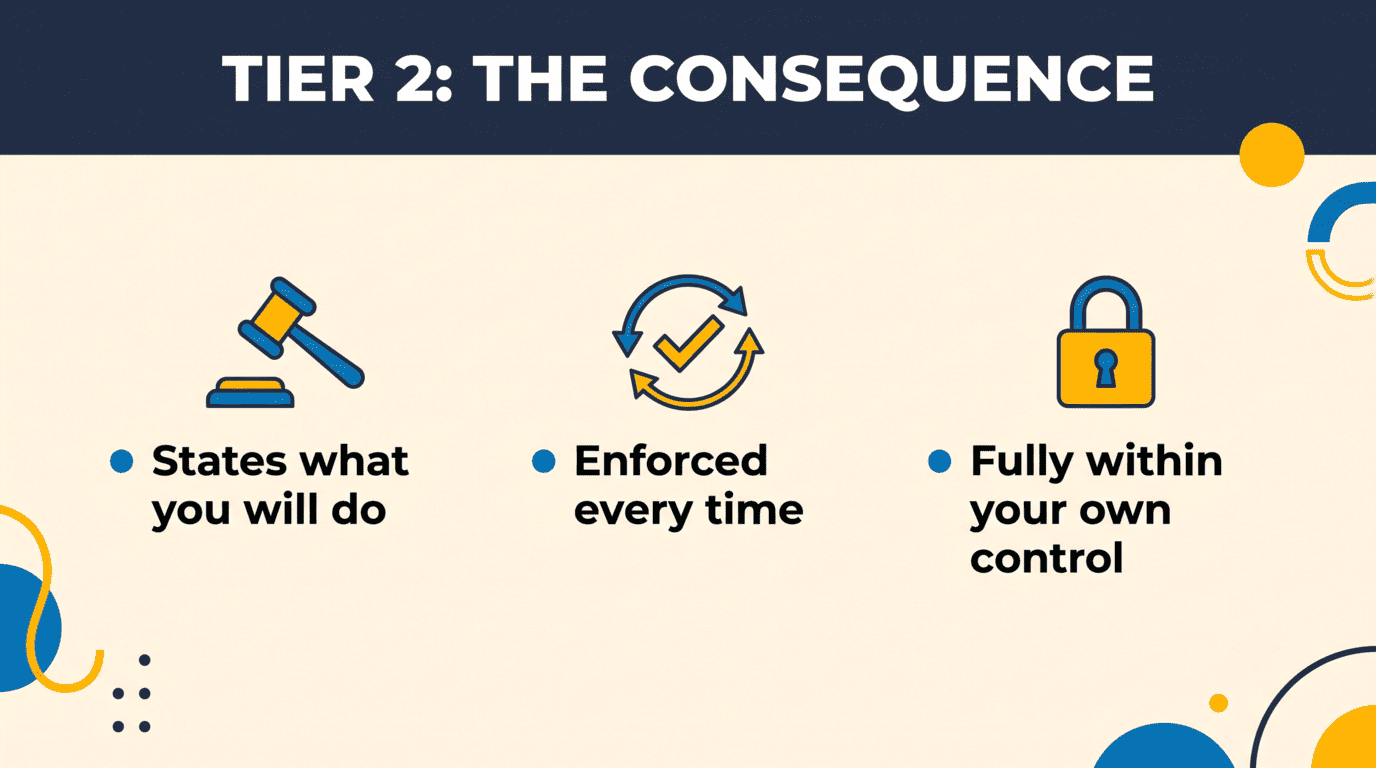
A consequence names what will change on your side, not what you want the other person to do differently. “If this happens again, I’ll leave early” is a consequence. “If this happens again, you need to stop” is just the same request said louder, and it puts the follow-through back in the other person’s hands instead of yours, which defeats the purpose of moving to this tier at all.
Following Through, Every Time
A consequence that isn’t enforced the first time it’s triggered teaches the opposite lesson from the one intended. An unenforced consequence is worse than no consequence at all, because it confirms that the stated boundary was negotiable after all, which makes the next boundary attempt land with even less weight.
Communication coaches who work on boundary escalation with clients often see the same pattern play out with a persistently boundary-crossing family member. The Tier 1 script gets stated calmly at a holiday gathering, gets ignored within the hour, and the instinct is to repeat the same script louder rather than move to Tier 2. The shift that actually works is moving to a stated, enforced consequence on the very next crossing, leaving the gathering early rather than issuing a second warning. The behavior doesn’t stop immediately, but the crossings become noticeably less frequent once the other person learns the consequence is real and not just a threat.
Choosing a Consequence That’s Actually Yours to Enforce
The most reliable consequences are ones that don’t require the other person’s cooperation to carry out. Leaving a gathering, ending a call, shortening a visit, or declining the next invitation are all fully within your own control. A consequence that depends on someone else agreeing to it, like asking a third party to intervene, is weaker precisely because it isn’t yours to enforce alone.
Consequences don’t need to be dramatic to be effective. A short, time-limited consequence often works better than an open-ended one, because it’s easier to actually follow through on and easier for the other person to understand as a direct response to a specific action, rather than a punishment that seems to come out of nowhere.
Related: Setting Boundaries With Parents
Tier 3, Disengagement
When Disengagement Is the Realistic Option
Disengagement becomes the realistic option once a person has been shown, repeatedly, that a stated and enforced consequence changes nothing about their behavior. This isn’t a failure of Tiers 1 and 2, it’s information. Some relationships don’t respond to structure because the other person isn’t actually willing to be in a relationship that has any structure at all.
Low-Contact and No-Contact as Legitimate Options
Low-contact and no-contact arrangements are more common, and less dramatic in practice, than they’re usually portrayed. A national survey led by Cornell sociologist Karl Pillemer found that 27 percent of American adults reported a current estrangement from a family member, a figure that translates to tens of millions of people living with exactly this kind of distance.

Researcher Kylie Agllias‘s qualitative research on adult-child estrangement found that people who go this route describe their core reasons clustering around abuse, poor parenting, and betrayal, and consistently frame the decision as considered rather than impulsive. Distance isn’t automatically a sign that something went wrong, sometimes it’s the thing that finally goes right.
Low-contact keeps a defined, limited channel open, holidays only, texts only, no in-person visits. No-contact closes the channel entirely for a period of time or indefinitely. Neither one requires a dramatic announcement or a final confrontation to be valid, a boundary can simply stop being restated once it’s clear restating it isn’t accomplishing anything.
Disengagement Doesn’t Have to Be Permanent or Announced
Stepping back rarely requires a formal, final conversation to be real. A gradual reduction in contact is just as legitimate as a stated no-contact decision, and either can be revisited later if the other person’s behavior genuinely changes, since disengagement is a response to a pattern, not an irreversible verdict on a person’s entire character.
Grief is a normal part of this tier, even when the decision is clearly the right one. Missing a version of the relationship that never fully existed is different from wanting the actual relationship back, and the two feelings can be present at the same time without one canceling out the other.
A Quick Reference for Which Tier You’re In
Most people find it useful to name, in the moment, which tier a situation has actually reached before reacting to it. A quick self-check works better than deciding in the heat of the moment:
- First time this specific behavior has happened, or first time you’re naming it out loud: Tier 1, state the script once.
- Behavior has already been named once and happened again: Tier 2, state and enforce a consequence.
- A stated, enforced consequence has already been tested and the behavior continues: Tier 3, consider low-contact or no-contact.
- Any immediate safety concern: skip the tiers and prioritize safety first, including professional support if needed.
Related: Why Is Setting Boundaries So Hard
Related: Communication & Social Skills
Frequently Asked Questions
What’s the difference between a boundary and a consequence?
A boundary states what you will and won’t accept, while a consequence states what you will personally do if that boundary gets crossed again. A boundary without a stated consequence tends to function as a request rather than an actual limit, which is why the two need to work together with someone who ignores boundaries.
Is it okay to go low-contact with a toxic family member?
Yes. Research on family estrangement, including a national survey led by Cornell’s Karl Pillemer, found that roughly 27 percent of American adults currently maintain some form of estrangement from a family member, which makes low-contact and no-contact far more common than they’re usually treated in everyday conversation.
What if the toxic person threatens to escalate when I set a boundary?
A threat to escalate is often a sign the boundary is working, not evidence it should be dropped. If the escalation involves any risk to your physical safety, that changes the calculus entirely and is worth discussing with a professional who can help plan a safe response.
How many times should I repeat the script before moving to a consequence?
Generally once, maybe twice if the first attempt was genuinely unclear. Repeating the same script more than that without a stated consequence tends to signal that the boundary isn’t actually being enforced, which makes it easier, not harder, for a toxic person to keep testing it.