Concentrated Wisdom Editorial Team researches, writes, and fact-checks this guide against primary sources before publication.
Eastern philosophy is not a single system. It is a label covering genuinely distinct traditions, and this guide treats Taoism’s wu wei and Buddhism’s non-attachment (anatta) as separate, precisely defined core moves rather than one interchangeable mystical attitude. Each move is traced to a real primary or near-primary source and then connected honestly to modern mental models it actually resembles, flow states, stoic-adjacent acceptance, and cognitive defusion in Acceptance and Commitment Therapy.
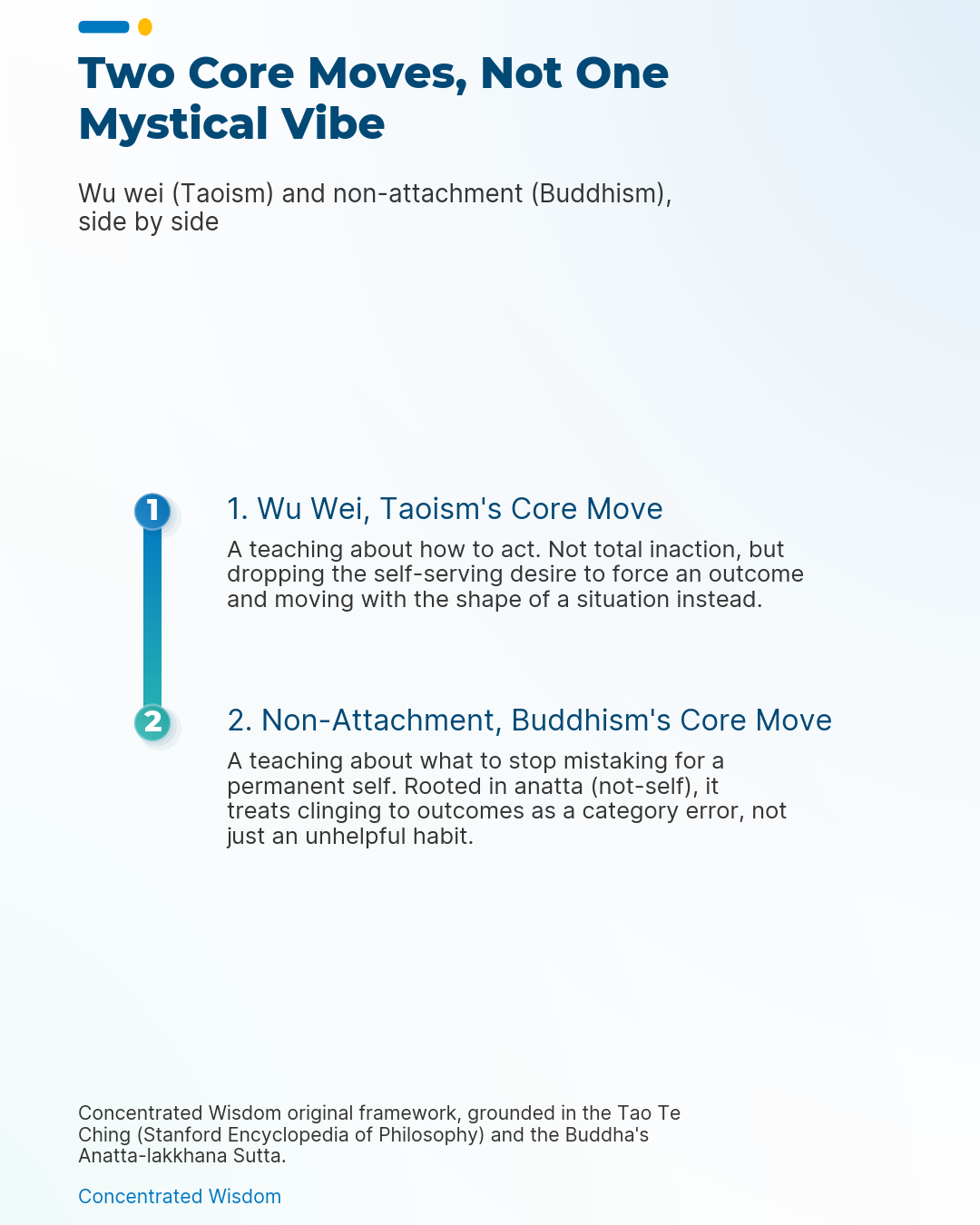
Eastern philosophy is not one system, it is an umbrella term for distinct traditions including Taoism, Buddhism, and Confucianism, each with its own texts, questions, and conclusions. Taoism’s core move is wu wei, drawn from the Tao Te Ching, meaning nonaction or effortless action, not laziness but a withdrawal of self-serving, forceful striving so a person acts in step with the natural pattern of things rather than against it. Buddhism’s core move is non-attachment, rooted in the doctrine of anatta or not-self taught in the Buddha’s Anatta-lakkhana Sutta, the claim that the body, feelings, perceptions, mental formations, and consciousness are all impermanent and therefore not a fixed self worth clinging to. These are not the same idea wearing different names. Wu wei is about how to act, non-attachment is about what to stop mistaking for a permanent self. Both show up in modern mental models, wu wei resembles the flow state described by psychologist Mihaly Csikszentmihalyi, and non-attachment resembles cognitive defusion in Acceptance and Commitment Therapy, observing a thought without fusing with it as fact.
Eastern philosophy is not one philosophy. It is a Western shorthand for a set of distinct traditions, Taoism, Buddhism, Confucianism, and others, that developed in different centuries, answer different questions, and sometimes flatly disagree with one another. This guide treats two of the most searched, most misunderstood ideas from that shorthand, Taoism’s wu wei and Buddhism’s non-attachment, as what they actually are: separate, precisely defined moves, not one interchangeable mystical vibe.
Why Eastern Philosophy Isn’t One Thing
The Umbrella-Term Problem
The phrase groups together traditions the way Western philosophy would have to group ancient Greek philosophy with the Enlightenment and Romanticism into a single unlabeled category. Those two Western movements are not a useful comparison because they agree, they’re useful because they were a direct reaction against each other, Enlightenment rationalism prizing reason and universal law, Romanticism pushing back with emotion, intuition, and the individual. Calling Taoism and Buddhism both simply Eastern philosophy without that same distinction does the same disservice, it hides real disagreement behind one convenient label.
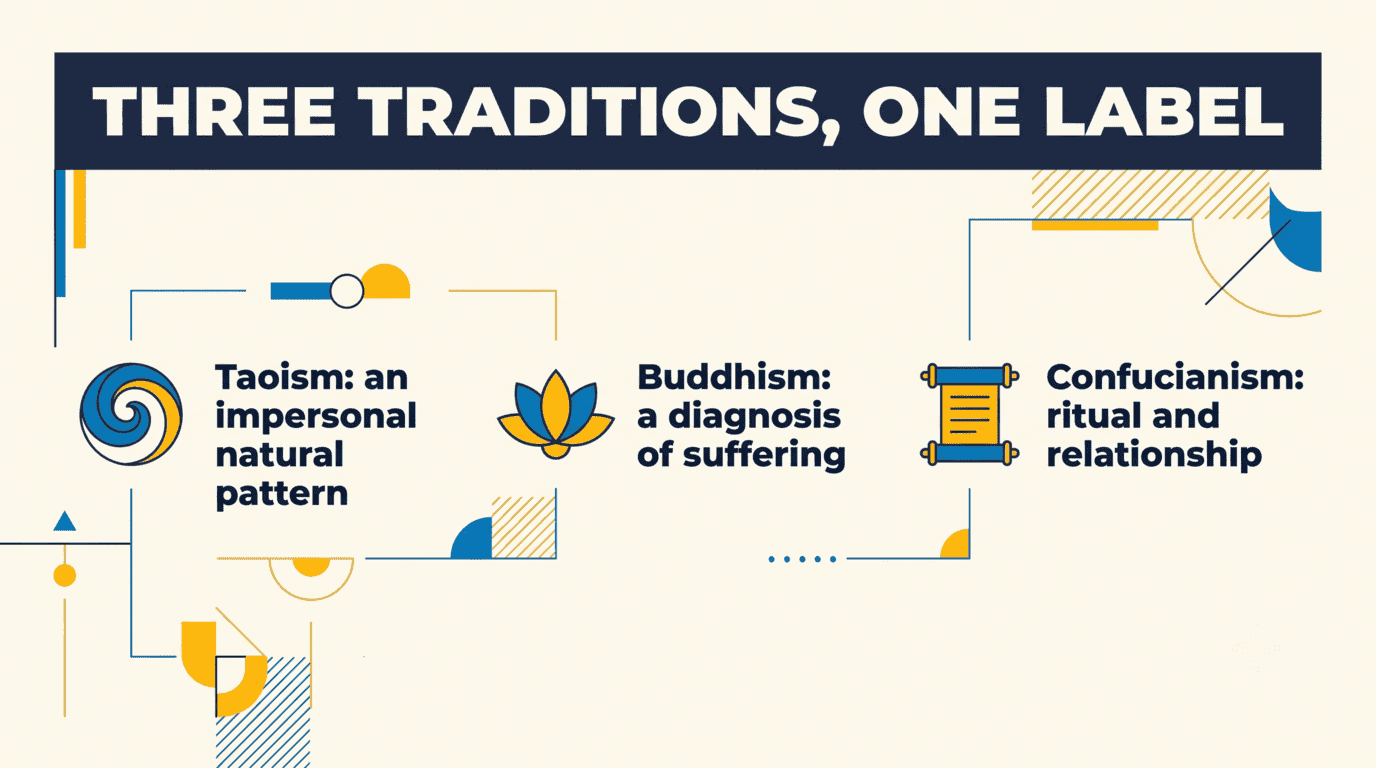
Taoism, rooted in the Tao Te Ching attributed to Laozi, is concerned with aligning human action with the Dao, an impersonal natural pattern, not a rulebook of virtues. Buddhism, founded on the teachings of Siddhartha Gautama roughly a century or two later in a different region entirely, starts from a diagnosis of suffering and builds an entire analysis of the mind and self around it. Confucianism, meanwhile, is largely a social and ethical philosophy, concerned with li (ritual propriety) and right relationships between people, closer in spirit to political philosophy than to either of the other two. Treating these three as one worldview is like treating Stoicism, Christianity, and utilitarianism as one worldview because they all originated west of the Indus.
The differences get sharper, not softer, on close inspection. One clear example: the search phrase taoism god doesn’t have a simple yes or no answer, because philosophical Taoism and religious Taoism are not quite the same thing. The Dao described in the Tao Te Ching is not a personal deity, it’s an impersonal source and pattern behind everything, without will or preference. But later religious Daoism did develop an organized pantheon, and by the second century CE, Laozi himself had been deified under the name Laojun (Lord Lao), with the first recorded imperial rites in his honor performed in 166 CE. So the honest answer is: the philosophy has no god, the religion that grew out of it does.
Taoism’s Core Move, Wu Wei
What Wu Wei Actually Means
Wu wei (無為) is built from two characters, wu (not, without) and wei (to do, to act), and it’s usually translated as nonaction or effortless action. Neither translation is quite right on its own, and the Stanford Encyclopedia of Philosophy’s entry on Laozi is direct about why: wu wei does not mean total inaction. A person practicing it still farms, still governs, still speaks. What drops away is the self-serving desire that normally drives action, the forcing, grasping, and controlling that comes from trying to bend outcomes to one’s own will.
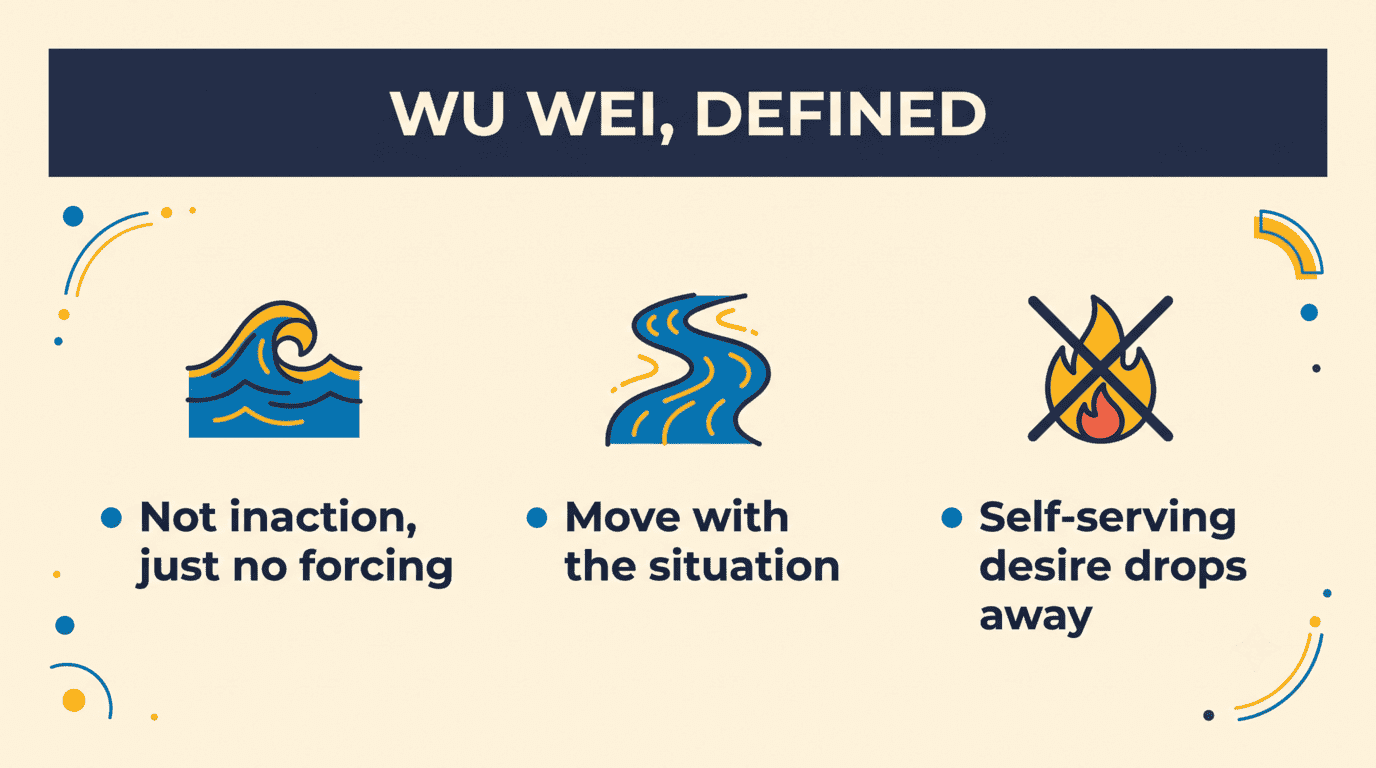
The clearest way to hold the idea is as a contrast, not a technique. Ordinary action is driven by wanting a specific outcome badly enough to force it. Wu wei is action that arises from reading the actual shape of a situation and moving with it rather than against it, the way water finds the lowest path without straining to do so. The Tao Te Ching returns to this image constantly, softness overcoming hardness, yielding overcoming resistance, because water is its favorite proof that non-forcing is not the same as passivity.
This matters because the popular version of wu wei, “just go with the flow”, quietly drops the hardest part. Going with the flow is easy when nothing is at stake. Wu wei is specifically about releasing the grip of desire in situations where forcing an outcome feels justified, a negotiation, a conflict, a plan that isn’t working. The practice is noticing the impulse to force and choosing not to act from it, not skipping action altogether.
Buddhism’s Core Move, Non-Attachment
What Non-Attachment Really Means
Popular usage flattens non-attachment into something close to emotional detachment, caring less so things hurt less. That is a real misreading of the doctrine it comes from, anatta (Pali) or anatman (Sanskrit), usually translated as not-self. The clearest statement of it is the Buddha’s own second recorded discourse, the Anatta-lakkhana Sutta, delivered at Deer Park in Isipatana. In it he walks through the five constituents of a person, form, feeling, perception, mental formations, and consciousness, and argues that none of them can be a fixed self, precisely because none of them stays fixed. What is impermanent is bound up with affliction, and what is bound up with affliction cannot honestly be called “mine, I, myself.”
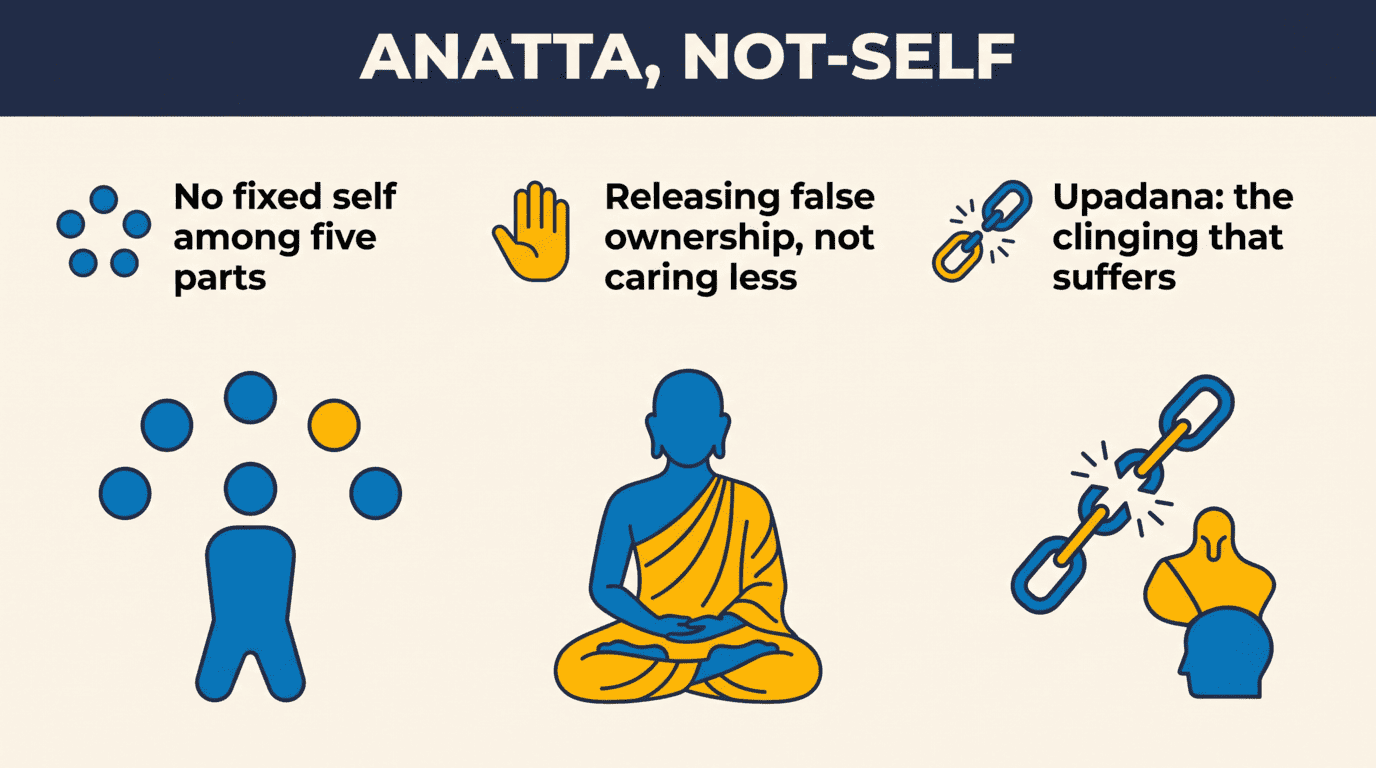
That’s a metaphysical claim about the nature of the self, not a mood or a coping style. Non-attachment follows from it logically: if there is no fixed self to protect, then clinging to outcomes as though they belong to a permanent “me” is a category error, not just an unhelpful habit. The Buddhist term for the grasping this produces, upadana (clinging), is treated as the mechanism that keeps suffering going, not the emotion itself. Letting go of clinging is not the same as caring less, it’s recognizing that the thing being gripped so tightly, a fixed, unchanging self with a stake in every outcome, was never actually there to begin with.
The distinction from Taoism’s wu wei is real and worth naming directly. Wu wei is a teaching about how to act, moving with the grain of things instead of forcing them. Non-attachment is a teaching about what to stop mistaking for a permanent self in the first place. They can look similar from the outside, both counsel less forcing and less gripping, but one is a strategy for effective action and the other is a claim about what a person fundamentally is. Conflating them is exactly the taoism vs buddhism confusion this whole umbrella term produces.
Where These Ideas Show Up in Modern Mental Models
Honest Connections, Not Forced Ones
Some of the strongest cases for calling these eastern philosophy core ideas still relevant come from psychology researchers who reached similar conclusions independently, then later recognized the overlap. Three connections hold up under scrutiny rather than collapsing into vague self-help paraphrase.
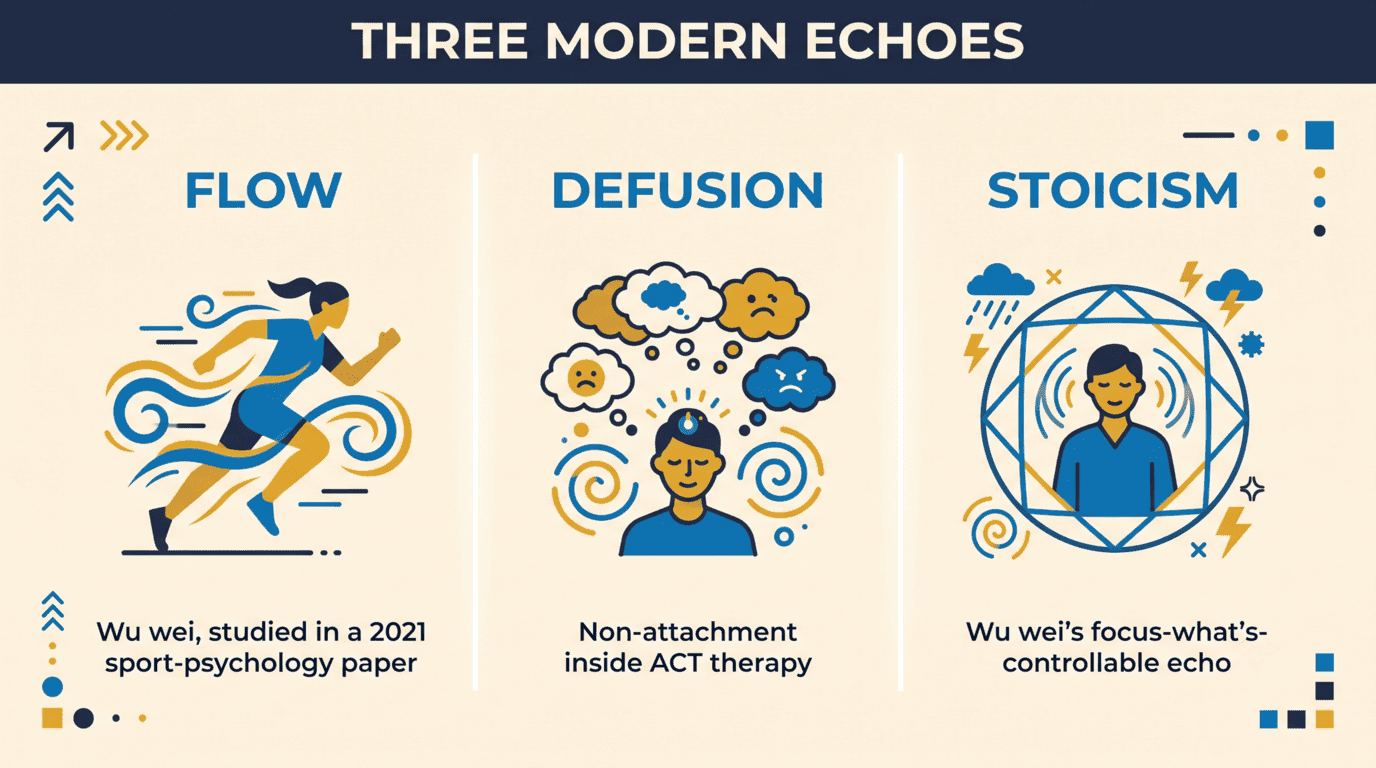
Wu wei and flow states. Psychologist Mihaly Csikszentmihalyi’s concept of flow, total absorption in an activity where effort stops feeling effortful, has been directly compared to wu wei in peer-reviewed sport psychology research, including a 2021 paper in Psychology of Sport and Exercise examining wu wei as an alternative framework for understanding effortless, non-striving performance. The overlap is real: both describe a state where forcing the outcome actively works against achieving it, and both treat that state as trainable rather than accidental.
Non-attachment and cognitive defusion. In Acceptance and Commitment Therapy (ACT), cognitive defusion is one of the therapy’s core processes, learning to observe a thought as a passing mental event rather than a literal fact demanding a reaction. That is structurally close to what anatta asks of a person’s relationship to the five constituents, not eliminating the thought or feeling, but no longer fusing with it as though it were a fixed, permanent self. ACT was built independently as a behavioral therapy, not as applied Buddhism, which is part of what makes the convergence notable rather than a marketing claim.
Wu wei and stoic-adjacent acceptance. Stoicism is a Western, Greek and Roman tradition, not an Eastern one, but its central move, focusing effort only on what’s within one’s control and accepting the rest without resistance, rhymes closely with wu wei’s refusal to force outcomes against the grain of events. The two traditions arrived at a similar practical stance from entirely different starting premises, which is a useful comparative-philosophy data point in its own right, and one covered in more depth in this site’s guide to Stoicism and Relationships.
None of this makes wu wei, non-attachment, flow, defusion, or Stoic acceptance the same idea. It makes them independently-arrived-at answers to an overlapping problem, how to act and how to relate to outcomes without being controlled by the need for a specific result. That overlap is the honest version of why these two-thousand-year-old ideas keep resurfacing in modern psychology instead of staying museum pieces.
The Three Traditions, Compared Directly
A single table won’t replace reading the primary texts, but it does correct the flattest version of the umbrella-term problem: assuming these traditions share a method just because they share a region.
| Tradition | Core Question | Core Move | Closest Modern Echo |
|---|---|---|---|
| Taoism | How should a person act without forcing outcomes? | Wu wei, nonaction / effortless action | Flow states |
| Buddhism | What is the self, really, and why does clinging to it cause suffering? | Non-attachment, grounded in anatta (not-self) | Cognitive defusion (ACT) |
| Confucianism | How should people relate to one another and to social order? | Li, ritual propriety and right relationship | Virtue ethics, role-based obligation |
Related: Spirituality & Philosophy
Related: Stoicism Relationships
Related: Good Philosophy Books for Beginners
Frequently Asked Questions
Is eastern philosophy one belief system?
No. Eastern philosophy is an umbrella term covering distinct traditions, including Taoism, Buddhism, and Confucianism, that developed separately, ask different core questions, and sometimes disagree with each other. Treating them as one worldview flattens real philosophical differences.
Does Taoism believe in a god?
The Tao itself, as described in the Tao Te Ching, is not a personal god, it’s an impersonal natural pattern. Religious Daoism, which developed later, does have a pantheon and deified Laozi as Laojun, so the honest answer depends on whether the question is about the philosophy or the later religion.
What is the difference between wu wei and non-attachment?
Wu wei, from Taoism, is a teaching about how to act without forcing outcomes. Non-attachment, from Buddhism, is a teaching about what to stop mistaking for a fixed, permanent self. They look similar from a distance but come from different premises and answer different questions.
Is wu wei the same as going with the flow?
Not exactly. The popular phrase drops the hardest part, wu wei is specifically about releasing the impulse to force an outcome in situations where forcing feels justified, not passively accepting whatever happens with no effort at all.
How does eastern philosophy connect to modern psychology?
Several eastern philosophy ideas have real, independently-documented overlaps with modern mental models, wu wei with flow states studied by Mihaly Csikszentmihalyi, and Buddhist non-attachment with cognitive defusion, a core process in Acceptance and Commitment Therapy. These are honest parallels, not identical concepts.