Concentrated Wisdom Editorial Team researches, writes, and fact-checks this guide against primary sources before publication.
Stoicism does not teach emotional suppression in relationships, it teaches holding attachment as a preferred indifferent, something valued fully but not required for your own good. The original Stoic texts, particularly Epictetus’s Enchiridion and Marcus Aurelius’s Meditations, describe engaging with love and loss through reason rather than denial. This guide breaks that distinction into a practical four-step process, the Open Hand Method, for applying it inside a real relationship.
Stoicism does not instruct anyone to suppress emotion in relationships. The ancient Stoics classified relationships as a preferred indifferent, something rational and worth pursuing with full effort, but not the source of a person’s own good, which they located in virtue instead. Epictetus taught this through his Enchiridion, writing that attachment should be held with awareness that a loved one is mortal, and that loss is better understood as returning something borrowed than as theft. Marcus Aurelius applied similar reasoning to daily conflict, expecting difficult behavior from others each morning and responding from reason rather than reaction. Applied to a modern relationship, the philosophy asks for full emotional investment alongside an internal stability that does not collapse if the relationship ends. That combination, depth without dependency, is what the original texts actually describe, not the emotional distance the word ‘stoic’ has come to suggest.
Does Stoicism Mean You Have to Suppress Your Emotions in Relationships
No, Stoicism does not teach emotional suppression in relationships. The Stoics classified another person as a preferred indifferent, something worth pursuing and valuing with full attention, without treating their presence as a requirement for your own good.
Look up stoic in a dictionary and the definition that surfaces is someone who accepts what happens without complaining or showing emotion. That definition describes a stereotype, not the ancient philosophy. Stoicism never asked anyone to stop caring about the people in their life.
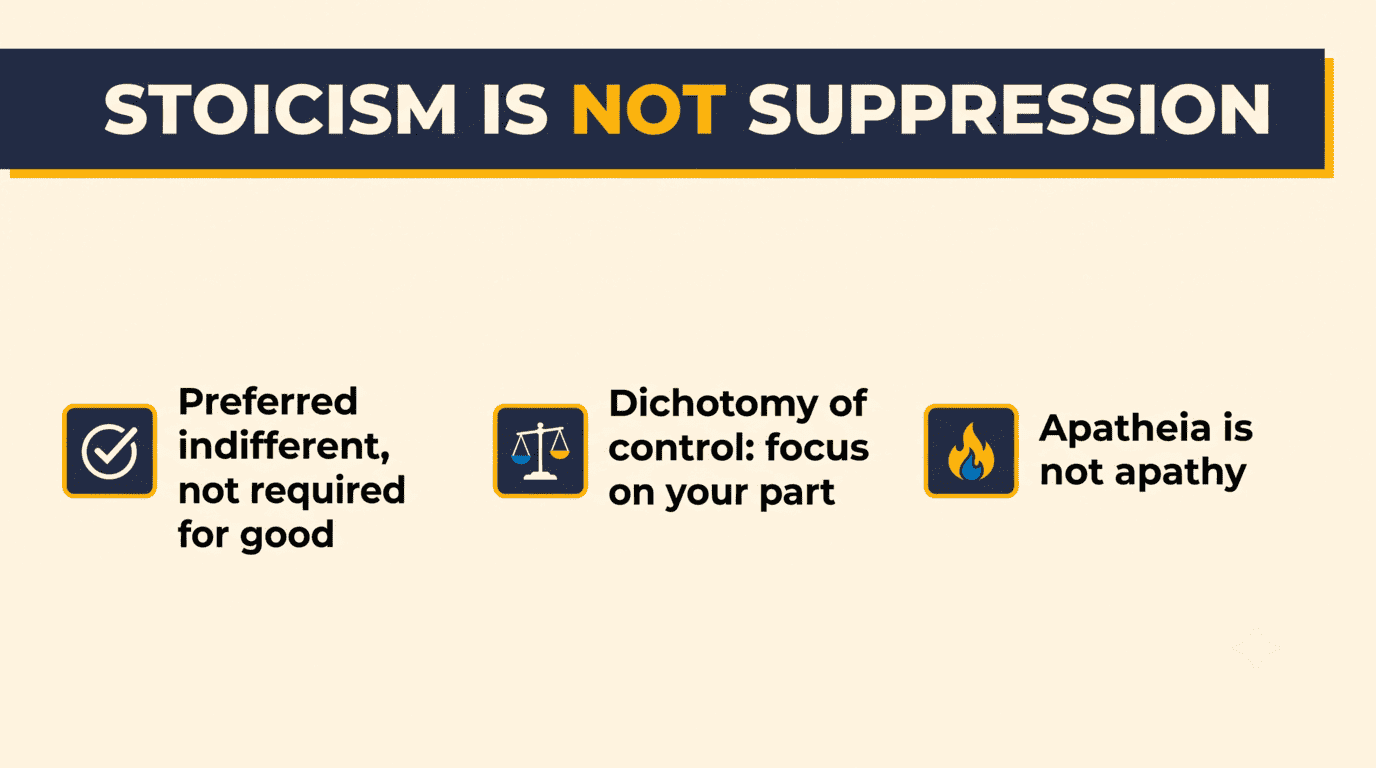
Stoicism is a Greek philosophy founded around 300 BCE by Zeno of Citium, built on a small set of stoic principles, virtue is the only true good, and everything else, health, wealth, reputation, even relationships, is secondary. Stoic values center on wisdom, courage, justice, and self-control. What are Stoics actually doing with a relationship, in this framework, they are applying the dichotomy of control, sorting what they can control (their own choices and reactions) from what they cannot (another person’s feelings or decisions), then building the relationship on the part that is actually theirs to build.
Why Stoicism Reads as Emotional Suppression
The confusion starts with a language shift. In everyday English, stoic became an adjective for a flat affect, gritted teeth through a funeral, a blank face at bad news. Stoicism the philosophy is a different thing. It distinguishes destructive passion from ordinary human feeling, and it targets only the former.
Marcus Aurelius wrote to himself, not for an audience, in the private notebook known today as Meditations. Its opening lines rehearse patience with difficult people, not indifference toward loved ones. Read the full passage and the tone is closer to a coping strategy for a hard morning than a rejection of feeling.
Epictetus, a former slave who became one of Rome’s most quoted teachers, built his entire system around one distinction, what is up to us and what is not. Emotion is up to us. Other people’s choices are not. That distinction gets flattened into cold detachment by readers skimming for a productivity hack instead of studying the source.
The philosophy has a specific goal in mind, eudaimonia, a flourishing life built on virtue rather than external outcomes. Getting there requires apatheia, freedom from destructive passion like uncontrolled rage or crushing anxiety. Apatheia is not apathy. It describes a mind steady enough to feel love, grief, and joy without those feelings hijacking judgment, the opposite of the modern sense of the word.
Related: Spirituality & Philosophy
What the Stoic Texts Actually Say About Attachment and Loss
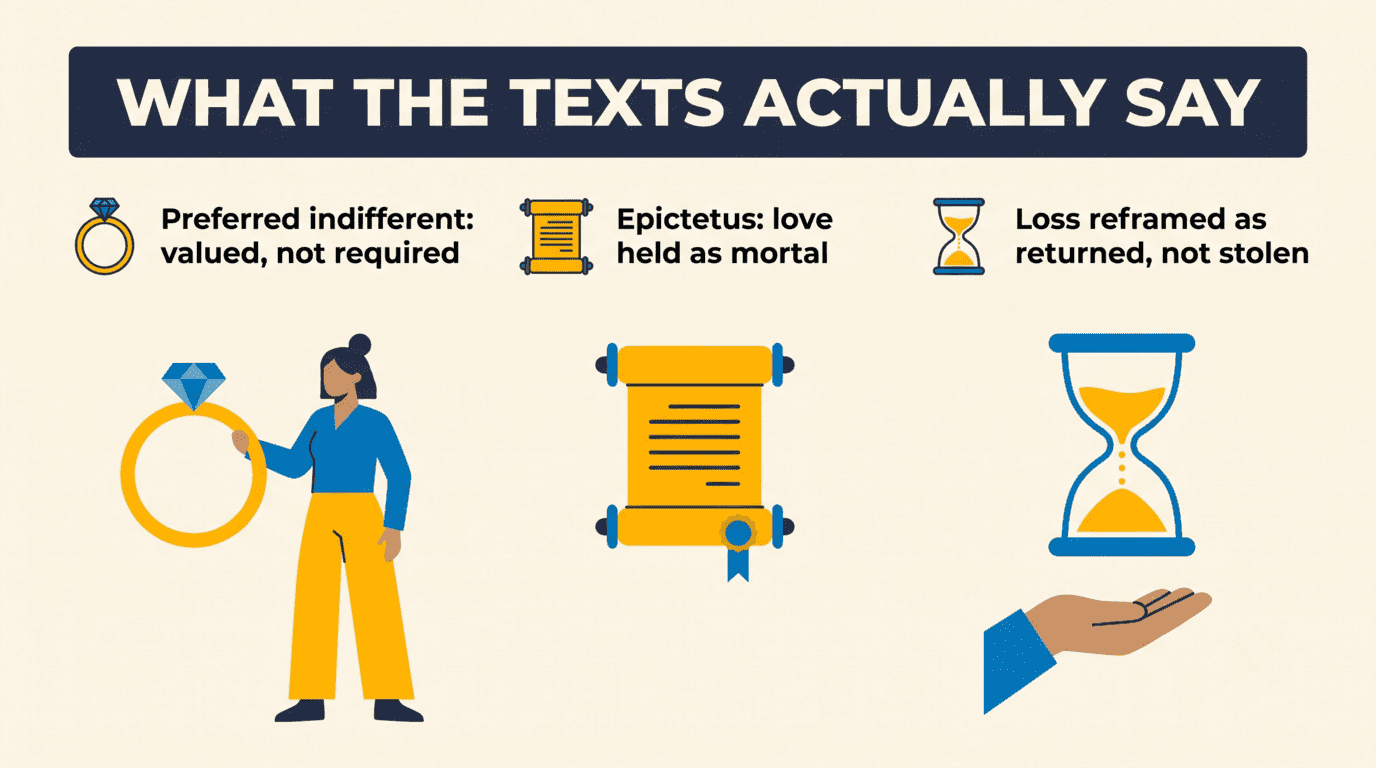
The Stoic texts describe people you love as a preferred indifferent, something rational to want and act toward, but not something your own wellbeing depends on possessing.
The Preferred Indifferent, Valuing Fully Without Needing
A preferred indifferent, proegmenon in the original Greek, is anything that is not virtue itself but is still worth choosing over its opposite, health over sickness, a good reputation over disgrace. The Stanford Encyclopedia of Philosophy‘s entry on Stoicism lists relationships and affection for family among these preferred things, valuable and rational to pursue, but not the seat of the good life.
That is not the same as not caring. A Stoic pursuing a preferred indifferent still acts with real effort and real feeling. The difference shows up only at the edges, in how a person responds when the preferred thing is lost.
Marcus Aurelius and Epictetus on Attachment and Loss
Epictetus gave the clearest instruction on attachment in the Enchiridion, his short handbook of Stoic practice. He wrote that when a person kisses a child or a spouse, they should silently remind themselves that they are kissing something mortal, so that if death comes, they are not shattered by it.
That line reads harshly out of context. In context, Epictetus is not telling anyone to love less. He is describing a mental habit, holding the relationship with open awareness of its impermanence, so love doesn’t collapse into denial when loss actually arrives.
Later in the same handbook, Epictetus reframes loss itself. Losing a spouse or child, he wrote, should be described as returning them rather than losing them, since nothing was ever truly owned to begin with. Marcus Aurelius practiced the same habit through what later Stoics called memento mori, a regular reminder of mortality meant to sharpen attention to the people in front of him, not distance him from them.
Related: Eastern Philosophy
Related: Good Philosophy Books for Beginners
Applying Stoicism to a Real Relationship
Applying Stoicism to a relationship comes down to one shift, stay fully engaged in the relationship while keeping your own peace of mind independent of whether it lasts or ends on your terms.
Valuing Deeply Without Dependency
One specific misreading of Stoic emotional restraint shows up more than any other in questions about whether Stoicism is compatible with emotional intimacy.
One person started keeping her boyfriend at arm’s length on purpose, reasoning that Stoicism meant she shouldn’t need him. Six weeks into practicing that distance, the relationship felt hollow rather than resilient. Reading the actual Enchiridion passages on loss instead of secondhand summaries corrected it immediately. Epictetus never told anyone to withhold love in advance of losing it. He told them to love fully and hold the fact of impermanence at the same time, not one instead of the other.
***Dependency means your own stability collapses without the other person. Depth of feeling is not the same thing, and nothing in the original texts asks anyone to trade one for the other.***
That mistake is common enough that it deserves a name of its own, mistaking withdrawal for a controlled response, using Stoic language to justify pulling away from a partner instead of resolving the actual disagreement. Genuine Stoic practice never treats a relationship problem as handled just because a person stopped mentioning it.
Handling Anger Toward a Partner, What Seneca Actually Said
Most writing on Stoicism and relationships treats anger as a side effect the dichotomy of control will quietly handle. Seneca thought the problem deserved its own book. His treatise De Ira, written for his brother Novatus, opens by calling anger a short madness, devoid of self-control, forgetful of kinship, obstinately engrossed in whatever it begins to do, deaf to reason and advice, a description most people would recognize from the middle of a bad argument with someone they love.
Seneca’s more useful claim is more precise than a warning. In Book II, he argues anger cannot act on its own, it requires the mind’s approval, built from two separate judgments: that a wrong has been done, and that it deserves to be avenged. Anger toward a partner, in this account, is not a reflex that happens to a person, it is a conclusion a person draws, and a conclusion can be interrupted before either judgment is fully agreed to.
***Anger toward a partner is not a reflex, it’s a conclusion, built from two judgments a person is still free to check before agreeing to either one.***
This is the same move Epictetus makes with the dichotomy of control, applied one step earlier, to the instant right before anger turns into something said that can’t be taken back.
The Open Hand Method, Four Steps for Practicing It
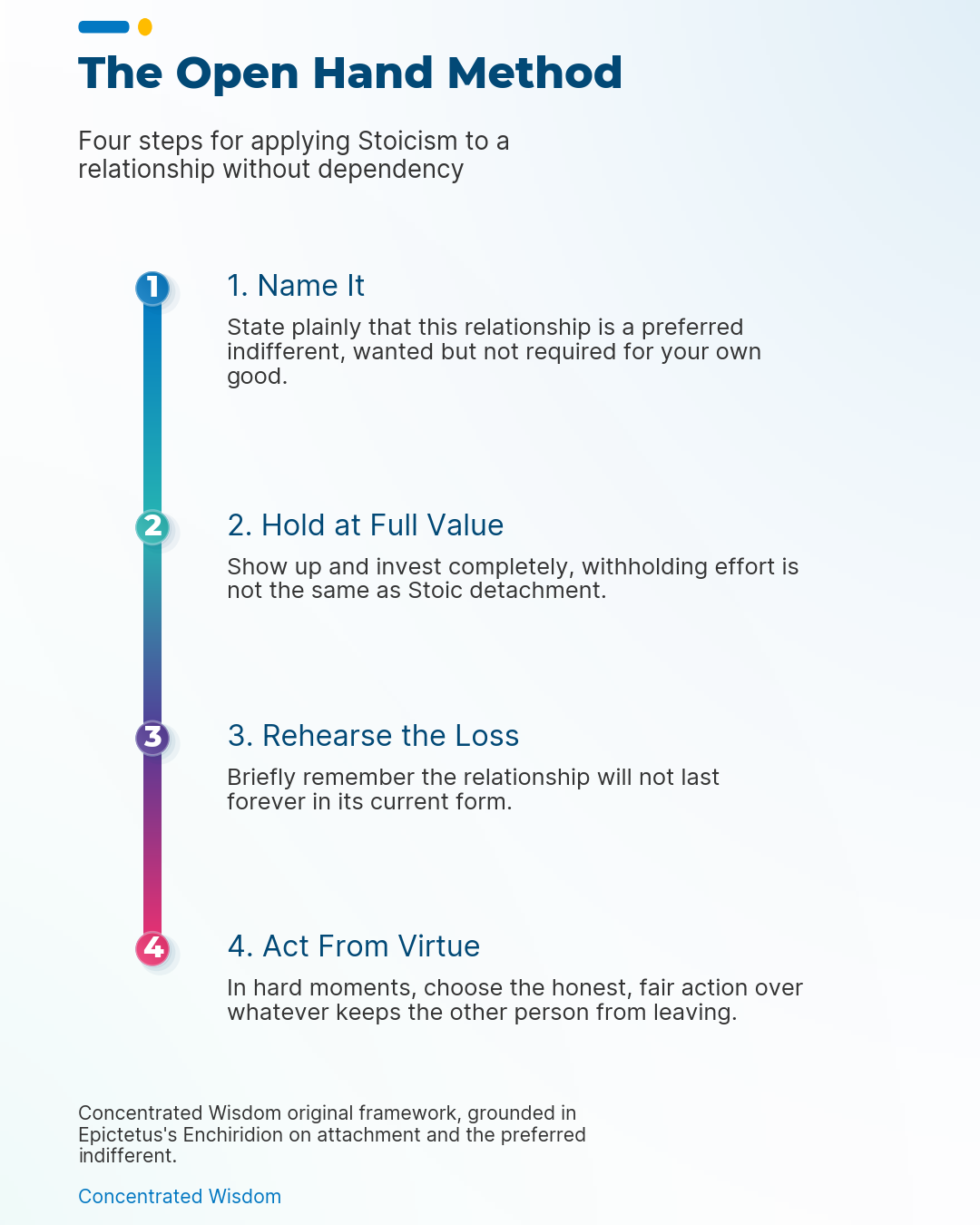
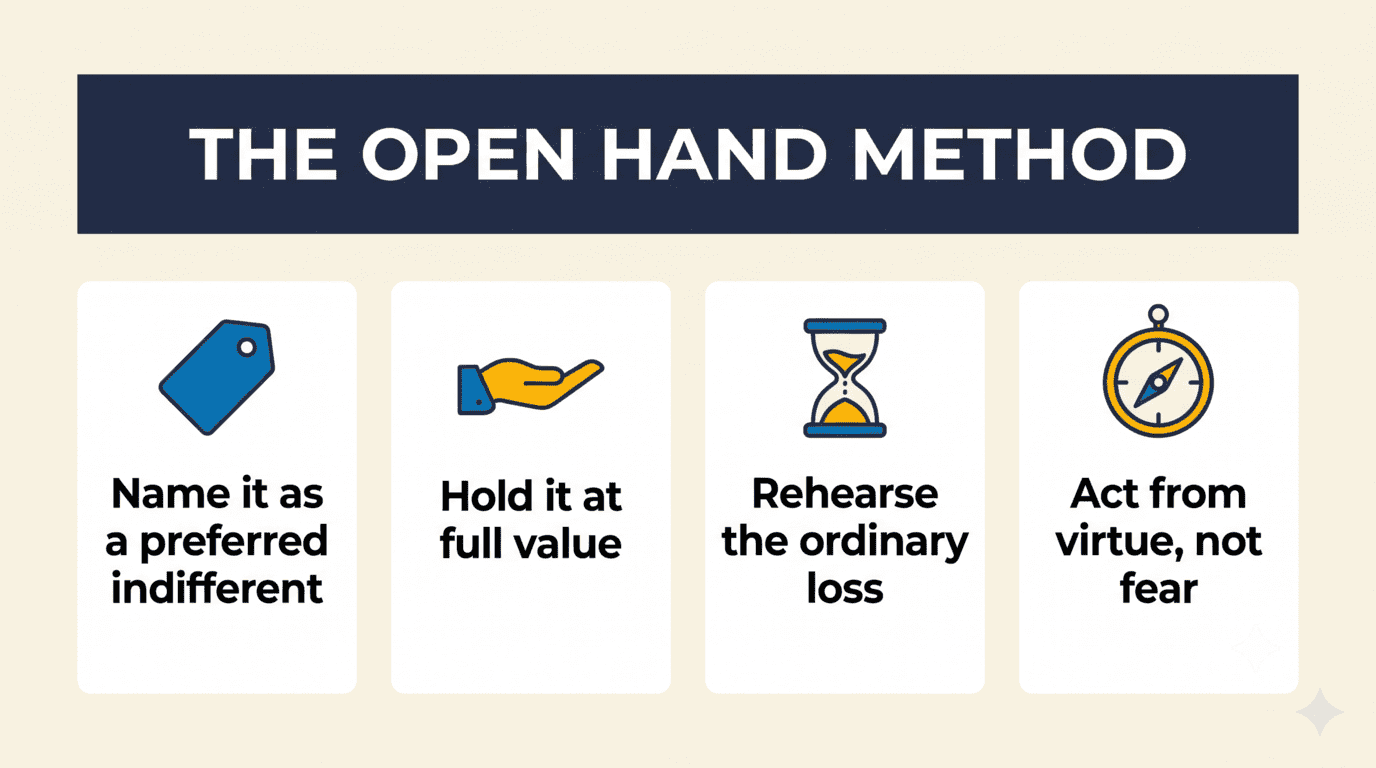
The Open Hand Method turns that distinction into four steps a person can actually run through during a real relationship moment, named for Epictetus’s own image of holding something valuable without a clenched fist.
- Name it as a preferred indifferent. Say plainly that this relationship is something you want, not something required for your own good.
- Hold it at full value. Show up, invest, and feel the relationship completely, withholding effort is not the same thing as Stoic detachment.
- Rehearse the ordinary loss. Take a brief moment to remember the relationship will not last forever in its current form, through a breakup, a move, or eventually death.
- Act from virtue, not fear of loss. When a hard decision comes up, choose the honest and fair action rather than whatever keeps the other person from leaving.
Run through these four steps in order and the pattern becomes clear, each step trades a fear-based reaction for a deliberate, virtue-based choice, which is the actual definition of Stoic mentality the original texts describe.
Frequently Asked Questions
Can a Stoic Person Fall in Love?
Yes. Stoicism never argued against romantic love, and Stoic writers describe genuine partnership as compatible with a virtuous life. What Stoicism asks is that a person’s sense of wellbeing not depend entirely on the relationship succeeding or continuing on a set timeline.
What Did the Stoics Actually Say About Love and Attachment?
Epictetus taught that attachment should be held with awareness of impermanence, comparing it to kissing something mortal rather than an object that cannot break or die. Marcus Aurelius applied similar reasoning to conflict, treating other people’s flaws as understandable rather than personal attacks. Neither philosopher argued for withholding love.
What Is a Preferred Indifferent in Stoicism?
A preferred indifferent is something that is not virtue itself but is still rational to want, health, reputation, or a relationship, for example. It is called indifferent because it is not the source of a good life on its own, and preferred because choosing it over its opposite still makes sense.
Does Stoicism Mean You Shouldn’t Grieve a Breakup?
No. Stoic texts describe grief as a natural reaction, not something to suppress by force. What the philosophy recommends is processing loss through reason rather than staying in prolonged distress, including reframing a loss as something returned rather than stolen.