

Most productivity advice treats your to-do list as a queue: first in, first out, whatever screams loudest gets done first. That’s precisely the model that keeps ambitious people busy without making them effective. The Eisenhower Matrix works from a different premise entirely: not everything urgent deserves your attention, and not everything important announces itself with a deadline.
The framework is credited to Dwight D. Eisenhower, who reportedly said, “What is important is seldom urgent, and what is urgent is seldom important.” He ran a five-star military career and a presidency on that distinction. You’re running a career, a household, and a mind full of competing obligations. The mental model scales down just as well as it scaled up.
What the Eisenhower Matrix Actually Is
The Eisenhower Matrix sorts every task on your plate into one of four quadrants, using two axes: urgency and importance. Urgency asks whether something demands action right now. Importance asks whether it moves you toward something that actually matters, your goals, your health, your relationships, your work.
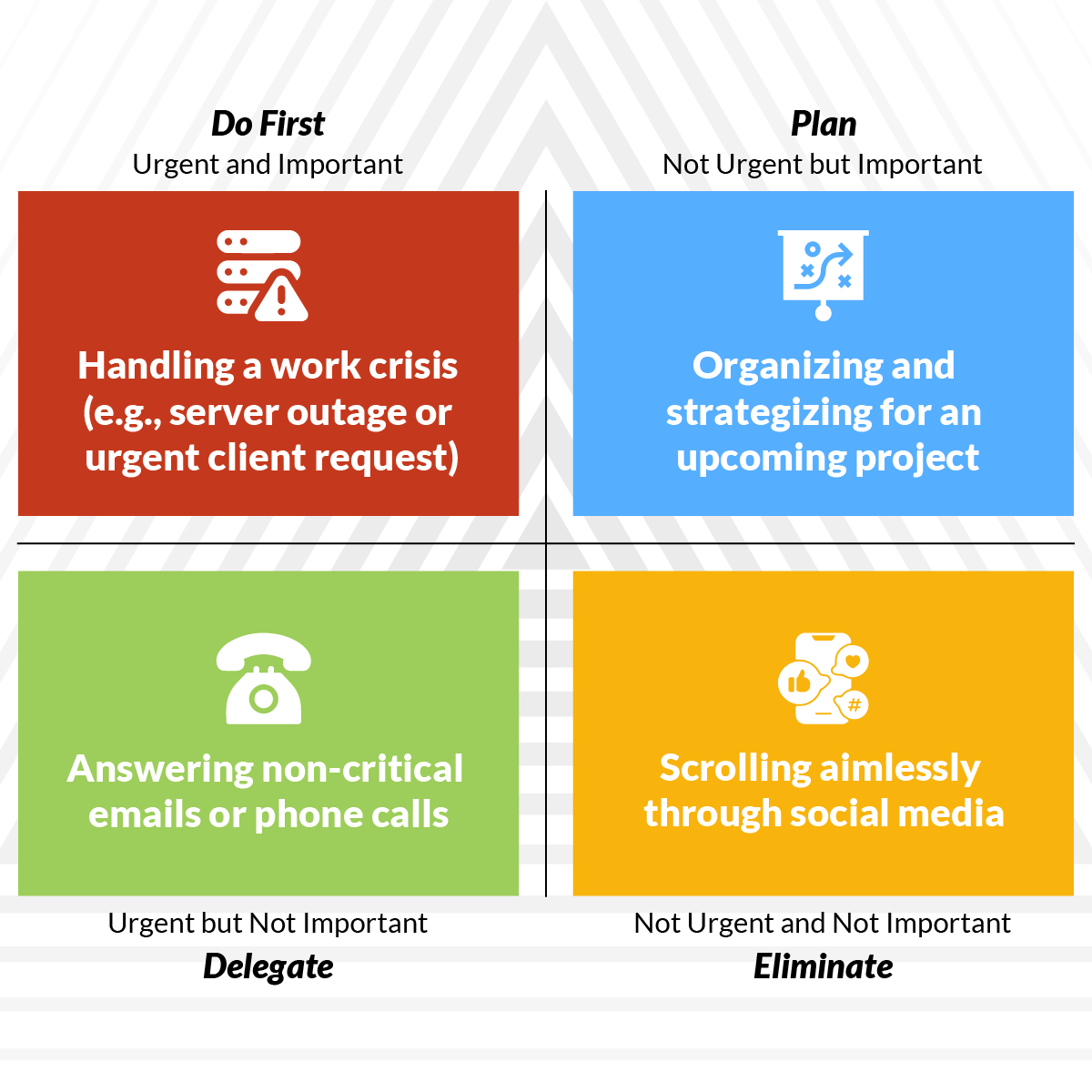
- Quadrant 1: Urgent and Important – Crises, hard deadlines, problems that compound if you ignore them. This is where you act immediately, no framework required.
- Quadrant 2: Not Urgent but Important – Strategic thinking, skill-building, relationships, health, the work that determines who you become. Nothing forces you here. That’s exactly the problem.
- Quadrant 3: Urgent but Not Important – Other people’s priorities disguised as yours. Most interruptions, most “quick” favors, most notifications live here.
- Quadrant 4: Not Urgent and Not Important – Time that disappears without a trace. Not inherently bad in small doses, dangerous as a default state.
Why Quadrant 2 Is Where Compounding Happens
Here’s the pattern worth noticing: most people spend their working lives oscillating between Quadrant 1 and Quadrant 3, reacting to fires and other people’s requests, and mistake the resulting exhaustion for productivity. Quadrant 2 is where compounding actually happens, the strategic planning, the skill you build once and use for a decade, the conversation that prevents ten future conflicts. None of it feels urgent while you’re doing it. All of it determines the shape of the next five years.
A case in point Consider someone (call him Frank) who spent years living entirely in Quadrant 1. Every day was a fire drill: inbox triage, last-minute requests, meetings that existed to schedule other meetings. The work got done. The trajectory never changed, because nothing he did addressed the system producing the fires in the first place.
The shift happened when he started protecting time for Quadrant 2 work before the week began, not after the urgent tasks were cleared, because they’re never fully cleared. He blocked time for career planning, for learning the skill that made him harder to replace, for the recovery that kept him from burning out. The fires didn’t stop entirely. They became rarer, because proactive work upstream prevents a measurable share of the emergencies downstream. That’s not a personality change. It’s a scheduling decision, repeated enough times to compound.
Where This Framework Actually Breaks Down
The Eisenhower Matrix sounds simple enough to sketch on a napkin, which is exactly why most people misapply it within a week. The failure isn’t understanding the four quadrants. It’s mistaking urgency for importance, over and over, because urgency is loud and importance is quiet.

- The Urgent and Important Mix-Up
A ringing phone feels urgent by design. That doesn’t make the call important. Before reacting, ask a sharper question: will this matter in a month? If the honest answer is no, it belongs in Quadrant 3 or 4, not at the top of your list. - Procrastination Wearing a Disguise
Quadrant 4 tasks feel productive in the moment and evaporate on contact with scrutiny. They’re comfortable precisely because they ask nothing difficult of you. Comfort and progress are rarely the same thing. - Overcommitment as a Habit
Saying yes to everything isn’t generosity, it’s a refusal to prioritize. Every yes to a Quadrant 3 request is a quiet no to the Quadrant 2 work that actually needed the time.
How to Crush It with the Eisenhower Matrix
Understanding the four quadrants is the easy part. Building a system that actually keeps you in Quadrant 2 is the work. Here’s what that looks like in practice.

- Plan the Week Before It Starts
If Quadrant 2 tasks aren’t on the calendar before Monday, Quadrant 1 and 3 will consume every open hour by Tuesday. Schedule the important work first, then let the urgent work fill in around it, not the reverse. - Time-Block for Deep Work
Protect uninterrupted blocks for the projects that actually move the needle. A calendar entry that says “focus time” is a boundary, not a suggestion, treat it accordingly. - Review and Recalibrate Weekly
This isn’t a system you set once. Check where your hours actually went. If Quadrant 3 crept back in, that’s information, not failure, use it to adjust next week’s plan. - Delegate Quadrant 3 Ruthlessly
If a task is urgent but not important to you specifically, it’s often important to someone else. Hand it off. Trying to personally handle every urgent request is a resourcing problem disguised as a virtue. - Build in Friction Against Distraction
Notifications are Quadrant 3 wearing a disguise, engineered to feel urgent. A five-second pause before reacting to one is often enough to recognize it for what it is.
What Changes When You Live in Quadrant 2
The Eisenhower Matrix isn’t a novelty from a five-star general’s old notebook. It’s a mental model for where your attention compounds instead of evaporates. Here’s what shifts when Quadrant 2 becomes the default, not the exception.
- Output Increases Without More Hours
Focusing on what’s genuinely important stops the wheel-spinning that comes from reacting to everything. Same 24 hours, measurably more progress. - Stress Drops
A life spent perpetually extinguishing fires is a stressful one by design. Quadrant 2 work is preventive. Fewer fires means less adrenaline, which your nervous system will thank you for. - Work-Life Balance Stops Being Theoretical
When the important-but-not-urgent things get scheduled, that includes the parts of life outside work, too. The hobbies and relationships you meant to get back to have a way of reappearing. - Your Career Compounds
Time invested in non-urgent, important work, skill-building, relationship capital, strategic thinking, is exactly the kind of work that gets someone promoted, while urgent firefighting rarely does. - Relationships Improve
Reactive people show up distracted. Proactive people show up present. That difference is felt by everyone around you, whether or not they could name why.
The Takeaway
The Eisenhower Matrix isn’t a productivity hack, it’s a lens for deciding what deserves your attention before the day decides for you. Most people don’t lack the time for what matters. They lack a system that protects it from everything that merely feels urgent. Start with one Quadrant 2 task this week. Put it on the calendar before anything else claims the slot, and notice what happens to the fires that used to define your days.