
By Concentrated Wisdom Editorial Team, which researches, writes, and fact-checks this guide against primary sources before publication.
Self-awareness activities for adults are structured exercises (not open-ended journaling) that build accurate self-knowledge through specific prompts, external feedback, and repetition. The fastest three to start today are the “What Am I?” daily check-in (replacing “why” questions with “what” questions), the Wheel of Life assessment (a visual gap-finder you can’t reason your way out of), and structured 360-degree feedback (external data a single person’s opinion can’t explain away). The twelve activities below, organized from daily micro-practices to advanced real-time work, cover both forms of self-awareness researchers actually measure.
Picture someone sitting in a journaling retreat, writing about themselves for the 87th consecutive day. By all logic, they should be the most self-aware person in the room. And yet, they are not. They are more confused about who they are than when they started.
This is the introspection paradox, and it is more common than you would expect.
Research by organizational psychologist Dr. Tasha Eurich found that while 95% of people believe they are self-aware, only 10–15% actually meet the measurable criteria (Eurich, “What Self-Awareness Really Is (and How to Cultivate It),” Harvard Business Review, 2018). The gap is not from laziness. Most people are genuinely trying. The problem is that the most popular self-awareness activities for adults are built on a flawed premise, that thinking more about yourself makes you understand yourself better.
It often does not. Sometimes, it makes things worse.
This is not an argument against self-reflection. It is an argument for doing it right, with the right activities, in the right sequence, targeting the right type of awareness.
This failure pattern is common in SEL workshops. Rooms full of earnest, well-meaning adults do genuine reflection and walk out just as confused as they walked in. The shift tends to happen in the same place, not in more thinking, but in a specific, structured exercise, most reliably the Blind-Spot Round below (a Concentrated Wisdom framework), where a colleague’s single-word description surfaces something about a person that had never once occurred to them. That is not a breakthrough anyone journals their way into. It requires structure, and it usually requires another person.
The Two Types of Self-Awareness (Most People Only Chase One)
Before diving into specific activities, the framework matters.
Self-awareness is not a single skill. According to Dr. Eurich’s research, it has two distinct but complementary forms.
Internal self-awareness is your ability to understand your own values, thoughts, emotions, behavioral patterns, and the triggers behind them. This is the inward gaze, knowing why you react the way you do, what drains you versus what energizes you.
External self-awareness is your ability to understand how others perceive you, your communication style, your blind spots, your impact on the people around you.
Here is the counterintuitive finding from Eurich’s data. There is almost no correlation between the two. You can be highly self-aware internally while carrying enormous blind spots about how you come across. People who score highest on internal self-awareness often score lowest on external awareness. They are so focused on their inner world that they forget they live in an outer one.
The activities below are organized specifically so you build both, not just the one that feels more comfortable.
Why ‘Why’ Is the Wrong Question
Dr. Eurich’s research makes a point that most journaling guides quietly ignore. We simply do not have direct access to most of our unconscious thoughts and motives. When we ask ourselves ‘why’ we feel or behave a certain way, we do not retrieve a truthful answer. We construct a plausible one, and then believe it.
This is why excessive introspection produces rumination, not revelation. The mind manufactures meaning in the absence of real data, a finding Eurich developed at length in her TED talk “Increase Your Self-Awareness With One Simple Fix.”
The fix is simple. Replace ‘why’ with ‘what.’ Instead of ‘Why am I always anxious before presentations?’ ask ‘What specifically happens the moment my anxiety spikes? What physical sensations arise first? What is the last thought I have before it escalates?’
‘What’ questions are grounded, observable, and actionable. ‘Why’ questions are often invitations for self-mythology.
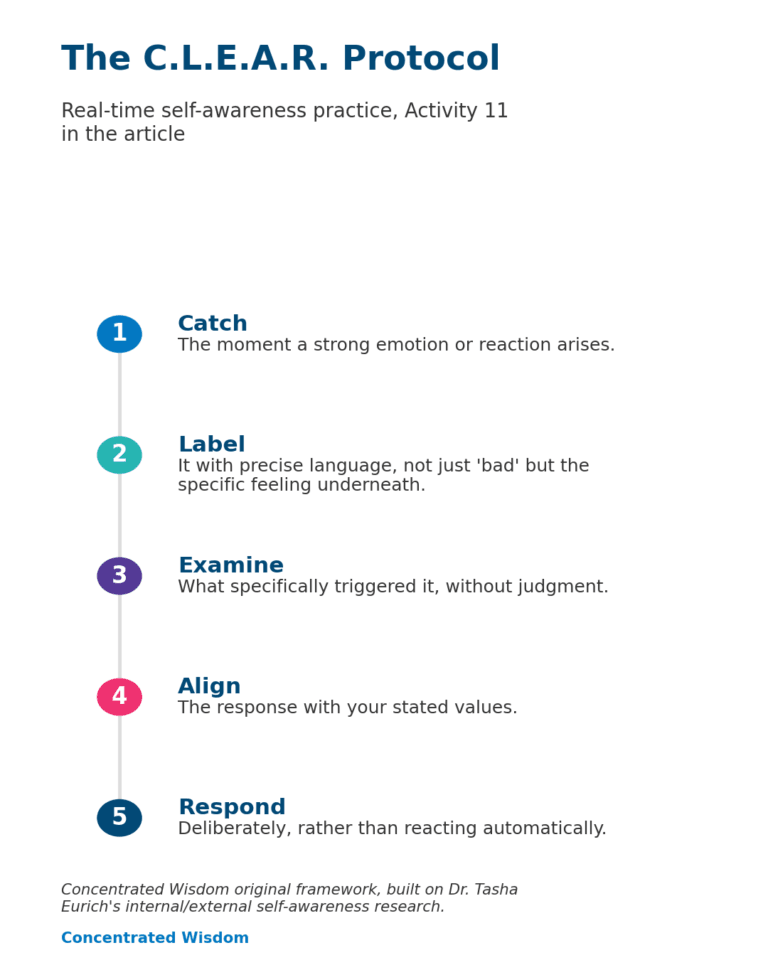
This insight is the foundation of the C.L.E.A.R. Protocol, a proprietary real-time self-awareness framework for adults, covered in full as Activity 11 below. It breaks into five steps.
- C. Catch the moment a strong emotion or reaction arises
- L. Label it with precise language (not just ‘bad’ but ‘humiliated,’ ‘overlooked,’ or ‘overstimulated’)
- E. Examine what specifically triggered it, without judgment
- A. Align the response with your stated values
- R. Respond deliberately rather than reacting automatically
The C.L.E.A.R. Protocol does not require a journal or a retreat. It is a micro-practice woven into ordinary moments (a meeting, a conversation, a decision point). It is what separates knowledge of self from command of self.
12 Self-Awareness Activities for Adults, Organized by Depth
These twelve are sequenced intentionally. Quick daily practices come first, then deeper solo reflection, then activities that require other people, then advanced real-time work. Start where you are, but do not stop at the first activity and call it a practice. Self-awareness is a compounding skill, not a one-time exercise.
Daily Micro-Activities (5 Minutes or Less)
1. The ‘What Am I?’ Daily Check-In (Internal, Beginner)
Each morning or evening, answer three questions in writing, using ‘what,’ never ‘why.’ What am I feeling right now, and what specifically caused it? What did I do today that aligns with my values? What do I want to do differently tomorrow?
Keep responses under five minutes. Brevity forces clarity. The goal is not therapy. It is calibration. Short, focused check-ins create a data trail over time, revealing emotional patterns that would otherwise disappear into the background noise of daily life.
2. The One-Line Values Check (Internal, Beginner)
End each day with a single sentence. Write, “Today I acted like someone who values ___.” Fill in the blank honestly, not aspirationally. If the blank is hard to fill, that is the data point, not a failure to explain away.
3. The Energy Audit (Internal, Beginner)
At the end of the day, list three things that happened. Mark each with a + or – based on whether it left you with more energy or less, regardless of whether it was “positive” on paper. A promotion conversation can be a –. A quiet walk can be a +. Over two weeks, the pattern tells you more about your actual values than any personality test.
Deeper Reflection Exercises
4. The Wheel of Life Assessment (Internal, Beginner to Intermediate)
Draw a circle. Divide it into eight segments representing key dimensions of your life, Career, Finances, Health, Relationships, Personal Growth, Fun and Recreation, Physical Environment, and Contribution or Purpose.
Rate your current satisfaction in each area from 1 (deeply dissatisfied) to 10 (fully satisfied). Shade each segment to the level of your rating.
The result is your life at a glance. A wheel with dramatic unevenness (a 9 in career and a 3 in relationships) tells a story that no journal entry could summarize as quickly. Visual asymmetry is impossible to rationalize. You can talk yourself out of feelings, but not out of a circle that shows clearly where you have been neglecting yourself.
5. The Values Clarification Exercise (Internal, Intermediate)
Most people think they know their values. Very few have actually tested them under pressure.
Write down 20 values that resonate with you. Then apply the brutal priority test. If you could only keep 5, which would you keep? Now, looking at your last 30 days, do your actual behaviors reflect those 5 values, or the ones that merely sound good?
The gap between espoused values and enacted values is one of the most diagnostic signals of self-awareness. A wide gap reveals cognitive dissonance. A narrow gap reveals integrity. Seeing the gap between your stated values and your actual time allocation creates productive discomfort, often the true entry point for change.
6. Johari Window Mapping (Solo Prep) (Internal and External, Intermediate)
The Johari Window, developed by psychologists Joseph Luft and Harry Ingham in 1955, divides self-knowledge into four quadrants, the open area (what you and others both know about you), your blind spot (what others see but you do not), your facade (what you know but others do not), and the unknown (what neither you nor others are yet aware of).
The goal of self-awareness work is to expand the open area. That happens by receiving feedback (shrinking the blind spot) and choosing strategic vulnerability (shrinking the facade).
Solo prep. Identify 10 adjectives you would use to describe yourself. This is the input you will compare against real feedback in Activity 7 below. On its own, this step only maps what you already believe about yourself, not your actual blind spots.
Group & Workplace Activities
Every solo exercise above has a ceiling. It can only surface what you already suspect about yourself. These three require another person or a team, and that is the point. External self-awareness cannot be built alone.
7. Structured 360-Degree Feedback (External, Intermediate to Advanced)
This is where the Johari Window from Activity 6 becomes practice instead of concept. Select 5 to 8 people across different contexts of your life, such as a colleague, a close friend, a family member, a mentor. Ask each person three questions. What is something I do that you find genuinely valuable or admirable? What is one behavior of mine that sometimes creates friction or confusion? What would you suggest I do differently?
Critical constraint. Receive the feedback in writing. Do not respond, defend, or explain in the moment. Thank them and sit with the responses for 48 hours before processing.
Most adults have never received honest, structured feedback outside a performance review. The external data often reveals patterns so consistent across respondents that they become impossible to dismiss as one person’s opinion. Compare the adjectives that come back against your Activity 6 list. The mismatches are your blind spot quadrant, named specifically.
8. The Team Blind-Spot Round (External, Workplace, Intermediate)
Run this in a 15-minute team meeting. Each person privately writes one word describing their own biggest professional blind spot, not shared yet. Separately, names are drawn in advance so each person has been assigned one colleague to describe (never their own manager, to reduce power-dynamic distortion). Each person writes one word they’d use to describe that colleague’s blind spot.
Then, one at a time, each person reveals their own self-chosen word out loud, followed immediately by the word their assigned colleague chose for them. Compare. The gap is the data.
This works precisely because it externalizes the Johari Window’s blind-spot quadrant in a structured, non-ambush format. Nobody is caught off guard, because everyone both gives and receives in the same round.
9. The Silent Values Sort (Internal and External, Workplace, Intermediate)
Give each team member the same list of 15 workplace values (autonomy, recognition, stability, mastery, collaboration, and so on). Silently and independently, everyone ranks their top 5. Reveal simultaneously, written down, not discussed first.
Teams are frequently stunned by how differently members rank the same list. Friction that felt personal in the moment (a disagreement about deadlines, about credit, about pace) often turns out to be a values-priority mismatch that nobody had actually named until this exercise forced it into the open.
Advanced Real-Time Self-Awareness Practice
10. Mindfulness as Metacognition, Not Relaxation (Internal, Intermediate to Advanced)
Mindfulness has become synonymous with stress relief. That category error limits its power for self-awareness.
The real application is metacognition, the ability to observe your own thinking. When practiced properly, mindfulness does not just calm the nervous system. It creates cognitive distance sufficient to watch your thoughts rather than be consumed by them.
Try this. Set a timer for 10 minutes. Sit without distraction. Each time a thought arises, do not suppress it, label it. ‘That is a planning thought.’ ‘That is a fear thought.’ ‘That is a self-critical thought.’ This labeling creates a taxonomy of your inner life that reveals dominant mental patterns far more clearly than analysis alone.
Neurologically, this practice engages the prefrontal cortex (the brain’s executive center) while reducing amygdala reactivity, the seat of defensive, automatic responses. You cannot change what you cannot observe. Metacognitive mindfulness gives you the observer position.
11. The C.L.E.A.R. Protocol in Real Time (Internal and External, Advanced)
This is the capstone practice. Take the five-step protocol from earlier in this article and apply it in live situations, not just in retrospect. The moment you feel reactive, triggered, or disengaged, engage the protocol in real time. Catch, Label, Examine, Align, Respond.
This is the hardest activity on this list, and also the most transformative. It requires the skill base built by the previous ten, emotional vocabulary from the daily check-ins, clarity of values from the clarification exercise, knowledge of your blind spots from the Johari and feedback work, and the metacognitive stability from mindfulness to pause mid-reaction.
12. The Weekly Reflection-Action Gap Audit (Internal and External, Advanced)
Once a week, pick one moment where you reacted instead of responding, a moment the C.L.E.A.R. Protocol should have caught but didn’t. Write down what actually happened, which C.L.E.A.R. step you skipped, and what the moment would have looked like if you had caught it.
This is not about guilt. It is about training the Reflection-Action Gap (the distance between knowing yourself and actually living from that knowledge) to shrink, one specific instance at a time.
Self-Awareness Activities for Students
If you’re looking for versions of this work for a teenager or a classroom rather than yourself, the exercises above need real adaptation, shorter time windows, more concrete language, and activities built around a young person’s developmental stage rather than a career or a team. Our companion piece, Self-Awareness Activities for Kids, covers the age-segmented version of this framework in full.
Start Here, Not Everywhere
The instinct when discovering self-awareness work is to start with the most intense activity available. That approach is backwards. Self-awareness is a compounding practice, not a one-time event.
Begin with the daily check-in (Activity 1) for two weeks. Add the Wheel of Life (Activity 4) once a month. Start the values clarification (Activity 5) when the check-in begins revealing patterns. Layer in the feedback work (Activities 6–7) only when you feel grounded enough to receive it without becoming defensive.
Progress is not measured in the number of activities completed. It is measured in the shrinking distance between who you think you are and who you actually are, in the moments that matter.
Frequently Asked Questions
What is the best self-awareness activity for adults?
The most effective starting activity is a structured daily check-in using ‘what’ questions rather than ‘why’ questions, an approach grounded in Dr. Tasha Eurich’s research, which avoids the rumination trap that undermines most introspection practices. For deeper work, combining the Johari Window (Activity 6) with structured 360-degree feedback (Activity 7) addresses both internal and external self-awareness, the two forms research identifies as independent and equally important.
Can you give me examples of self-awareness?
Yes, for a full breakdown of what self-awareness looks like in practice, mapped to a framework rather than a random list, see our companion article, Self-Awareness Examples.
How can I practice self-awareness?
Through structured reflection with a fixed prompt (not open-ended journaling, which tends to loop), a feedback source outside your own head (a trusted person, not just self-assessment), and repetition, a single session rarely moves the needle. The twelve activities above are organized in that exact order.
What are five ways to improve self-awareness?
Name your emotions specifically rather than broadly (“frustrated that this took longer than planned” versus “annoyed”); track what consistently drains or energizes you (Activity 3); ask one person for one piece of specific feedback (Activity 7); keep a short daily “what surprised me about myself” note (Activity 1); revisit an old decision and name what you would do differently now.
How long does it take to build self-awareness?
Measurable improvements can occur within six to eight weeks of consistent daily practice. Self-awareness is a compounding, lifelong skill, the first shifts arrive quickly, but the deepest understanding develops over years of layered practice. The key variable is not duration but consistency and honest engagement with external feedback.
This article was written and fact-checked by the Concentrated Wisdom Editorial Team, and adapts the frameworks above into exercises adults can run on their own.