

Free Download
Setting Boundaries With Parents: Scripts for the 4 Most Common Flashpoints
A print-ready PDF version of this guide. No email required.
Concentrated Wisdom Editorial Team researches, writes, and fact-checks this guide against primary sources before publication.
This article is for informational purposes only and isn’t a substitute for personalized professional advice.
Boundaries with parents are distinctly harder than boundaries with peers because they require renegotiating a role that was set decades before either person had any say in it. This article covers why that old-role dynamic makes parent boundaries different, gives concrete scripts for the four most common flashpoints, unsolicited advice, guilt about visits or calls, money, and criticism of your choices, and explains why pushback over time is part of the process, not a sign to stop.
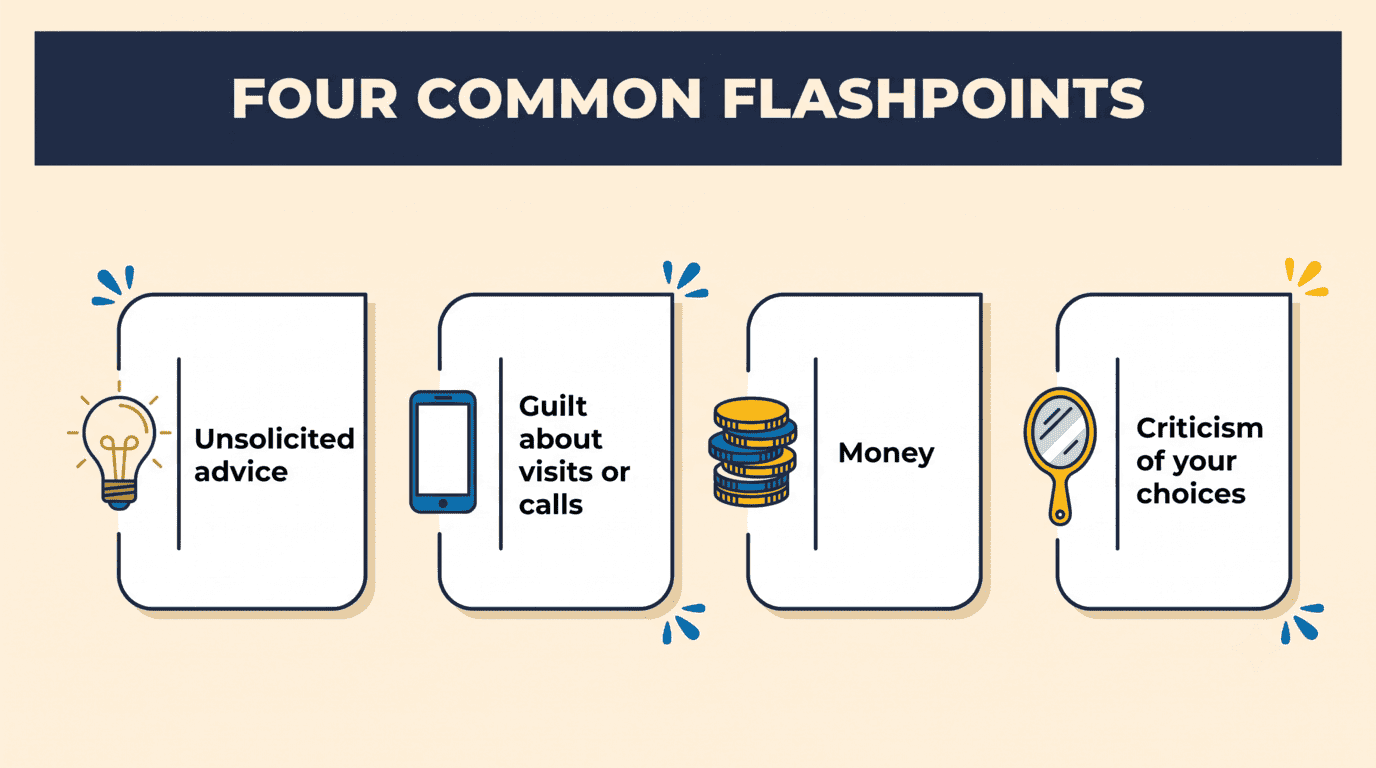
Setting boundaries with parents is harder than setting boundaries with a peer because it requires renegotiating a role, child to parent, that was assigned before either person had any say in its terms. Old family roles resist renegotiation even when both people have changed, and a parent can experience a reasonable boundary as a loss of a role they’ve held for decades, not just a request. Four flashpoints account for most of the friction, unsolicited advice, guilt-tripping about visits or calls, money, and criticism of a person’s parenting or life choices, each of which needs its own specific script rather than one generic boundary sentence. Family estrangement research, including national survey data collected by Cornell sociologist Karl Pillemer, finds parent-child estrangement is common enough that pushback and slow renegotiation, not instant acceptance, is the realistic expectation.
Boundaries with parents are distinctly harder to set than boundaries with a peer because they require renegotiating a role that was assigned decades ago, long before either person had any say in its terms. A boundary with a friend adjusts an agreement. A boundary with a parent has to rewrite one, which is why the same script that works cleanly on a coworker can land completely differently at a family dinner.
Why This Is Different From Other Boundaries
The old-role dynamic is the core reason parent boundaries feel different from every other kind. A parent spent years in a role where guiding, correcting, and deciding for you was not just allowed but required, and a boundary asks them to stop doing something that used to be their actual job. That’s a much bigger ask than it looks like on paper.
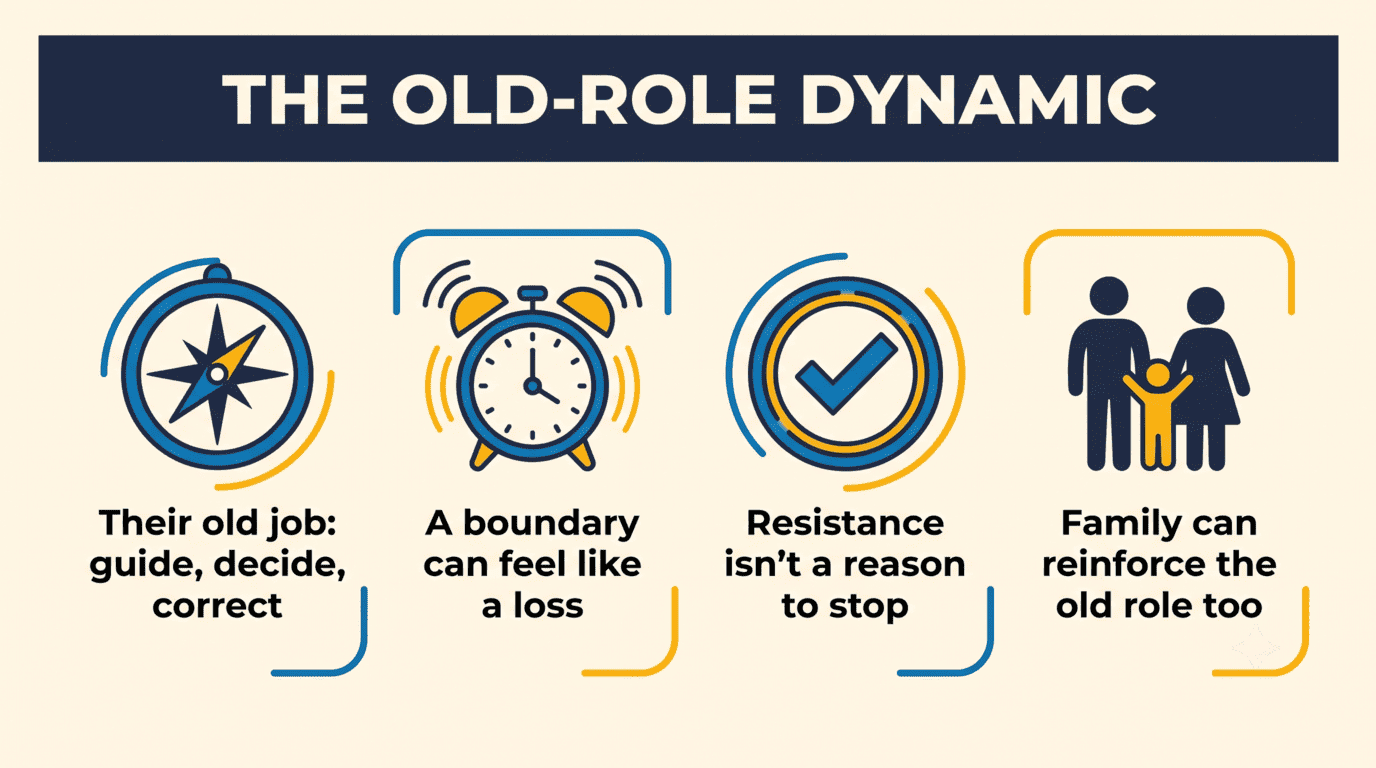
This is also why a completely reasonable boundary can trigger a disproportionate reaction. The parent isn’t only hearing the specific request, they’re often hearing it as evidence that the relationship, and their place in it, has changed in a way they didn’t choose and weren’t consulted on.
None of this makes the boundary wrong. It explains the resistance without requiring the resistance to change the plan. Understanding why a parent pushes back is different from deciding the pushback means the boundary should be dropped.
A parent isn’t the only source of this dynamic either. Siblings, extended family, and even the adult child themselves often reinforce the old role without meaning to, stepping in to smooth things over or apologize on the parent’s behalf, which can quietly undercut a boundary that’s otherwise being held well. Naming this out loud to the wider family, once, tends to reduce how often it happens.
Scripts for the Four Common Flashpoints
Flashpoint One, Unsolicited Advice
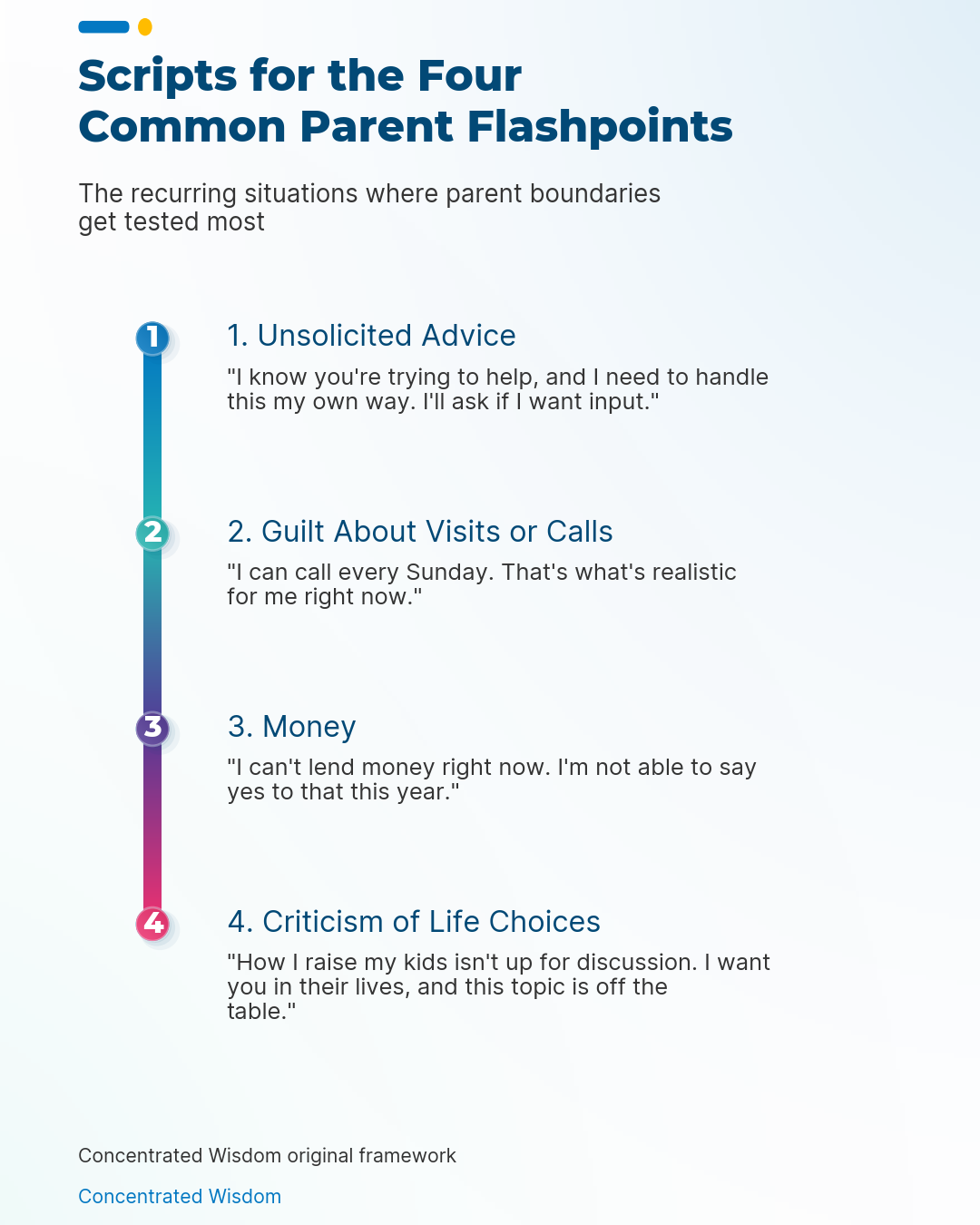
Unsolicited advice usually comes from a genuine place, which is exactly why it’s hard to push back on without feeling ungrateful. The script separates the intention from the impact rather than arguing with either one: “I know you’re trying to help, and I need to handle this my own way. I’ll ask if I want input.”
If the advice continues after that, a shorter follow-up works better than repeating the full explanation: “We talked about this, I’ve got it.” Repeating the reasoning a second or third time usually reopens the debate instead of closing it.
Flashpoint Two, Guilt-Tripping About Visits or Calls
Guilt about frequency of contact often shows up as a comparison or a sigh rather than a direct request. The script states the actual availability instead of defending it: “I can call every Sunday. That’s what’s realistic for me right now.” Naming a specific, sustainable commitment tends to land better than a vague promise to “try to call more.”
For the comment that follows, “you never have time for me” a steady, non-defensive response holds the line without escalating it, “I hear that this is hard. Sunday calls are what I can consistently offer.”
Flashpoint Three, Money
Money boundaries with a parent carry extra weight because of history, whether that history is genuine past support or an unspoken expectation of repayment. The script is specific and time-bound rather than open-ended: “I can’t lend money right now. I’m not able to say yes to that this year.” A specific limit is easier to hold than a vague no, and harder to argue around.
If the request repeats, the answer stays the same rather than getting re-explained from scratch, “Same answer as before, that hasn’t changed.” Consistency here does more work than a longer justification would.
Flashpoint Four, Criticism of Your Parenting or Life Choices
Criticism of parenting style or major life choices often gets framed as concern, which makes it harder to name directly as a boundary issue. The script draws the line around the topic, not around the relationship: “How I raise my kids isn’t up for discussion. I want you in their lives, and this topic is off the table.”
This flashpoint benefits from a clear separation between the specific topic and the overall relationship. Making it clear the boundary protects the relationship rather than threatens it tends to reduce how much a parent hears the boundary as rejection.
A Quick Reference for All Four Scripts
Each flashpoint script follows the same underlying shape, name the specific limit, then state what you will do, not what you want them to do. Keeping that structure consistent across all four situations makes each individual script easier to remember and deliver under pressure.
- Unsolicited advice, name that you’ve got it handled and will ask if input is wanted.
- Guilt about visits or calls, name a specific, sustainable frequency instead of a vague promise.
- Money, name a specific limit tied to a timeframe rather than an open-ended no.
- Criticism of parenting or life choices, name the topic as off-limits while affirming the relationship stays open.
Related: Setting Boundaries With Toxic People
Holding the Boundary Over Time
Expect Pushback, Don’t Read It as Failure
Pushback after a parent boundary is common enough that it should be planned for rather than treated as a sign the boundary was a mistake. A parent testing a new boundary once or twice isn’t unusual, it’s often just the old role checking whether the new terms are actually going to hold or whether the previous pattern will resume if they wait long enough.
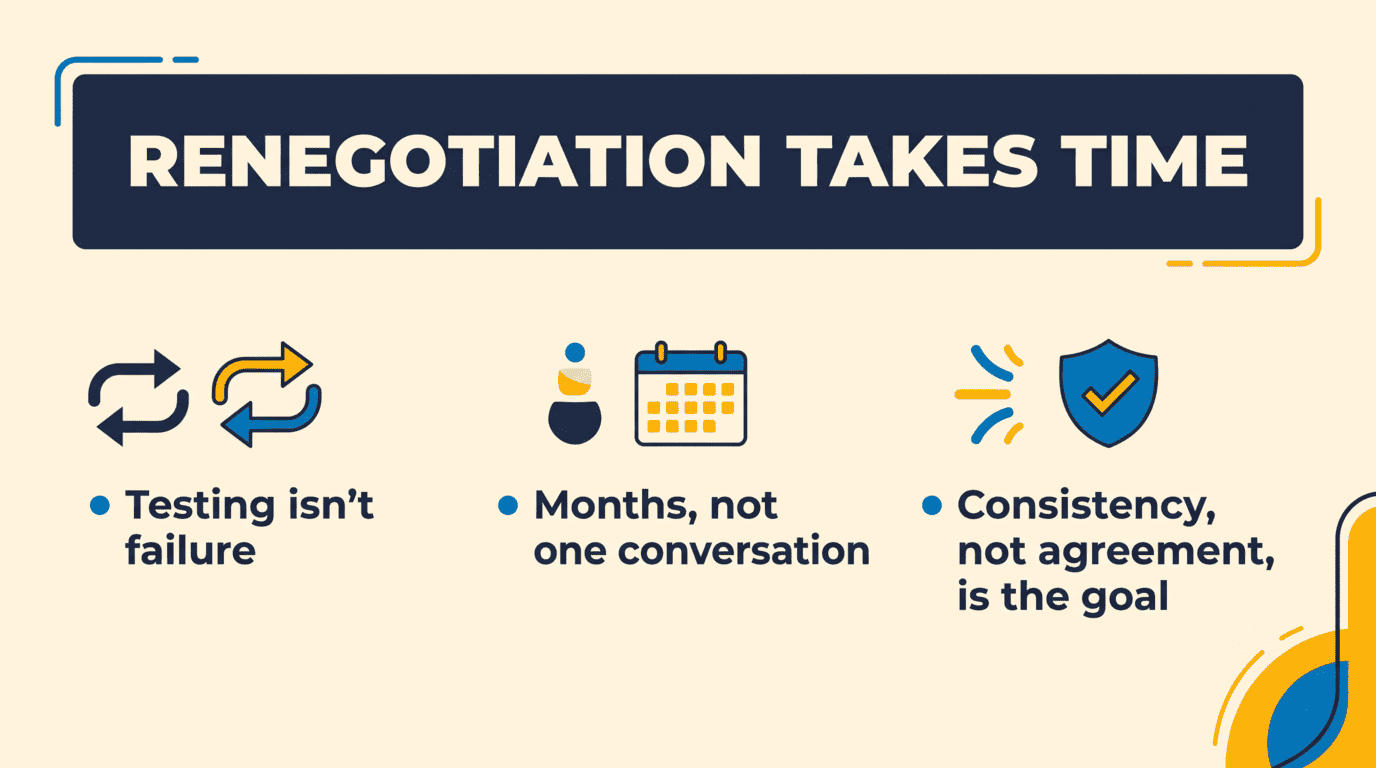
Communication coaches who work on boundary-setting often describe a recognizable pattern with adult children and aging parents. Someone renegotiating an always-available role, being the one who drops everything for every call, every errand, every crisis, sets a clear limit and the parent initially responds as though the adult child has become unreliable rather than simply more specific. The relationship doesn’t rupture over this, it recalibrates, usually across several months rather than a single conversation, as the parent learns which requests still get a yes and which ones now get a clear no.
Renegotiation Is a Process, Not One Conversation
Family estrangement research supports treating this as a gradual process rather than a single resolved event. A national survey led by Cornell sociologist Karl Pillemer found parent-child estrangement common enough that slow, repeated renegotiation, not instant acceptance, is the realistic expectation for most families working through a real change in the relationship.
A boundary that gets tested repeatedly and held consistently tends to eventually stop being tested. The goal isn’t a parent who agrees with every boundary, it’s a parent who has learned, through repetition, that this particular boundary is not going to move.
A single setback doesn’t undo the progress already made. One difficult phone call after months of a boundary holding cleanly isn’t evidence the whole approach failed, it’s usually just a harder day. Returning to the same steady script the next time is what actually reinforces the new pattern, not abandoning it after one rough exchange.
Related: Why Is Setting Boundaries So Hard
Related: Communication & Social Skills
Frequently Asked Questions
Why do boundaries with parents feel harder than boundaries with anyone else?
Because a parent boundary requires renegotiating an old role, not just adjusting an agreement between equals. A parent spent years in a position where guiding and deciding for you was expected, so a boundary can register as a loss of that role, not just a specific request.
What if my parent says I’m being disrespectful for setting a boundary?
A calm, specific boundary is not disrespect, even if it gets labeled that way in the moment. Holding a steady, non-defensive tone while restating the boundary, rather than escalating or backing down, usually does more to shift the dynamic over time than trying to win the disrespect argument itself.
How long does it take for a parent to accept a new boundary?
There’s no fixed timeline, but research on family relationships suggests gradual renegotiation over months is typical rather than instant acceptance after one conversation. Consistency in holding the boundary matters more than how the first conversation goes.
Is it normal to feel guilty setting boundaries with an aging parent?
Yes, guilt is one of the most common reactions, especially when the boundary involves caregiving or availability. Feeling guilty doesn’t mean the boundary is wrong, it often just means the old role is still influencing how the change feels in the moment.