
Concentrated Wisdom Editorial Team researches, writes, and fact-checks this guide against primary sources before publication.
This article is for informational purposes only and isn’t a substitute for personalized professional advice.
Not being able to stop thinking about someone is not one experience, it is three distinct mechanisms that feel identical from the inside: attachment activation, an unresolved narrative the mind keeps trying to finish, and reward circuitry responding to novelty or uncertain reinforcement. This guide separates the three using real attachment and neuroscience research, offers a short self-diagnostic for identifying which one is actually running, and gives a mechanism-specific intervention for each, since suppressing the thought works differently depending on which loop is producing it.
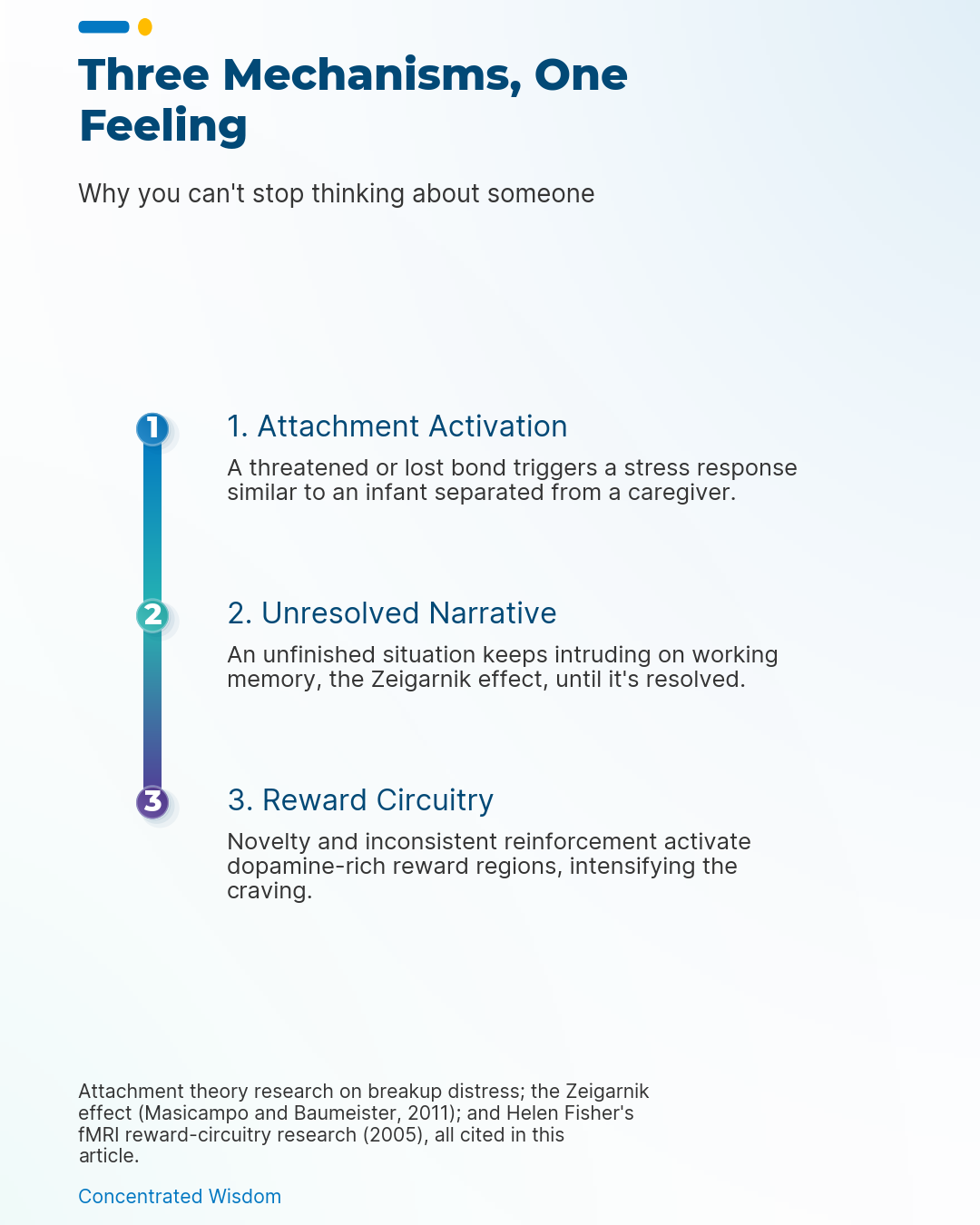
Constantly thinking about someone usually comes from one of three distinct psychological mechanisms, not a single generic cause. The first is attachment activation, where losing or destabilizing a bond with an attachment figure triggers a stress response similar to an infant separated from a caregiver, a pattern grounded in attachment theory and documented in research on breakup distress. The second is an unresolved narrative, related to the Zeigarnik effect first documented by Bluma Zeigarnik in 1927, where an unfinished emotional situation keeps intruding on working memory until it is resolved. A 2011 study by E.J. Masicampo and Roy Baumeister in the Journal of Personality and Social Psychology found that simply making a concrete plan, not completing the task itself, was enough to quiet the intrusive thoughts. The third is novelty and reward circuitry, grounded in Helen Fisher’s 2005 fMRI research showing early romantic attraction activates the same dopamine-rich caudate nucleus and ventral tegmental area involved in addiction, intensified further when reinforcement from the other person is inconsistent. Identifying which mechanism is actually running determines which intervention will work, since suppressing the thought outright tends to backfire regardless of which of the three is behind it.
The short answer: constantly thinking about someone comes from one of three distinct mechanisms, attachment activation, an unresolved narrative, or novelty and reward circuitry, and they feel identical from the inside even though they respond to different fixes.
What’s Actually Driving the Loop
Attachment Activation
Attachment activation happens when a bond with an attachment figure is threatened or lost, and the mind responds with a stress pattern similar to an infant separated from a caregiver, a core prediction of attachment theory. Research on breakup distress has found that relationship dissolution can produce persistent recurrent thoughts about the lost person, psychological disorientation, and separation distress, not because the person is being missed casually, but because the attachment system itself has been destabilized and is signaling to reconnect.
Unresolved Narrative
The second mechanism is an unresolved narrative, grounded in the Zeigarnik effect, first documented by psychologist Bluma Zeigarnik in 1927, which found that unfinished tasks and situations stay active in memory and keep intruding on attention until they’re resolved. A 2011 study by E.J. Masicampo and Roy Baumeister in the Journal of Personality and Social Psychology extended this directly to intrusive thoughts, finding that unfinished goals compete for working memory until addressed.
Novelty and Reward Circuitry
The third mechanism is novelty and reward circuitry. Helen Fisher’s 2005 fMRI research found that viewing images of a romantic interest activates the ventral tegmental area and caudate nucleus, dopamine-rich regions tied to reward, motivation, and the pursuit of a goal, at an intensity comparable to substance reward pathways. A related line of research led by Donatella Marazziti in 1999 found that people newly in love had serotonin transporter levels roughly 40 percent lower than controls, statistically indistinguishable from patients with obsessive-compulsive disorder, a finding that helps explain why early-stage romantic thoughts can feel genuinely involuntary and looping rather than a matter of willpower.
Where Limerence Fits In
The felt experience of all three mechanisms running together already has a name: limerence, a term coined by psychologist Dorothy Tennov in her 1979 book Love and Limerence to describe an involuntary, intrusive state of romantic infatuation, marked by near-constant thinking about another person, a craving for reciprocation, and real difficulty focusing on anything else. Limerence isn’t a separate, fourth mechanism, it’s what it feels like when attachment activation, an unresolved narrative, and reward circuitry are all running at once, most intensely during the early, uncertain stage of a new attraction, which is exactly why it can feel so much stronger and more involuntary than an established relationship’s version of the same loop.

Attachment, Unfinished Business, or Something Else
A Short Self-Diagnostic
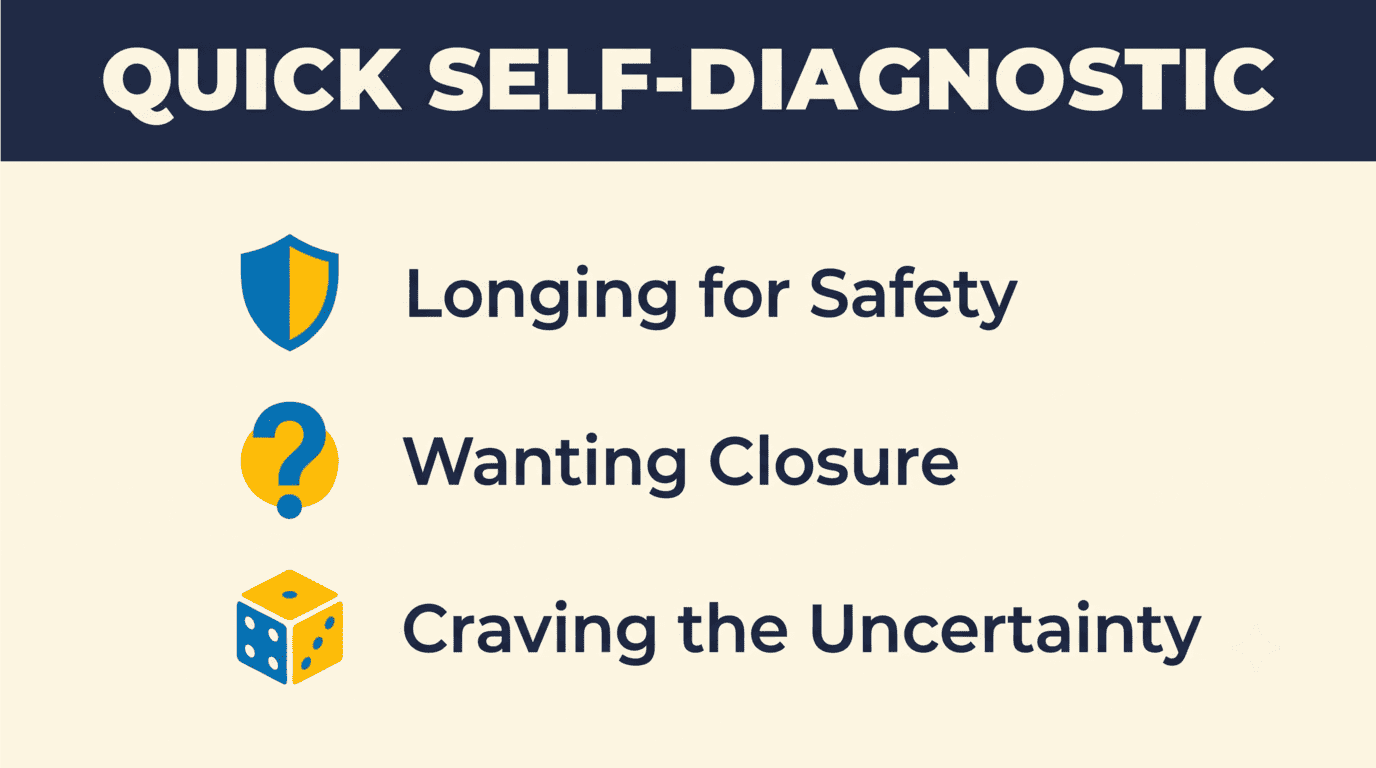
The three mechanisms tend to show a different emotional flavor underneath the same surface symptom of not being able to stop thinking about someone. The table below separates them by what the thinking actually feels like when examined closely.
| Signal | Attachment Activation | Unresolved Narrative | Reward Circuitry |
|---|---|---|---|
| What the thought feels like | A pull toward safety or reconnection | A need for the story to make sense or end cleanly | A craving, similar to wanting a specific stimulus |
| When it’s strongest | During or right after a loss or conflict | After an ambiguous or abrupt ending | During inconsistent contact or a new, uncertain connection |
| What it responds to | Comfort, reassurance, a real or substitute secure connection | A concrete plan or explicit closure, not full resolution | Removing unpredictable reinforcement, not more contact |
| Common trigger | An anniversary, a shared space, a reminder of the bond itself | An unanswered question, an unsent message, an unclear ending | A partner who is warm, then distant, then warm again |
Studying approach-avoidance dynamics and intermittent-reinforcement patterns in romantic relationships tends to surface one consistent pattern: the reward-circuitry mechanism is the one most often mistaken for the other two, because it produces the same felt urgency as attachment activation while actually responding to unpredictability rather than to loss. A relationship that alternates between warmth and withdrawal keeps the reward system engaged specifically because the next response is uncertain, not despite it.
Related: When Someone Blocks You Psychology
Interrupting It Without Suppressing It
What Actually Works for Each Mechanism
Trying to just stop thinking about someone tends to backfire regardless of the mechanism, since actively suppressing a thought reliably makes it more frequent, not less. The more effective move is matching the intervention to the mechanism.
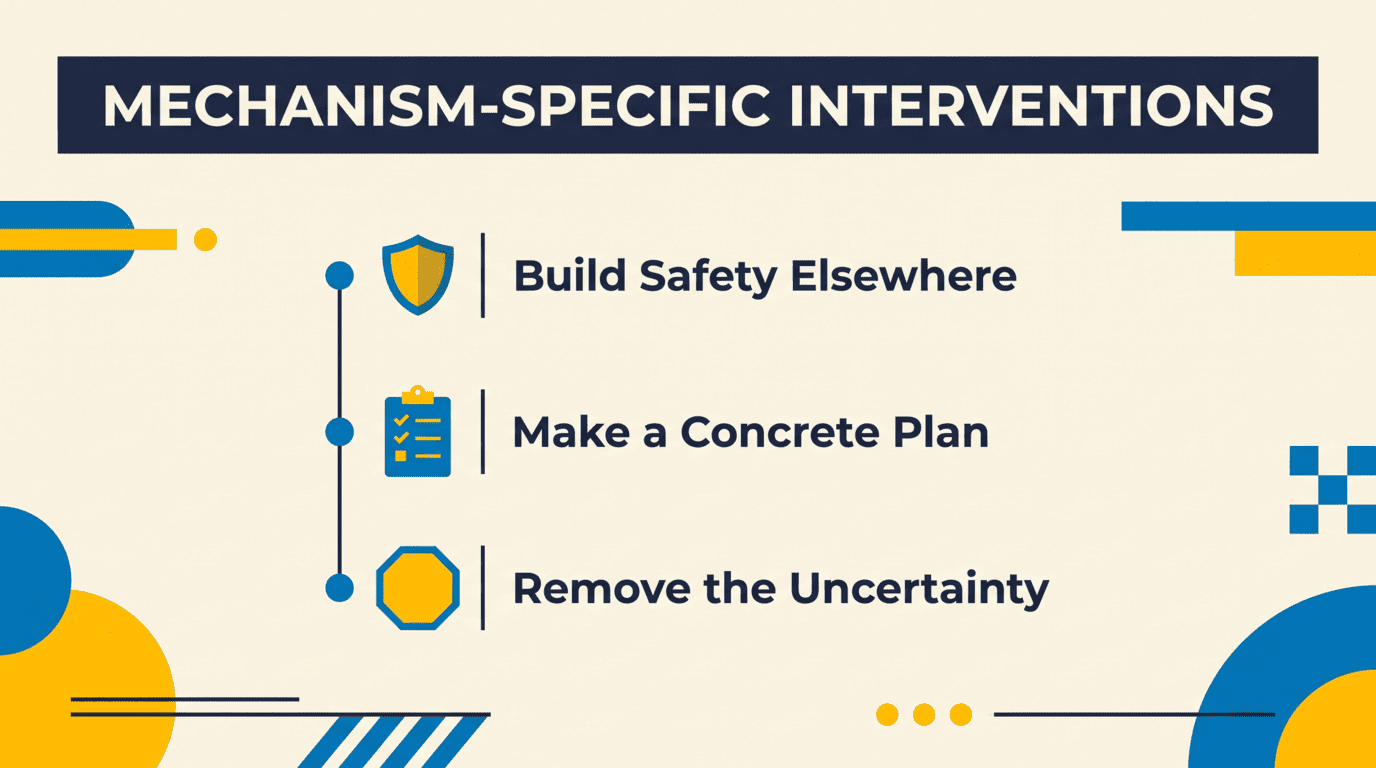
- For attachment activation, build a real source of safety and connection elsewhere, a friend, a routine, a support system, since the system is signaling for reconnection and responds to genuine reassurance more than to distraction
- For an unresolved narrative, write down a concrete plan for how you will handle the situation going forward, since Masicampo and Baumeister’s 2011 research found that making a plan, not full closure, was enough to reduce the intrusive loop
- For reward circuitry, remove the unpredictable reinforcement itself, inconsistent contact, mixed signals, checking their activity, since the craving responds to uncertainty and tends to intensify with more exposure to it, not less
- For all three, name which mechanism is actually running before choosing a response, since the same action, like reaching out, helps one mechanism and actively worsens another
Related: Psychology & Human Behavior
Frequently Asked Questions
Why can’t I stop thinking about someone I’m no longer with?
This is most often attachment activation, a stress response triggered when a bond with an attachment figure is lost or destabilized. Research on breakup distress has found this can produce persistent recurrent thoughts about the person, since the attachment system is signaling to reconnect, not simply reflecting sentiment.
Is constantly thinking about someone a sign of love or something else?
Not necessarily. Helen Fisher’s 2005 fMRI research found that early romantic attraction activates dopamine-rich reward circuitry regardless of whether the connection is healthy, and that activation intensifies with uncertainty or inconsistent contact, which is a reward response, not a reliable measure of love.
Why does an unfinished or unclear ending make someone harder to stop thinking about?
This connects to the Zeigarnik effect, first documented in 1927, which found that unfinished situations stay active in memory until resolved. A 2011 study by E.J. Masicampo and Roy Baumeister found that simply making a concrete plan, not completing the situation, was enough to quiet the intrusive thoughts.
Does trying to suppress thoughts about someone actually work?
Generally no. Actively suppressing a specific thought tends to make it recur more often, not less, regardless of which mechanism is producing it. Matching the response to the actual mechanism, safety-building for attachment activation, a concrete plan for an unresolved narrative, or removing unpredictable reinforcement for reward circuitry, tends to work better than suppression alone.