Concentrated Wisdom Editorial Team researches, writes, and fact-checks this guide against primary sources before publication.
This article is for informational purposes only and isn’t a substitute for personalized professional advice.
Most self-awareness activities for adults fail because introspection, the most commonly recommended approach, can actively increase rumination rather than clarity. This article works from the Internal-External Awareness Stack and introduces the C.L.E.A.R. Protocol, a five-step real-time framework for closing the gap between knowing yourself and acting from that knowledge. Drawing on research by Dr. Tasha Eurich, it organizes seven activities by depth so genuine, compounding self-awareness builds instead of surface-level self-reflection.
Self-awareness activities for adults are structured exercises that help people understand their thoughts, emotions, values, behaviors, and how others perceive them. Research by psychologist Dr. Tasha Eurich found that while 95% of people believe they are self-aware, only 10 to 15% actually meet the measurable criteria. The most effective activities address two distinct forms, internal self-awareness (understanding your own psychology) and external self-awareness (understanding how others see you). The seven highest-impact activities are a structured daily check-in using what questions, the Wheel of Life assessment, a values clarification exercise, Johari Window mapping, structured 360 degree feedback, mindfulness practiced as metacognition, and the C.L.E.A.R. Protocol (Catch, Label, Examine, Align, Respond). Activities that rely exclusively on introspective why questioning often backfire by generating rumination rather than insight. The most effective approach combines solitary reflection with external input from trusted sources, built progressively over time.
Picture someone sitting in a journaling retreat, writing about themselves for the 87th consecutive day. By all logic, they should be the most self-aware person in the room. They are not. They are more confused about who they are than when they started.
This is the introspection paradox, and it’s more common than you’d expect. Research by organizational psychologist Dr. Tasha Eurich found that while 95% of people believe they are self-aware, only 10 to 15% actually meet the measurable criteria. The gap isn’t from laziness. Most people are genuinely trying. The problem is that the most popular self-awareness activities for adults are built on a flawed premise, that thinking more about yourself makes you understand yourself better. It often doesn’t. Sometimes it makes things worse.
The Two Types of Self-Awareness (Most People Only Chase One)
Before diving into specific activities, the framework matters. Self-awareness is not a single skill. According to Eurich’s research, it has two distinct but complementary forms.
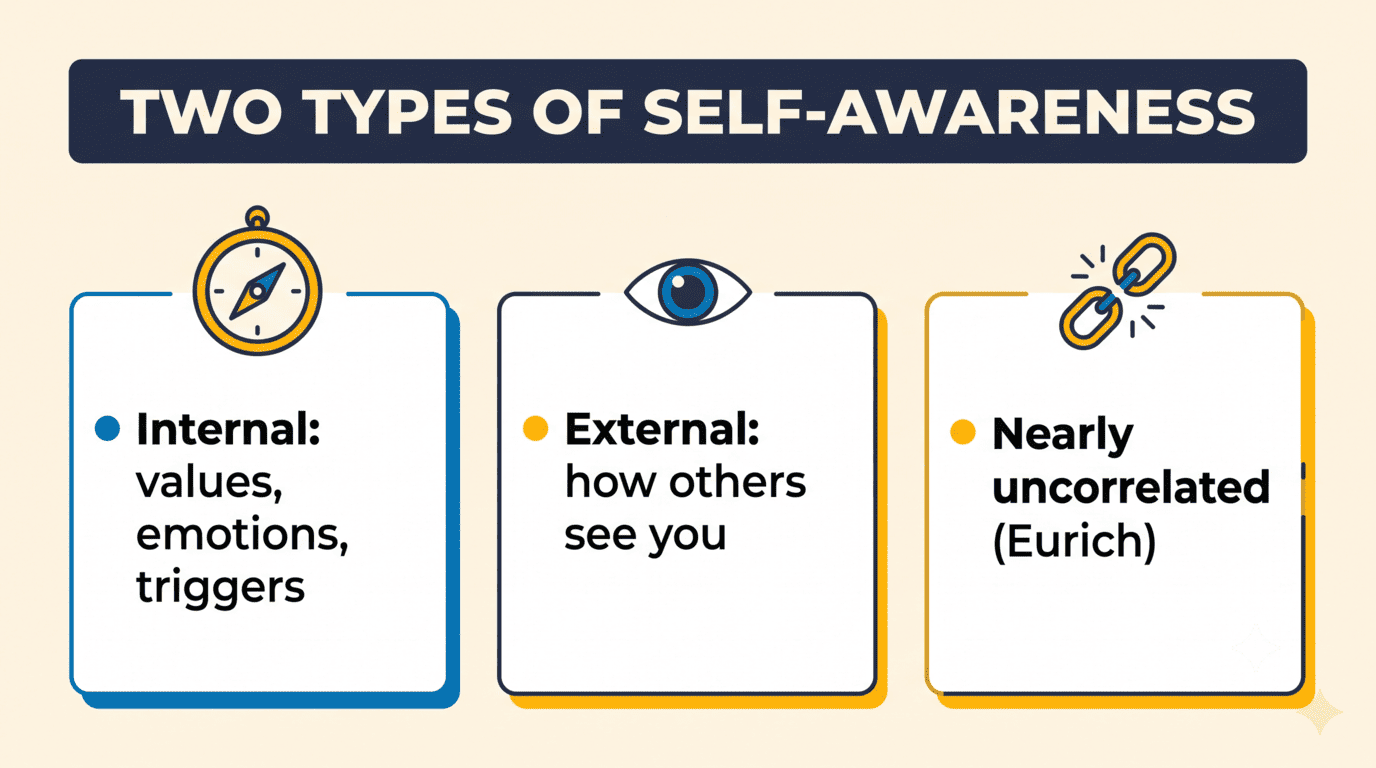
Internal self-awareness is your ability to understand your own values, thoughts, emotions, behavioral patterns, and the triggers behind them. This is the inward gaze, knowing why you react the way you do, what drains you versus what energizes you.
External self-awareness is your ability to understand how others perceive you, your communication style, your blind spots, your impact on the people around you.
Here’s the counterintuitive finding from Eurich’s data, there’s almost no correlation between the two. You can be highly self-aware internally while carrying enormous blind spots about how you come across. People who score highest on internal self-awareness often score lowest on external awareness, they’re so focused on their inner world that they forget they live in an outer one.
The activities that actually work address both.
It’s a fair question whether any of this is actually measurable, or just a feeling. It is measurable. Researchers Anthony Grant, Jane Franklin, and Peter Langford developed the Self-Reflection and Insight Scale (SRIS), a validated 20-item questionnaire that scores self-reflection and insight as two separate factors, which is what makes it possible to say an activity genuinely built insight rather than just generated more thinking. Insight, in this research, is a different quality than reflection itself, more reflection doesn’t automatically produce more insight, which is a version of the same trap Eurich’s research points to.
Where Self-Awareness Fits Inside Emotional Intelligence
None of this happens in a vacuum. Self-awareness activities aren’t just personal-development exercises floating on their own, they sit inside a much larger, well-established psychological framework.

Psychologist Daniel Goleman‘s 1995 book Emotional Intelligence names self-awareness as one of the core components of emotional intelligence, the broader skill set of recognizing, understanding, and managing emotions in yourself and others. This is a different, and much more established, contribution than the specific ‘what, not why’ technique covered earlier in this article, that mechanic traces to Eurich’s later research, not Goleman’s. Goleman’s real contribution is structural, he’s a major reason self-awareness is treated as a measurable, trainable professional competency today, not just a therapy-room concept.
That structural placement matters practically. If self-awareness sits at the base of emotional intelligence, weak self-awareness doesn’t just limit self-knowledge, it caps how far the rest of your emotional intelligence can develop. Every activity in this article is, in that sense, foundational work.
Why “Why” Is the Wrong Question
Eurich’s research points to a specific reason most journaling guides quietly ignore, people simply don’t have direct access to most of their unconscious thoughts and motives. When you ask yourself why you feel or behave a certain way, you don’t retrieve a truthful answer. You construct a plausible one, and then believe it.

This is why excessive introspection produces rumination, not revelation. The mind manufactures meaning in the absence of real data.
The fix is surprisingly simple, replace ‘why’ with ‘what.’ Instead of “Why am I always anxious before presentations,” ask “What specifically happens the moment my anxiety spikes? What physical sensations arise first? What is the last thought I have before it escalates?”
‘What’ questions are grounded, observable, and actionable. ‘Why’ questions are often invitations for self-mythology.
This insight is the foundation of the C.L.E.A.R. Protocol, a proprietary real-time self-awareness framework for adults.
- C, Catch the moment a strong emotion or reaction arises
- L, Label it with precise language, not just “bad” but “humiliated,” “overlooked,” or “overstimulated”
- E, Examine what specifically triggered it, without judgment
- A, Align the response with your stated values
- R, Respond deliberately rather than reacting automatically
The C.L.E.A.R. Protocol doesn’t require a journal or a retreat. It’s a micro-practice woven into ordinary moments, a meeting, a conversation, a decision point. It’s what separates knowledge of self from command of self.
Related: Emotional Maturity vs Intelligence
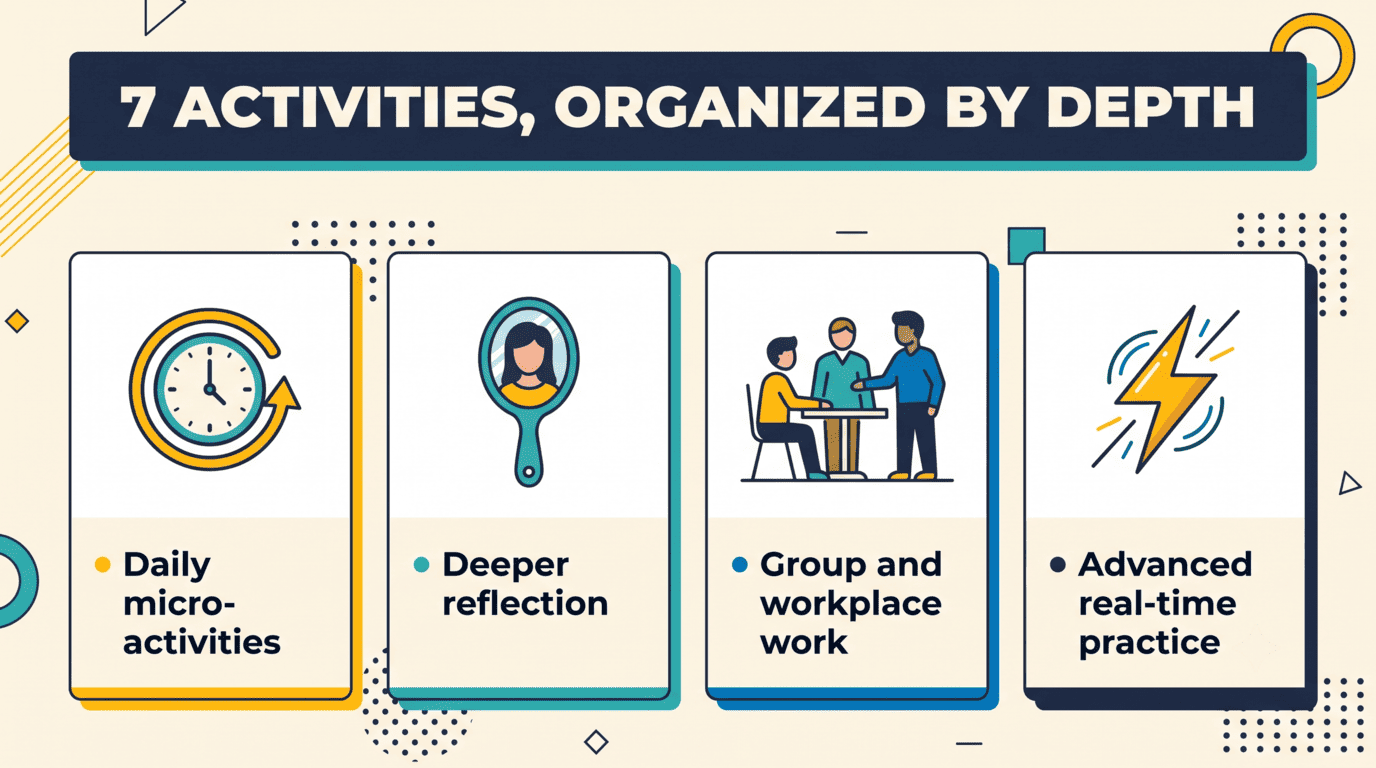
7 Self-Awareness Activities for Adults, Organized by Depth
These activities are sequenced intentionally, from accessible entry points to deeper practice. Start where you are. But don’t stop at the first activity and call it a practice.
Daily Micro-Activities (5 Minutes or Less)
Activity 1, The “What Am I?” Daily Check-In
Internal, beginner. Each morning or evening, answer three questions in writing, using ‘what,’ never ‘why.’
- What am I feeling right now, and what specifically caused it?
- What did I do today that aligns with my values?
- What do I want to do differently tomorrow?
Keep responses under five minutes. Brevity forces clarity. The goal isn’t therapy, it’s calibration. Short, focused check-ins create a data trail over time, revealing emotional patterns that would otherwise disappear into the background noise of daily life.
Deeper Reflection Exercises
Activity 2, The Wheel of Life Assessment
Internal, beginner to intermediate. Draw a circle. Divide it into eight segments representing the key dimensions of your life, career, finances, health, relationships, personal growth, fun and recreation, physical environment, and contribution or purpose.
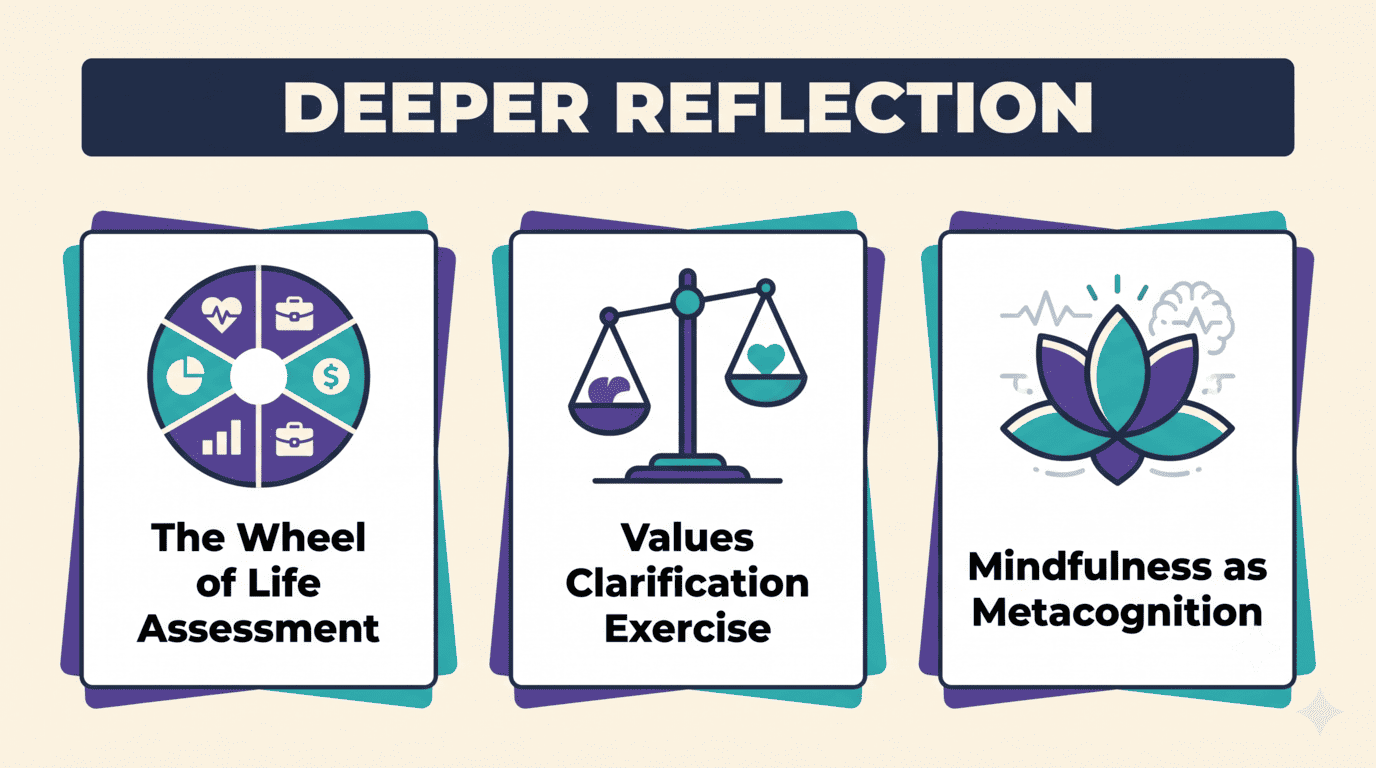
Rate your current satisfaction in each area from 1 (deeply dissatisfied) to 10 (fully satisfied). Shade each segment to the level of your rating.
The result is your life at a glance. A wheel with dramatic unevenness, a 9 in career and a 3 in relationships, tells a story that no journal entry could summarize as quickly. Visual asymmetry is impossible to rationalize. You can talk yourself out of feelings, but not out of a circle that shows clearly where you’ve been neglecting yourself.
Related: Life Areas for Goal Setting
Activity 3, The Values Clarification Exercise
Internal, intermediate. Most people think they know their values. Very few have actually tested them under pressure.
Write down 20 values that resonate with you. Then apply what decision theorists call the brutal priority test, if you could only keep 5, which would you keep? Now, looking at your last 30 days, do your actual behaviors reflect those 5 values, or the ones that merely sound good?
The gap between espoused values and enacted values is one of the most diagnostic signals of self-awareness. A wide gap reveals cognitive dissonance. A narrow gap reveals integrity. Seeing the gap between your stated values and your actual time allocation creates productive discomfort, which is often the true entry point for change.
Activity 6, Mindfulness as Metacognition, Not Relaxation
Internal, intermediate to advanced. Mindfulness has become synonymous with stress relief. That category error limits its power for self-awareness.
The real application is metacognition, the ability to observe your own thinking. When practiced properly, mindfulness doesn’t just calm the nervous system. It creates cognitive distance sufficient to watch your thoughts rather than be consumed by them.
This distinction traces back to how the practice entered clinical use in the first place. Jon Kabat-Zinn built Mindfulness-Based Stress Reduction (MBSR) around paying attention to the present moment on purpose and without judgment, a framing built for observation, not relaxation. Relaxation, when it shows up, is a byproduct of that observation, not the point of it, which is the opposite order most people assume the practice runs in.
Try this. Set a timer for 10 minutes. Sit without distraction. Each time a thought arises, don’t suppress it, label it. “That’s a planning thought.” “That’s a fear thought.” “That’s a self-critical thought.” This labeling creates a taxonomy of your inner life that reveals dominant mental patterns far more clearly than analysis alone.
Neurologically, this practice activates the prefrontal cortex, the brain’s executive center, while reducing amygdala reactivity, the seat of defensive, automatic responses. You can’t change what you can’t observe. Metacognitive mindfulness gives you the observer position.
Group and Workplace Activities
Activity 4, Johari Window Mapping
Internal and external, intermediate. The Johari Window, developed by psychologists Joseph Luft and Harry Ingham, divides self-knowledge into four quadrants.
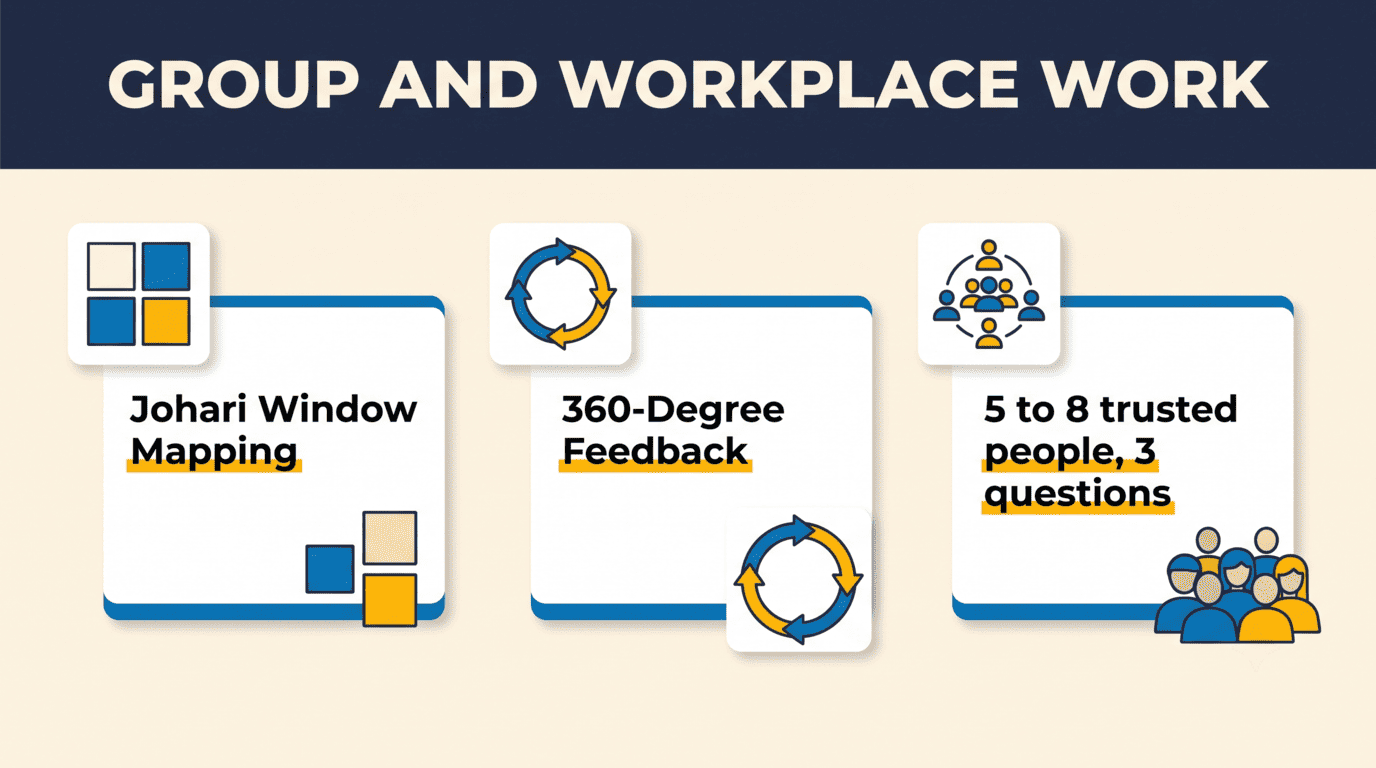
- Open area, what you and others both know about you
- Blind spot, what others see about you, but you don’t
- Facade, what you know about yourself, but others don’t
- Unknown, what neither you nor others are yet aware of
The goal of self-awareness work is to expand the open area by receiving feedback (shrinking the blind spot) and choosing strategic vulnerability (shrinking the facade).
The activity: identify 10 adjectives you’d use to describe yourself. Ask 5 trusted people in your life to do the same. Map the overlaps and divergences. The adjectives in the blind spot quadrant, descriptors others chose that you didn’t, represent your highest-leverage self-awareness data.
Activity 5, Structured 360-Degree Feedback
External, intermediate to advanced. If the Johari Window is the concept, structured 360-degree feedback is the practice in motion.
Select 5 to 8 people across different contexts of your life, a colleague, a close friend, a family member, a mentor. Ask each person three questions.
- What is something I do that you find genuinely valuable or admirable?
- What is one behavior of mine that sometimes creates friction or confusion?
- What would you suggest I do differently?
Critical constraint: receive the feedback in writing. Don’t respond, defend, or explain in the moment. Thank them and sit with the responses for 48 hours before processing.
Most adults have never received honest, structured feedback outside a performance review. The external data often reveals patterns so consistent across respondents that they become impossible to dismiss as one person’s opinion.
Advanced Real-Time Self-Awareness Practice
Activity 7, The C.L.E.A.R. Protocol in Real Time
Internal and external, advanced. This is the capstone practice. Take the five-step protocol above and apply it in live situations, not just in retrospect. The moment you feel reactive, triggered, or disengaged, engage the protocol in real time.
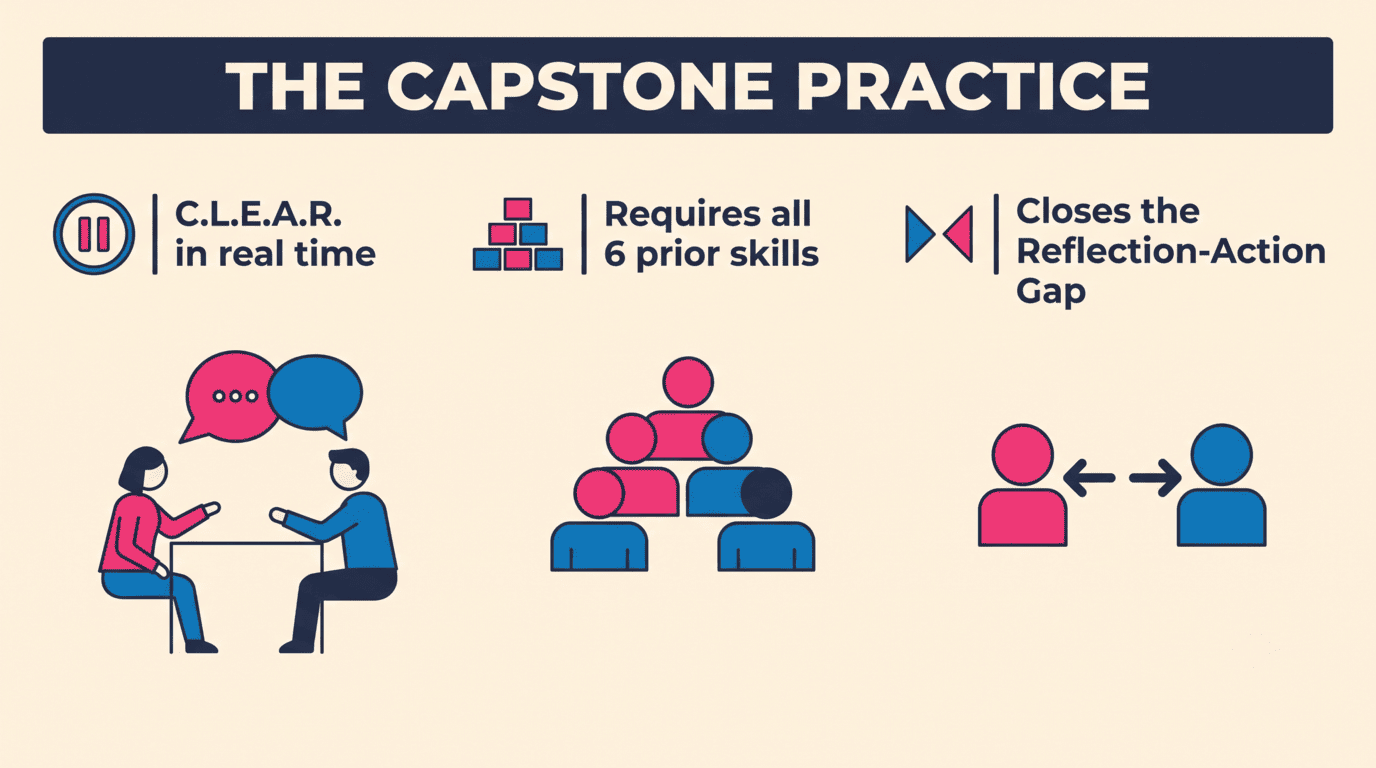
This is the hardest activity on this list, and also the most transformative. It requires the skill base built by the previous six activities, emotional vocabulary from the check-ins, clarity of values from the clarification exercise, knowledge of your blind spots from the Johari and 360 work, and the metacognitive stability from mindfulness to pause mid-reaction.
When practiced consistently, the C.L.E.A.R. Protocol closes the Reflection-Action Gap, the distance between knowing yourself and actually living from that knowledge in the moments that matter most.
Start Here, Not Everywhere
The instinct when discovering self-awareness work is to start with the most intense activity available. That approach is backwards. Self-awareness is a compounding practice, not a one-time event.

Begin with the daily check-in for two weeks. Add the Wheel of Life once a month. Start the values clarification when the check-in begins revealing patterns. Layer in feedback work only when you feel grounded enough to receive it without becoming defensive.
Progress is not measured in the number of activities completed. It’s measured in the shrinking distance between who you think you are and who you actually are, in the moments that matter.
Related: Psychology & Human Behavior
Frequently Asked Questions
What is the best self-awareness activity for adults?
The most effective starting activity is a structured daily check-in using “what” questions rather than “why” questions. This approach, supported by Dr. Tasha Eurich’s research, avoids the rumination trap that undermines most introspection practices. For deeper work, combining the Johari Window with structured 360-degree feedback addresses both internal and external self-awareness, the two forms that research identifies as independent and equally important.
How long does it take to build self-awareness?
Measurable improvements in self-awareness can occur within six to eight weeks of consistent daily practice. Self-awareness is a compounding, lifelong skill though, the first shifts arrive quickly, but the deepest understanding develops over years of layered practice. The key variable is not duration but consistency and honest engagement with external feedback.
What is the difference between self-awareness and self-reflection?
Self-reflection is the activity, the act of deliberately thinking about your experiences, emotions, and behaviors. Self-awareness is the outcome, a stable, accurate understanding of who you are and how you operate in the world. Reflection is the tool, awareness is what you build with it. Reflection without structure can produce rumination, which is the opposite of awareness, more noise, less signal.
Can self-awareness be built at any age?
Yes. While many foundational patterns form in childhood, neuroplasticity research confirms that adults at any age can develop genuine self-awareness skills. The prefrontal cortex, which governs self-monitoring and emotional regulation, remains malleable throughout adulthood. The activities in this article can produce lasting changes regardless of when you start, the constraint is willingness to receive honest input, not age.
How do researchers actually measure self-awareness?
The most established tool is the Self-Reflection and Insight Scale (SRIS), a validated 20-item questionnaire developed by researchers Anthony Grant, Jane Franklin, and Peter Langford that scores self-reflection and insight as two separate factors. That separation matters because more reflection doesn’t automatically produce more insight, a finding consistent with why undirected introspection so often produces rumination instead of clarity.