Concentrated Wisdom Editorial Team researches, writes, and fact-checks this guide against primary sources before publication.
This article is for informational purposes only and isn’t a substitute for personalized professional advice.
This guide collects 52 self-awareness quotes from Carl Jung, the Stoic philosophers, and modern emotional-intelligence researchers, organized into nine practical themes instead of one long undifferentiated list. Each quote comes with real analysis connecting it to an actual self-awareness practice, not just a caption underneath it. Several widely shared lines that are commonly misattributed online, including one usually credited to Viktor Frankl, are corrected here to their real, documented source.
Self-awareness quotes work best when grouped by what they actually teach, not scattered into one long undifferentiated list. This guide organizes 52 verified quotes across nine themes: short and shareable lines, personal growth, emotional intelligence, relationships, leadership, Carl Jung’s writing on the shadow, Stoic philosophy from Marcus Aurelius, Epictetus, and Seneca, additional quotes from writers and psychologists, and reflection questions drawn from Socrates and Rilke. Every quote is checked against its original source rather than copied from an existing quote list, which is why a widely shared line usually attributed to Viktor Frankl, about the space between stimulus and response, is corrected here to its real, documented author, psychologist Rollo May. Research from Harvard Business Review found that while 95 percent of people believe they are self-aware, only 10 to 15 percent actually are, which is the real argument for why a quote roundup needs to do more than repeat a caption under each line.
What Is Self-Awareness?
Self-awareness is the clear-eyed capacity to see your own emotions, values, and patterns as they actually are, not as you assume them to be. Organizational psychologist Tasha Eurich’s research, published in Harvard Business Review, found two distinct kinds: internal self-awareness, how clearly you see your own values and reactions, and external self-awareness, how accurately you understand how other people actually experience you. The two skills are not the same, and having one is no guarantee of the other.
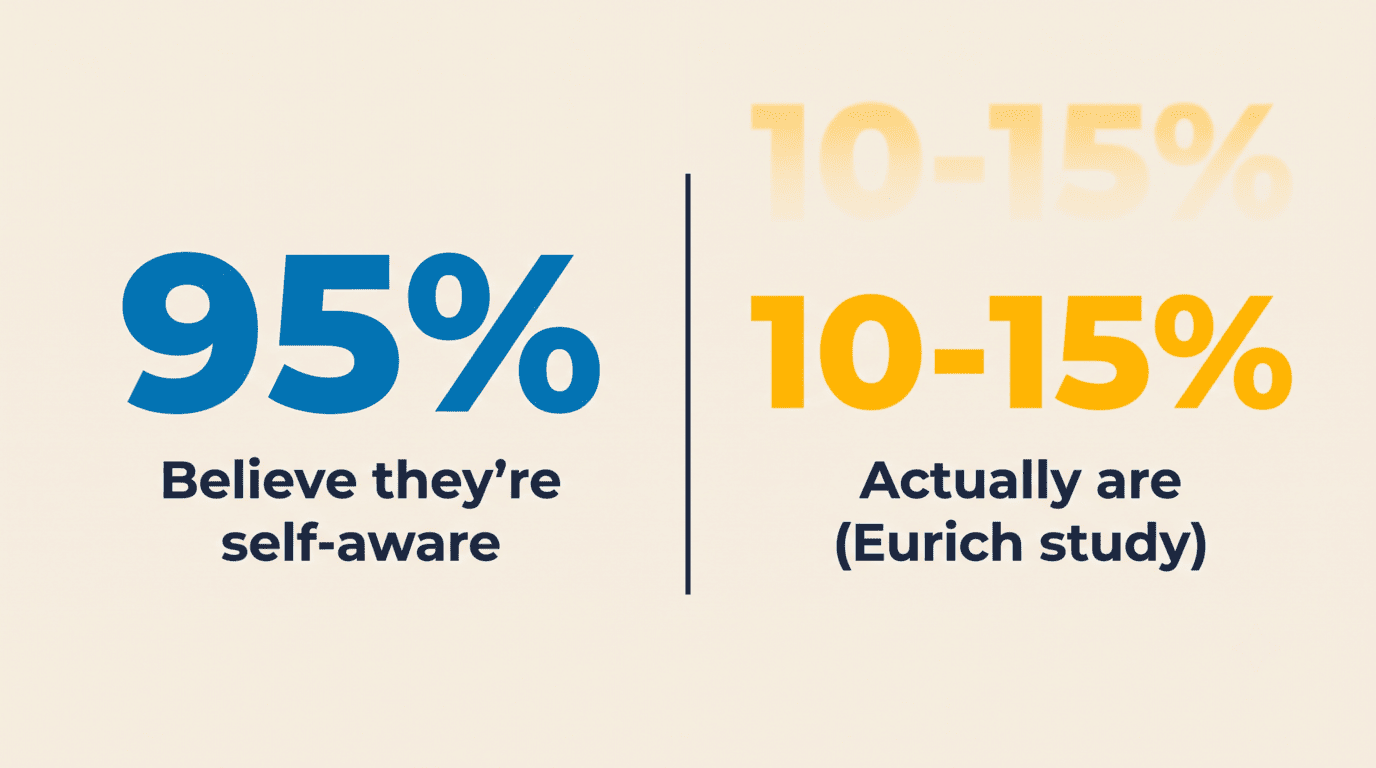
Despite 95 percent of people believing they are self-aware, Eurich’s four-year study of nearly 5,000 people found that only 10 to 15 percent actually meet the criteria. Concentrated Wisdom calls that space the Mirror Gap: the widening distance between how self-aware someone assumes they are and how self-aware they actually are. It’s the real reason a quote roundup that just stacks lines under a heading rarely moves anyone past a private nod of agreement. A quote only closes the Mirror Gap when it’s paired with something to actually do with it.
In reviewing reader questions on Concentrated Wisdom’s other self-reflection guides, the same pattern shows up constantly: someone can quote Jung’s line about the shadow accurately and still have no real idea what their own shadow actually contains. A quote is a flashlight, not a mirror. It points at the idea, but readers still have to turn it on themselves.
The 52 quotes below are grouped by exactly what they’re good for closing: short lines for a quick reset, quotes on personal growth, emotional intelligence, relationships, leadership, Carl Jung’s writing on the shadow, Stoic philosophy, additional quotes from writers and psychologists, and reflection questions drawn from thinkers who spent their careers on this exact gap.
Related: Psychology & Human Behavior
Short & Shareable Self-Awareness Quotes
These seven lines are short enough to remember without trying, which is exactly the point. A quote you can’t recall under pressure doesn’t actually help in the moment you need it.
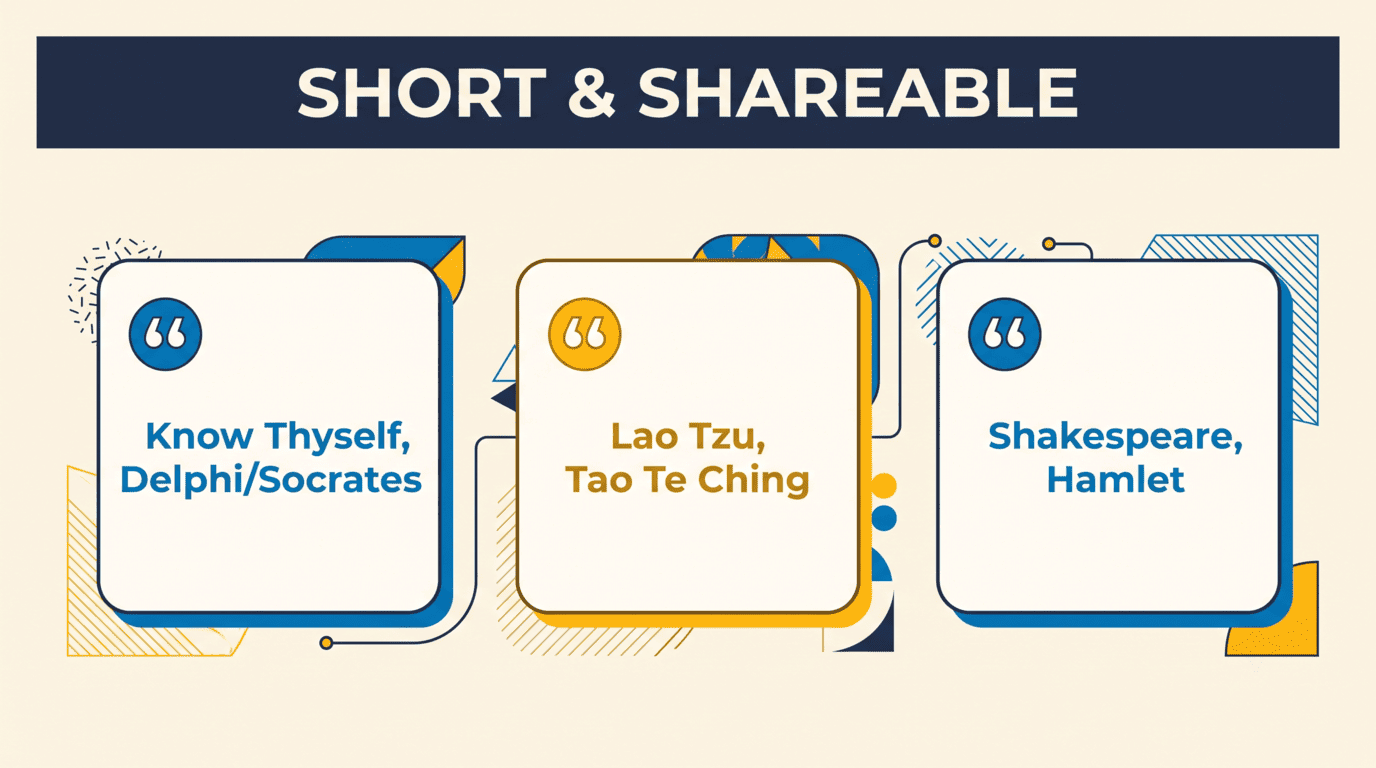
“Know thyself.” Inscribed at the Temple of Apollo at Delphi centuries before Socrates made it his life’s project, per Plato’s dialogues, the maxim survives because it refuses to explain itself. It’s an instruction, not a conclusion.
“Knowing others is wisdom, knowing yourself is enlightenment.” Lao Tzu, Tao Te Ching, chapter 33. Lao Tzu ranks the two skills on purpose: knowing other people is useful, but turning that same clear-eyed attention on yourself is the harder, rarer achievement.
“To know what you know and what you do not know, that is true knowledge.” Confucius, Analects, Book II. Confucius is describing a specific skill: the ability to locate the edge of your own competence, which is most of what modern psychology now calls metacognition.
“The greatest thing in the world is to know how to belong to oneself.” Michel de Montaigne, Essays. Montaigne spent two decades writing essays that were really one long argument for self-possession as the actual goal, not self-improvement for its own sake.
“Insist on yourself; never imitate.” Ralph Waldo Emerson, Self-Reliance (1841). Emerson wrote this when “self-reliance” meant something closer to psychological independence than the productivity-hack version the phrase gets used for today.
“The first step toward change is awareness. The second step is acceptance.” Nathaniel Branden, The Six Pillars of Self-Esteem (1994). Branden, whose work shaped how modern psychology talks about self-esteem, is explicit that awareness alone doesn’t finish the job. Acceptance is the step most people skip.
“This above all: to thine own self be true.” William Shakespeare, Hamlet, Act 1, Scene 3. The line is spoken by Polonius, a character Shakespeare otherwise plays as a fool, which is either an accident or the entire joke: even a foolish man can hand you a true sentence.
The Power of Self-Awareness in Personal Growth
Growth quotes get vague fast. These eight hold up because each one names a specific mechanism, not just a mood.
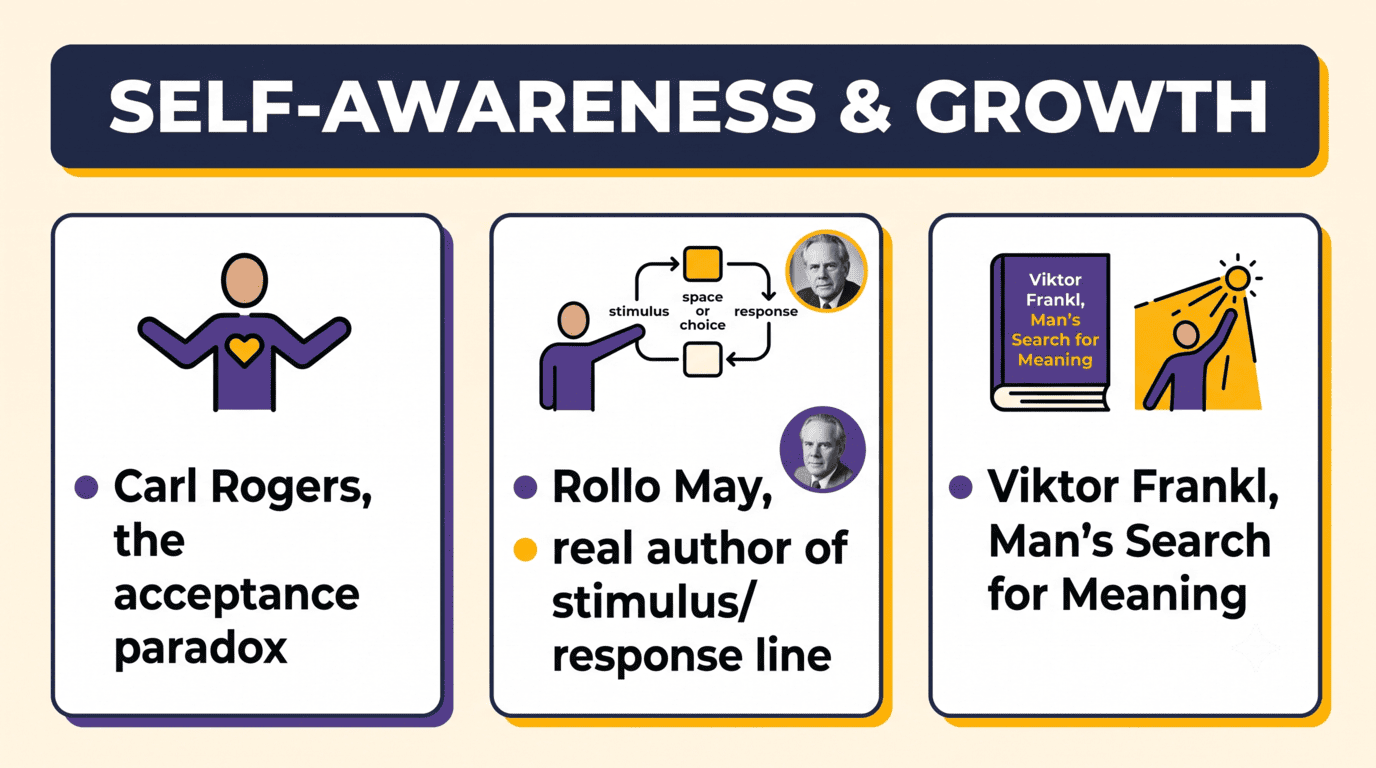
“The curious paradox is that when I accept myself just as I am, then I can change.” Carl Rogers, On Becoming a Person (1961). Rogers, the founder of humanistic psychology, is naming a real paradox: fighting your current self tends to entrench it, while honest acceptance is what actually frees up movement.
“Human freedom involves our capacity to pause between stimulus and response and, in that pause, to choose the one response toward which we wish to throw our weight.” Rollo May, The Courage to Create (1975). A version of this idea is usually credited to Viktor Frankl, but the Viktor Frankl Institute itself has confirmed the popular line isn’t his; it was popularized by Stephen Covey, who found the phrase in an unattributed library book. The real, documented originator is psychologist Rollo May.
“Nothing ever goes away until it teaches us what we need to know.” Pema Chödrön, When Things Fall Apart (1996). Chödrön’s Buddhist teaching reframes a repeated pattern as unfinished information, not just bad luck showing up twice.
“Feelings come and go like clouds in a windy sky. Conscious breathing is my anchor.” Thich Nhat Hanh, Being Peace (1987). The image works because it doesn’t ask you to stop the clouds, only to stop mistaking yourself for the weather.
“When we are no longer able to change a situation, we are challenged to change ourselves.” Viktor Frankl, Man’s Search for Meaning (1946). Unlike the misattributed “space between stimulus and response” line above, this is Frankl’s own, verified sentence, worth using in its place.
“No one saves us but ourselves. No one can and no one may. We ourselves must walk the path.” Dhammapada, verse 165. The line refuses the comfort of rescue, which is part of why it has survived roughly two thousand years of translation.
“Before I can tell my life what I want to do with it, I must listen to my life telling me who I am.” Parker Palmer, Let Your Life Speak (2000). Palmer inverts the usual goal-setting order: instead of deciding who to become and forcing your life to match, you start by noticing who you already, actually are.
“Caring for myself is not self-indulgence, it is self-preservation, and that is an act of political warfare.” Audre Lorde, A Burst of Light (1988). Lorde’s line matters here because self-awareness without self-regard is just surveillance. Knowing yourself has to include deciding you’re worth taking care of.
Related: What Is the Internal Locus of Control
Self-Awareness Quotes and Emotional Intelligence
Self-awareness is the entry point of emotional intelligence, not a side effect of it. The researchers who built the field say so directly.
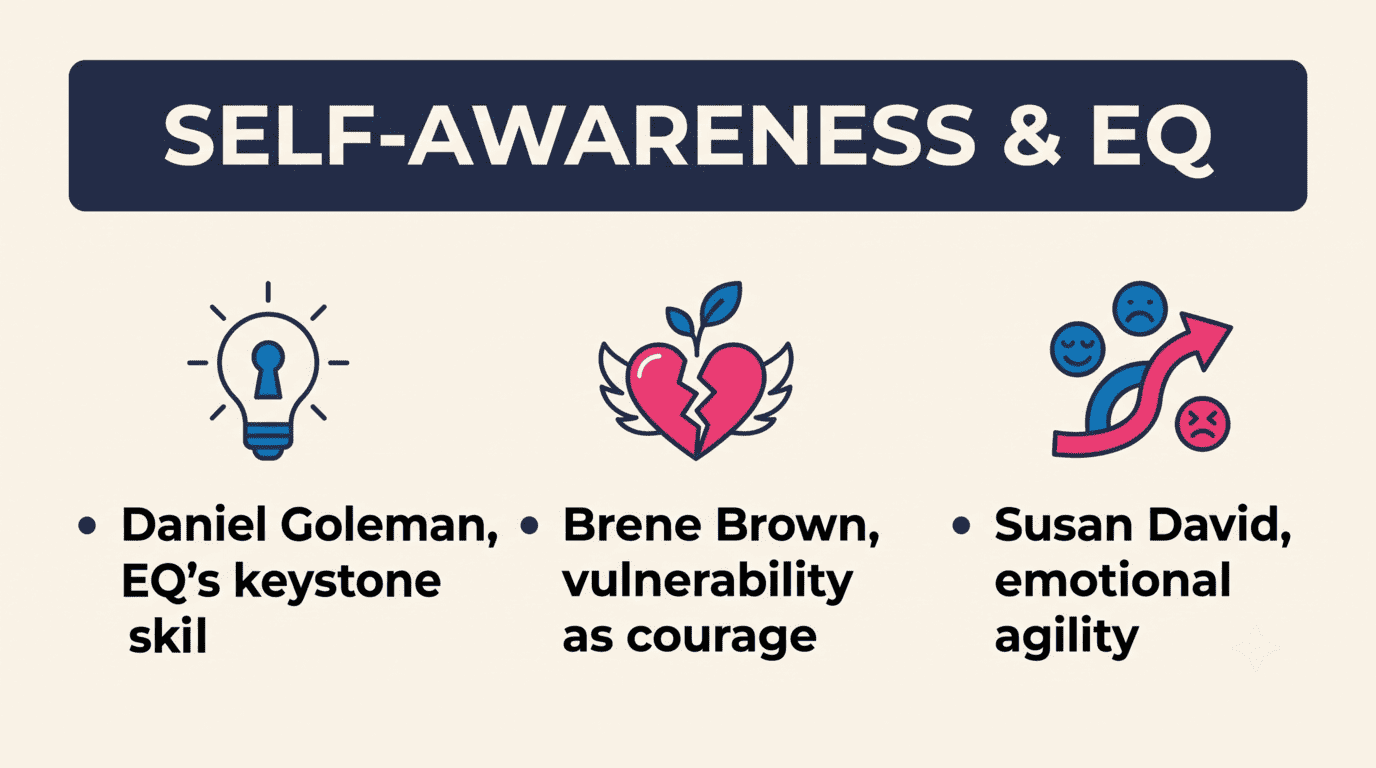
“Self-awareness, recognizing a feeling as it happens, is the keystone of emotional intelligence.” Daniel Goleman, Emotional Intelligence (1995). Goleman puts self-awareness first in his framework on purpose. Every other EQ skill, from self-regulation to empathy, depends on first noticing what you’re actually feeling.
“If your emotional abilities aren’t in hand, if you don’t have self-awareness, if you are not able to manage your distressing emotions, if you can’t have empathy and have effective relationships, then no matter how smart you are, you are not going to get very far.” Daniel Goleman. The line is Goleman’s plain rebuttal to the idea that raw intelligence is the main thing that determines how far someone gets.
“Vulnerability is not winning or losing; it’s having the courage to show up and be seen when we have no control over the outcome.” Brené Brown, Daring Greatly (2012). Brown’s research reframes vulnerability as a form of self-awareness in action: knowing exactly what’s at stake and staying present anyway.
“What is necessary to change a person is to change his awareness of himself.” Abraham Maslow, widely attributed to Toward a Psychology of Being (1962). Maslow’s larger body of work on self-actualization treats this as a working premise, not a footnote: change follows awareness, it doesn’t precede it.
“Discomfort is the price of admission to a meaningful life.” Susan David, The Gift and Power of Emotional Courage (TED Talk, 2017). David’s talk pushes back on a culture that treats positivity as the goal; naming discomfort accurately is itself a self-awareness skill.
“Awareness is the power that is concealed within the present moment.” Eckhart Tolle, The Power of Now (1997). Tolle ties self-awareness directly to attention: the capacity is only ever available in the present moment, never in the memory or the plan.
How Self-Awareness Transforms Relationships
Most relationship advice focuses on the other person. These six quotes are a reminder that the more reliable lever is usually the one you actually control.
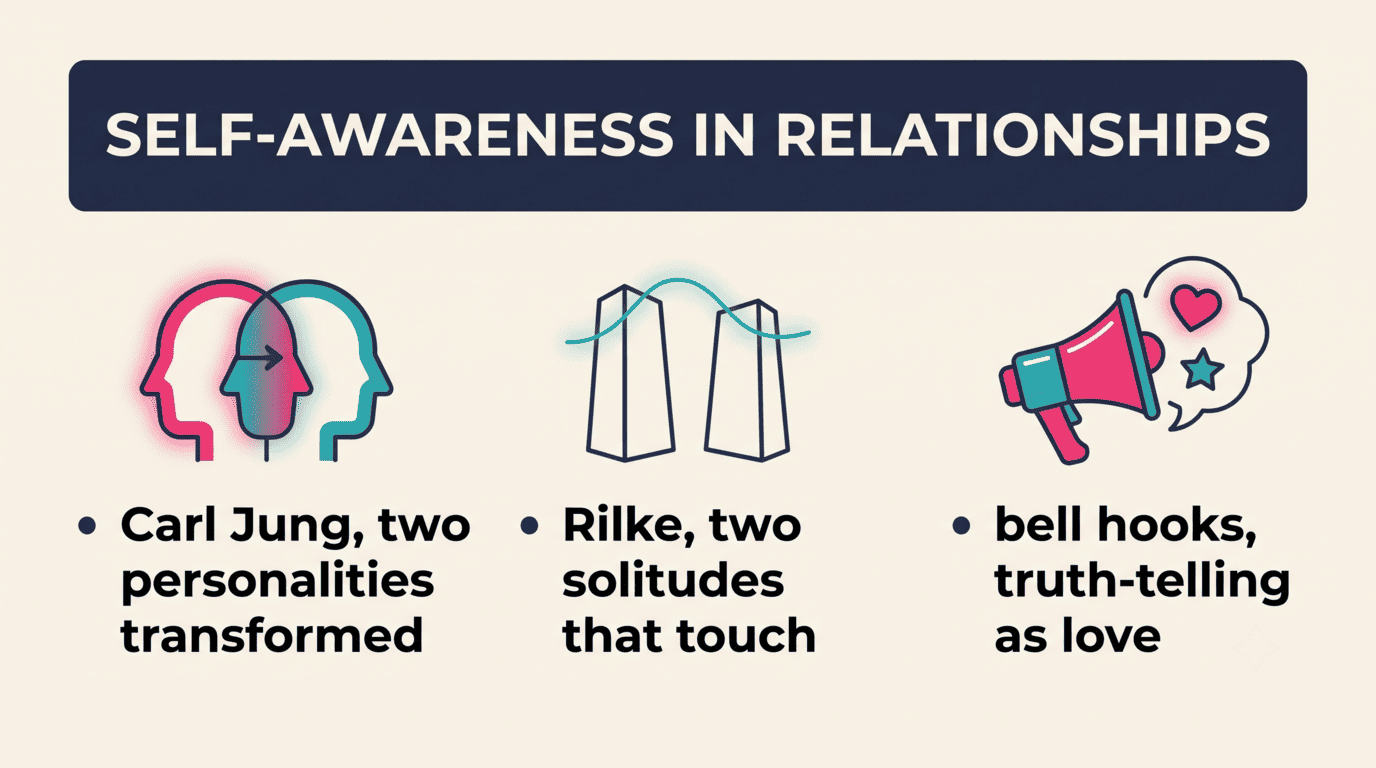
“The meeting of two personalities is like the contact of two chemical substances: if there is any reaction, both are transformed.” Carl Jung, Modern Man in Search of a Soul (1933). Jung’s chemistry metaphor is a warning as much as an observation: you don’t get to enter a real relationship and stay unchanged by it.
“Love consists in this, that two solitudes protect and touch and greet each other.” Rainer Maria Rilke, Letters to a Young Poet (1929). Rilke’s line requires you to actually know your own solitude before you can offer it to someone else without collapsing into them.
“Let there be spaces in your togetherness.” Khalil Gibran, The Prophet (1923). Gibran’s instruction only makes sense once you accept that you have to actually know what you need space for, which is a self-awareness problem before it’s a relationship one.
“The heart of justice is truth telling, seeing ourselves and the world the way it is rather than the way we want it to be.” bell hooks, All About Love: New Visions (2000). hooks connects honest self-perception directly to how fairly someone can treat another person.
“When you love someone, the best thing you can offer is your presence.” Thich Nhat Hanh, True Love: A Practice for Awakening the Heart (1997). Presence is a self-awareness skill before it’s a relationship one: you can’t offer attention you’re not actually paying.
“Connection is why we’re here. It is what gives purpose and meaning to our lives.” Brené Brown, Daring Greatly (2012). Brown’s research treats connection as a need on the level of food or shelter, not a bonus for people who have already sorted everything else out.
Self-Awareness in Leadership and Success
Leadership advice tends to point outward, at teams, strategy, and results. These five quotes point the other direction on purpose.
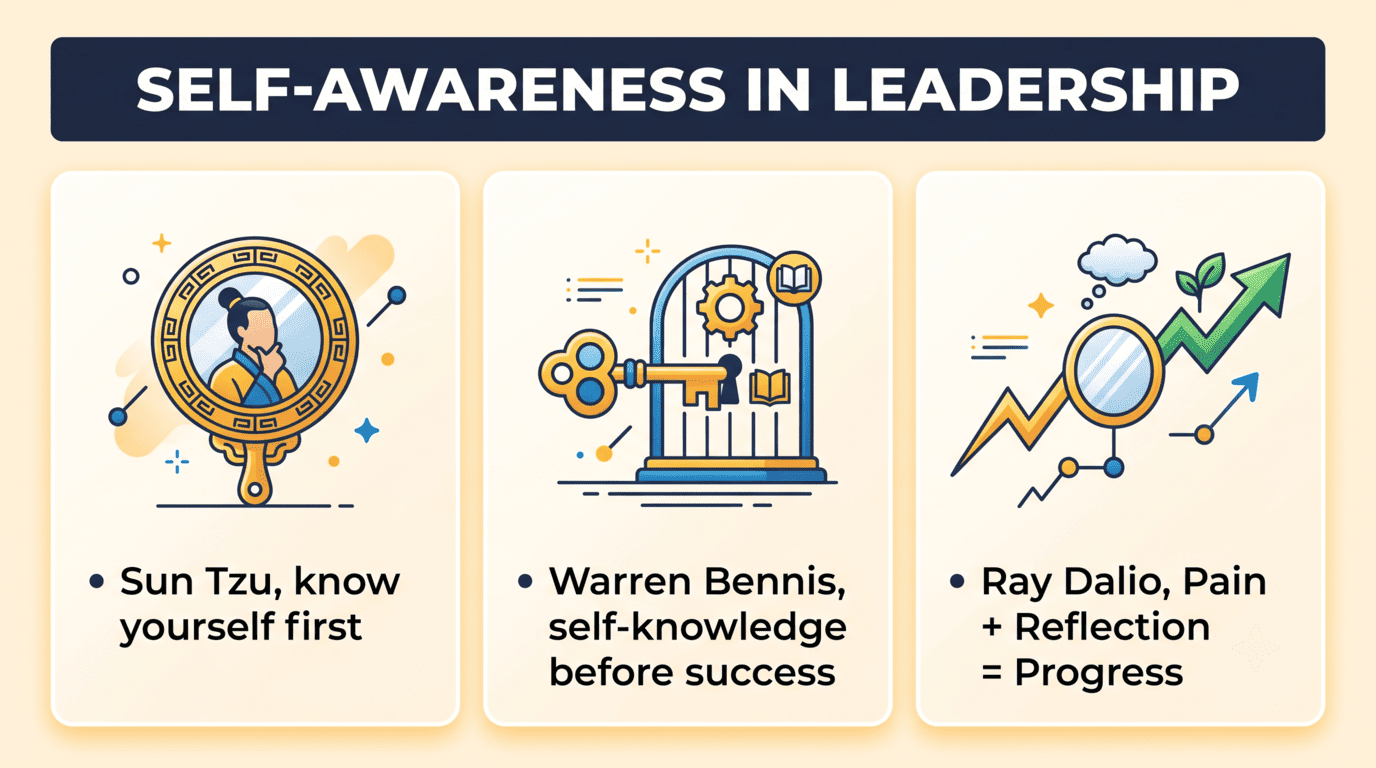
“If you know the enemy and know yourself, you need not fear the result of a hundred battles.” Sun Tzu, The Art of War. Read past the military framing and the actual claim is a strategy one: self-knowledge is a competitive advantage, not just a personal virtue.
“Self-knowledge has traditionally been considered the most difficult task any of us faces, but until you truly know yourself, strengths and weaknesses, know what you want to do and why you want to do it, you cannot succeed in any but the most superficial sense of the word.” Warren Bennis, On Becoming a Leader (1989). Bennis, one of the founders of modern leadership studies, is explicit that surface-level success is exactly what you get without this work.
“I learned that courage was not the absence of fear, but the triumph over it.” Nelson Mandela, Long Walk to Freedom (1994). The line requires Mandela to have been aware enough of his own fear to name it accurately, which is the self-awareness part most retellings skip past.
“Leadership is solving problems. The day soldiers stop bringing you their problems is the day you have stopped leading them.” Colin Powell, It Worked for Me: In Life and Leadership (2012). Powell’s version of self-awareness for leaders is specific: notice the moment people stop being honest with you, because that silence is a signal about you, not them.
“Pain + Reflection = Progress.” Ray Dalio, Principles (2017). Dalio’s formula is a real operating principle at his own firm, not a slogan: the reflection step is what turns a setback into usable information instead of just a bad week.
Additional Quotes to Deepen Self-Awareness
Six more quotes from writers and thinkers outside psychology proper, each one earning its place by naming something the sections above didn’t quite cover.
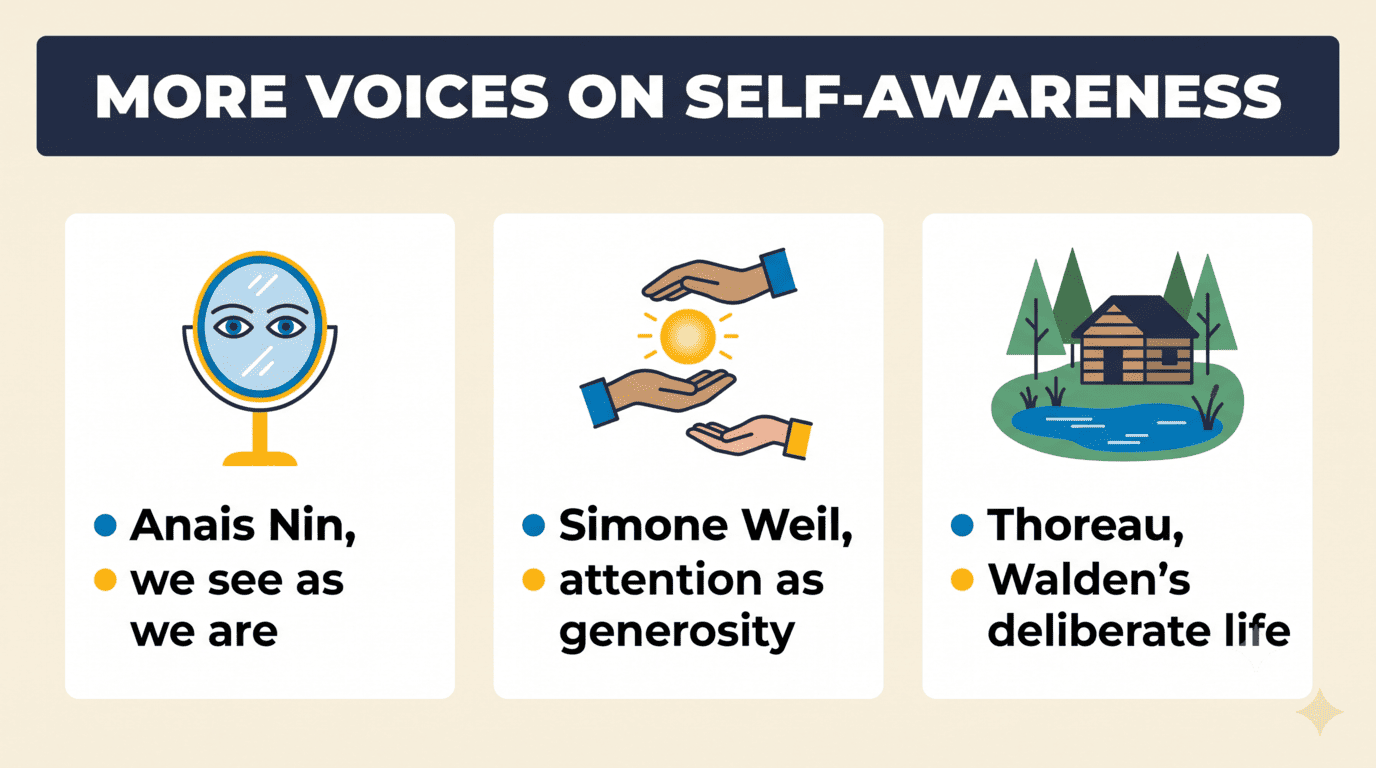
“We don’t see things as they are, we see them as we are.” Anaïs Nin, Seduction of the Minotaur (1961). Nin didn’t claim this as her own line. She attributed it in the text to Talmudic wisdom, though the exact Talmudic source is disputed among scholars. The honest version of the citation is more interesting than the meme version.
“Attention is the rarest and purest form of generosity.” Simone Weil, Gravity and Grace (1947). Weil’s line makes a case that noticing yourself and noticing another person draw on the exact same scarce resource.
“Each man had only one genuine vocation: to find the way to himself.” Hermann Hesse, Demian (1919). Hesse’s coming-of-age novel treats self-knowledge as the actual job description of a human life, not a side quest to a career.
“I went to the woods because I wished to live deliberately, to front only the essential facts of life.” Henry David Thoreau, Walden (1854). “Deliberately” is doing the real work in this sentence: Thoreau isn’t describing an escape, he’s describing an audit.
“To have that sense of one’s intrinsic worth which constitutes self-respect is potentially to have everything: the ability to discriminate, to love and to remain indifferent.” Joan Didion, “On Self-Respect” (1961). Didion’s essay argues self-respect isn’t about being liked. It’s about being willing to know your own choices well enough to answer for them.
“To be nobody but yourself in a world which is doing its best, night and day, to make you everybody else means to fight the hardest battle which any human being can fight, and never stop fighting.” e.e. cummings, widely attributed to a 1955 letter. cummings frames self-awareness as an ongoing fight rather than a state you arrive at once and keep.
Carl Jung on Self-Awareness
Carl Jung gets quoted more than almost anyone else on this topic, and misquoted almost as often. These four lines are checked against his actual published works, not a meme account.
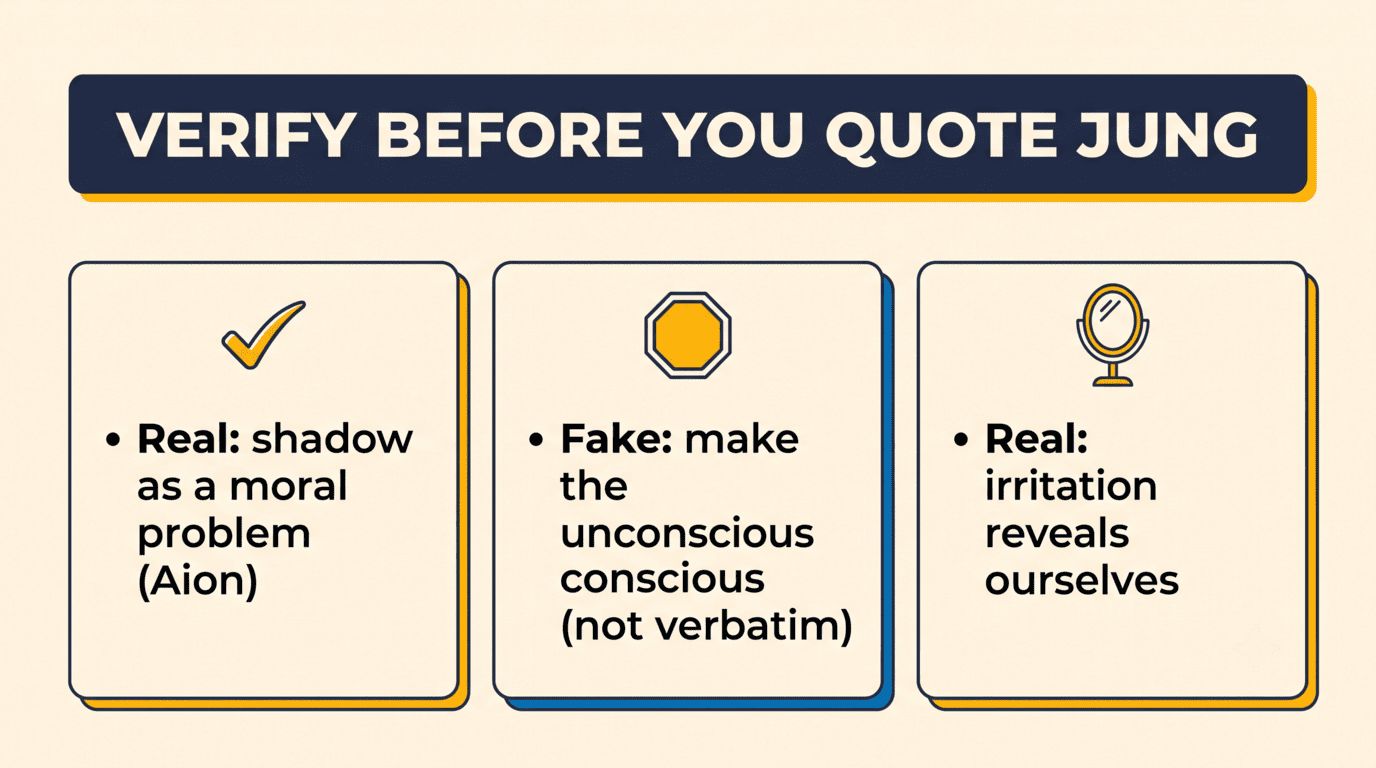
“Everything that irritates us about others can lead us to an understanding of ourselves.” Carl Jung, Memories, Dreams, Reflections (1962). Jung is describing irritation as data: the intensity of a reaction to someone else’s flaw is often a clue about an unexamined trait of your own.
“The shadow is a moral problem that challenges the whole ego-personality, for no one can become conscious of the shadow without considerable moral effort.” Carl Jung, Aion (1951). This is Jung’s actual opening definition of the shadow, and it’s blunter than the pop-psychology version: facing it takes effort, not just curiosity.
“One does not become enlightened by imagining figures of light, but by making the darkness conscious.” Carl Jung, Psychology and Alchemy. A version of a related idea circulates as “Until you make the unconscious conscious, it will direct your life and you will call it fate,” but that exact sentence doesn’t appear anywhere in Jung’s collected works. It’s a modern paraphrase of a real passage in Aion, where Jung wrote that an unmade-conscious inner situation “happens outside, as fate.” The paraphrase captures the idea. It isn’t a real quote.
“Knowing your own darkness is the best method for dealing with the darknesses of other people.” Carl Jung, The Symbolic Life. This is the practical payoff of shadow work: it isn’t only self-focused, it’s also the most reliable tool Jung names for handling difficult people without being ruled by the reaction.
Related: Deep Shadow Work Prompts
Stoic Self-Awareness Quotes
Stoic philosophy is built almost entirely on one recurring move: separate what’s actually yours to control from what isn’t, and put your attention only on the first pile. These seven lines are that move stated seven different ways.
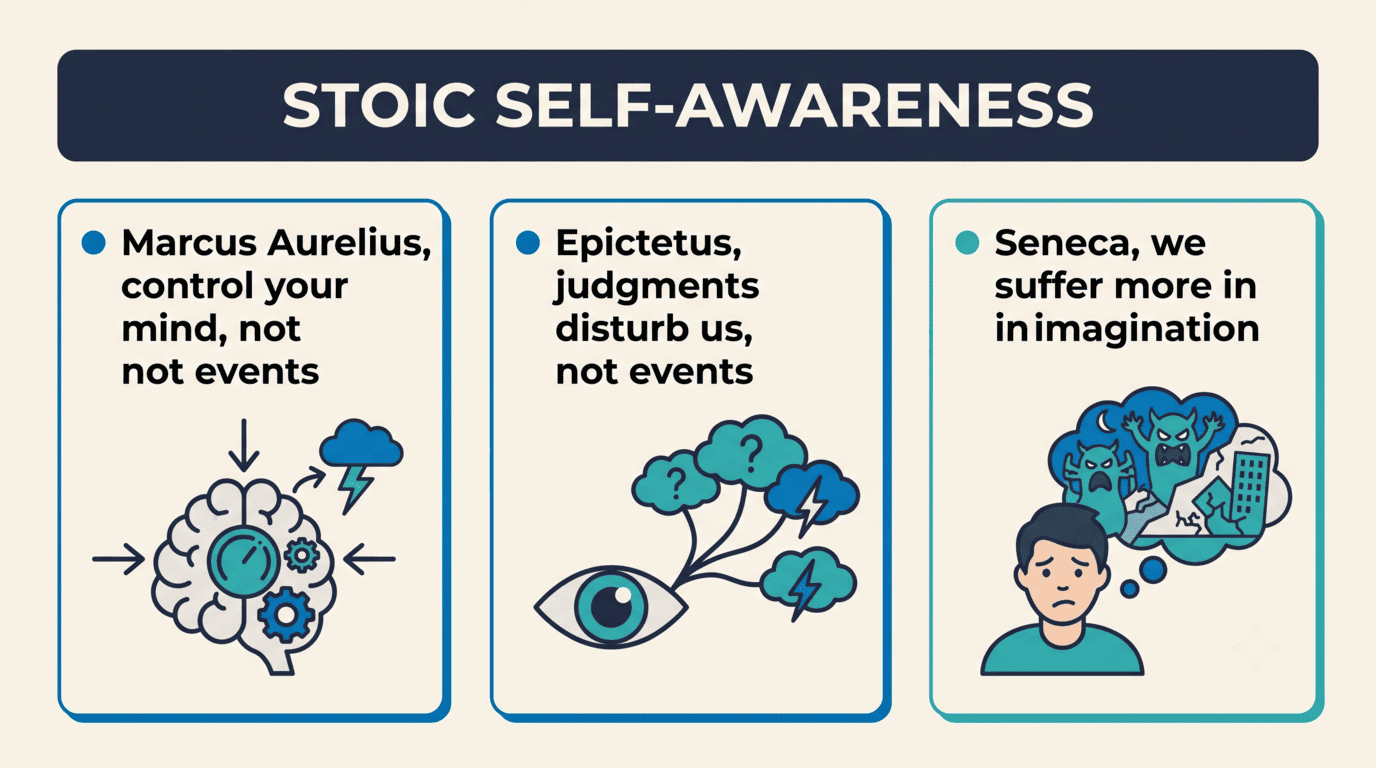
“You have power over your mind, not outside events. Realize this, and you will find strength.” Marcus Aurelius, Meditations, Book 4. Aurelius wrote this as a private journal entry, not advice for an audience, which is part of why it still reads as sincere rather than performed.
“The soul becomes dyed with the color of its thoughts.” Marcus Aurelius, Meditations, Book 5. The dye metaphor is precise: repeated thought patterns don’t just pass through, they stain.
“Waste no more time arguing about what a good man should be. Be one.” Marcus Aurelius, Meditations, Book 10. A direct rebuke to anyone, including Concentrated Wisdom’s readers, who reads about self-awareness longer than they practice it.
“It is not events that disturb people, it is their judgments concerning them.” Epictetus, Enchiridion, opening line. This is the more precise, original phrasing behind the popular but looser paraphrase “it’s not what happens to you, it’s how you react.”
“First say to yourself what you would be, and then do what you have to do.” Epictetus, Discourses, Book 3. Epictetus puts self-definition before action on purpose. Skip the first step and the second one has nothing to aim at.
“As is a tale, so is life: not how long it is, but how good it is, is what matters.” Seneca, Epistulae Morales ad Lucilium, Letter 77. Seneca wrote this letter while genuinely considering his own death, which is worth knowing before dismissing the line as a greeting-card platitude.
“We suffer more often in imagination than in reality.” Seneca, Letters from a Stoic. A two-thousand-year-old description of what modern therapy calls catastrophizing.
Self-Awareness Reflection Questions
Three more quotes, chosen specifically because each one is really a question in disguise.
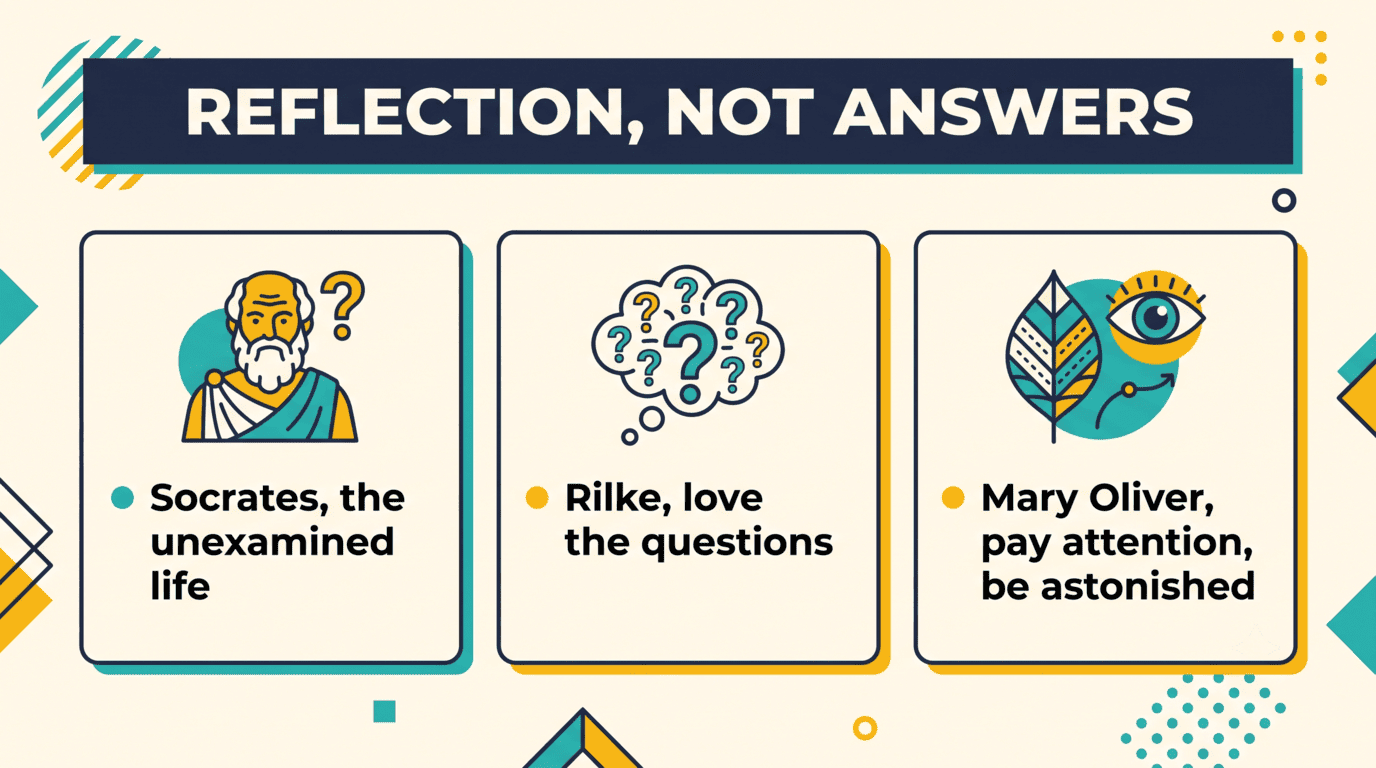
“The unexamined life is not worth living.” Socrates, as recorded in Plato’s Apology (38a). Socrates said this at his own trial, arguing that he would rather die than agree to stop asking questions, which is worth remembering the next time the line shows up on a coffee mug.
“Be patient toward all that is unsolved in your heart and try to love the questions themselves.” Rainer Maria Rilke, Letters to a Young Poet (1929). Rilke’s advice is a direct antidote to the pressure to resolve self-awareness work into a tidy conclusion by a certain deadline.
“Instructions for living a life: Pay attention. Be astonished. Tell about it.” Mary Oliver, “Sometimes,” from Red Bird (2008). Oliver’s three-step instruction is short enough to actually use as a daily checklist, not just admire as poetry.
Five questions drawn from the thinkers above, meant to be used one at a time rather than all in one sitting.
- What did I make excuses for this week, and what would it look like to name it plainly instead?
- Which of my own reactions this month would surprise someone who only knows my public version of myself?
- If a stranger read my last ten text messages, what would they conclude I actually value?
- What feedback have I heard more than once and quietly dismissed?
- Which of the quotes above did I resist the most, and what does that resistance point to?
Why Self-Awareness Matters in Today’s World
Self-awareness quotes get shared constantly, but distraction is the more concrete argument for why the underlying skill still matters. Attention fragmented across notifications, feeds, and a work culture that rewards fast reaction over reflection is exactly the condition under which the Mirror Gap widens instead of closing.
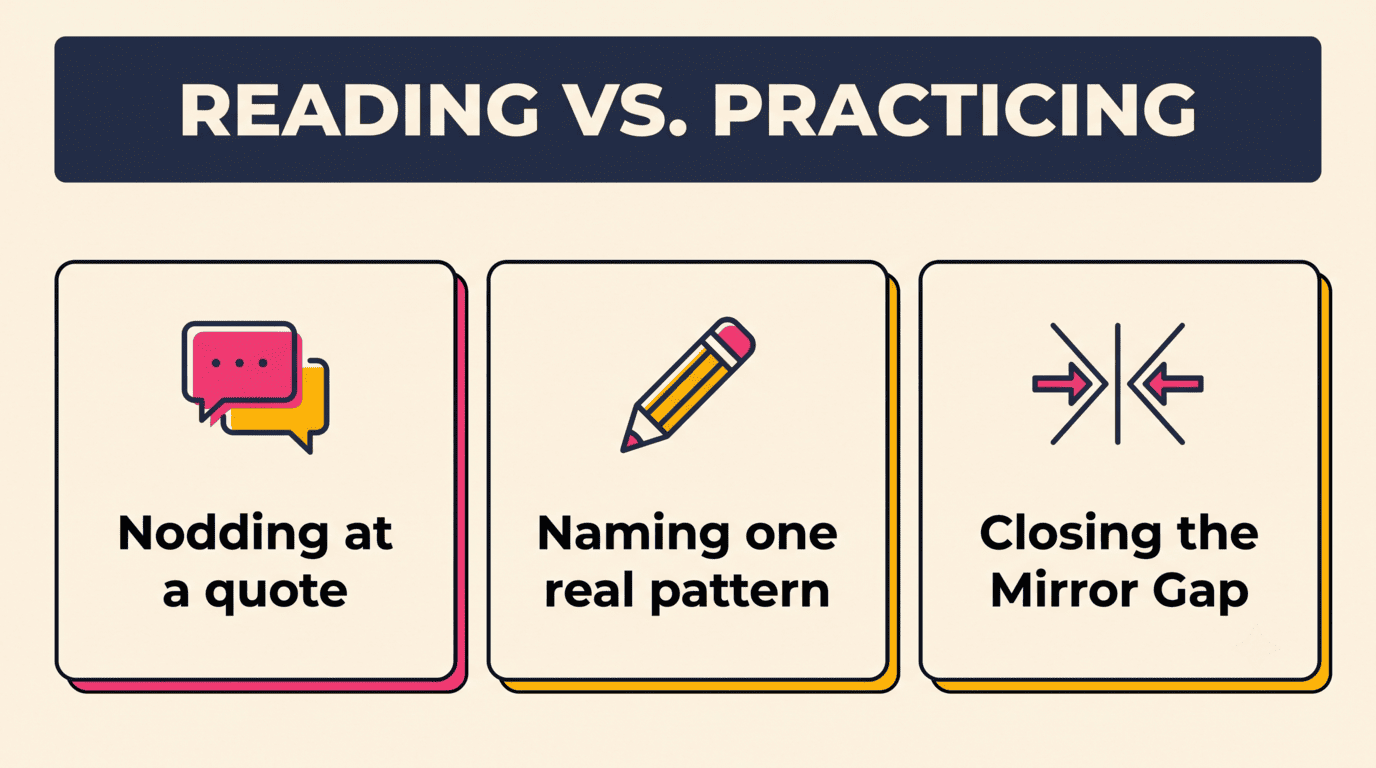
The gap between reading a quote and actually practicing what it names is usually where a quote roundup stops being useful. It doesn’t have to be.
| Reading a Self-Awareness Quote | Practicing What It Actually Names |
|---|---|
| Nodding along at “know thyself” | Naming one specific pattern you actually repeat, out loud or on paper |
| Sharing a Jung quote about the shadow | Writing down one trait you dislike in someone else and asking where you do it too |
| Bookmarking a Stoic quote about control | Separating one real problem into what you control and what you don’t, this week |
| Reading a quote about vulnerability | Telling one person one true, slightly uncomfortable thing this week |
None of the 52 quotes above will do that work by themselves. That was never really the promise of a good quote; it was only ever the starting point.
Related: Deep Mindfulness Gratitude Quotes
Frequently Asked Questions
What is the most famous self-awareness quote?
“Know thyself,” the maxim inscribed at the Temple of Apollo at Delphi and associated with Socrates through Plato’s dialogues, is likely the single most quoted line on the topic. Among modern thinkers, Carl Jung’s writing on the shadow, especially the idea that people find real self-understanding by making their own darkness conscious rather than by imagining themselves as purely good, gets cited almost as often.
Are Carl Jung’s most popular self-awareness quotes actually real?
Some of the most-shared ones aren’t. “Until you make the unconscious conscious, it will direct your life and you will call it fate” doesn’t appear verbatim anywhere in Jung’s collected works; it’s a modern paraphrase of a real passage in Aion. “The privilege of a lifetime is to become who you truly are” has been traced to Joseph Campbell, not Jung. Genuine, sourced Jung lines on self-awareness include his definition of the shadow in Aion and his observation in Memories, Dreams, Reflections that what irritates us about others often points back at ourselves.
What are short self-awareness quotes I can actually remember?
The shortest, most memorable lines tend to be the oldest ones: “Know thyself” (the Delphic maxim), Lao Tzu’s “knowing yourself is enlightenment” from the Tao Te Ching, and Shakespeare’s “to thine own self be true” from Hamlet all fit in a single breath, which is part of why they’ve survived this long.
What do Stoic philosophers say about self-awareness?
Stoic self-awareness quotes from Marcus Aurelius, Epictetus, and Seneca return again and again to one move: separating what you actually control, your own judgments and reactions, from what you don’t, outside events. Epictetus opens the Enchiridion with this exact distinction, and Marcus Aurelius restates it throughout Meditations as a private reminder to himself, not as advice for an audience.