Concentrated Wisdom Editorial Team researches, writes, and fact-checks this guide against primary sources before publication.
This article is for informational purposes only and isn’t a substitute for personalized professional advice.
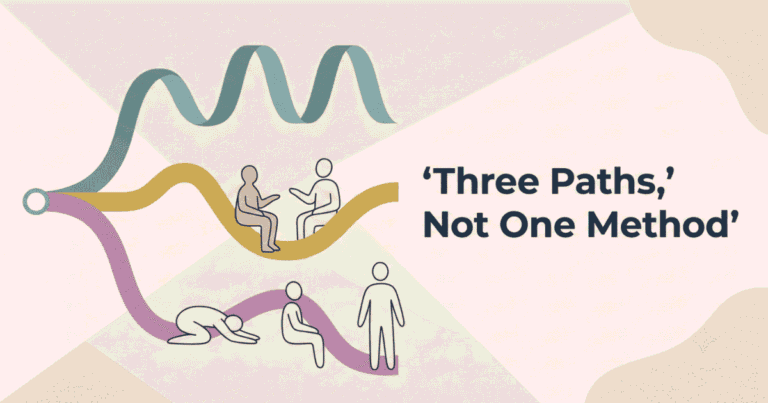
Somatic Experiencing, Sensorimotor Psychotherapy, and trauma-sensitive yoga are three distinct approaches to working with trauma through the body, and they aren’t interchangeable. Somatic Experiencing centers on pendulation, moving attention between activation and safety in small doses, and suits people who want a gentler, less verbal entry point. Sensorimotor Psychotherapy folds body awareness directly into talk therapy for people who want to keep working with narrative and attachment history, while trauma-sensitive yoga offers a structured, choice-based movement practice for people who find moving the body easier than talking about it.
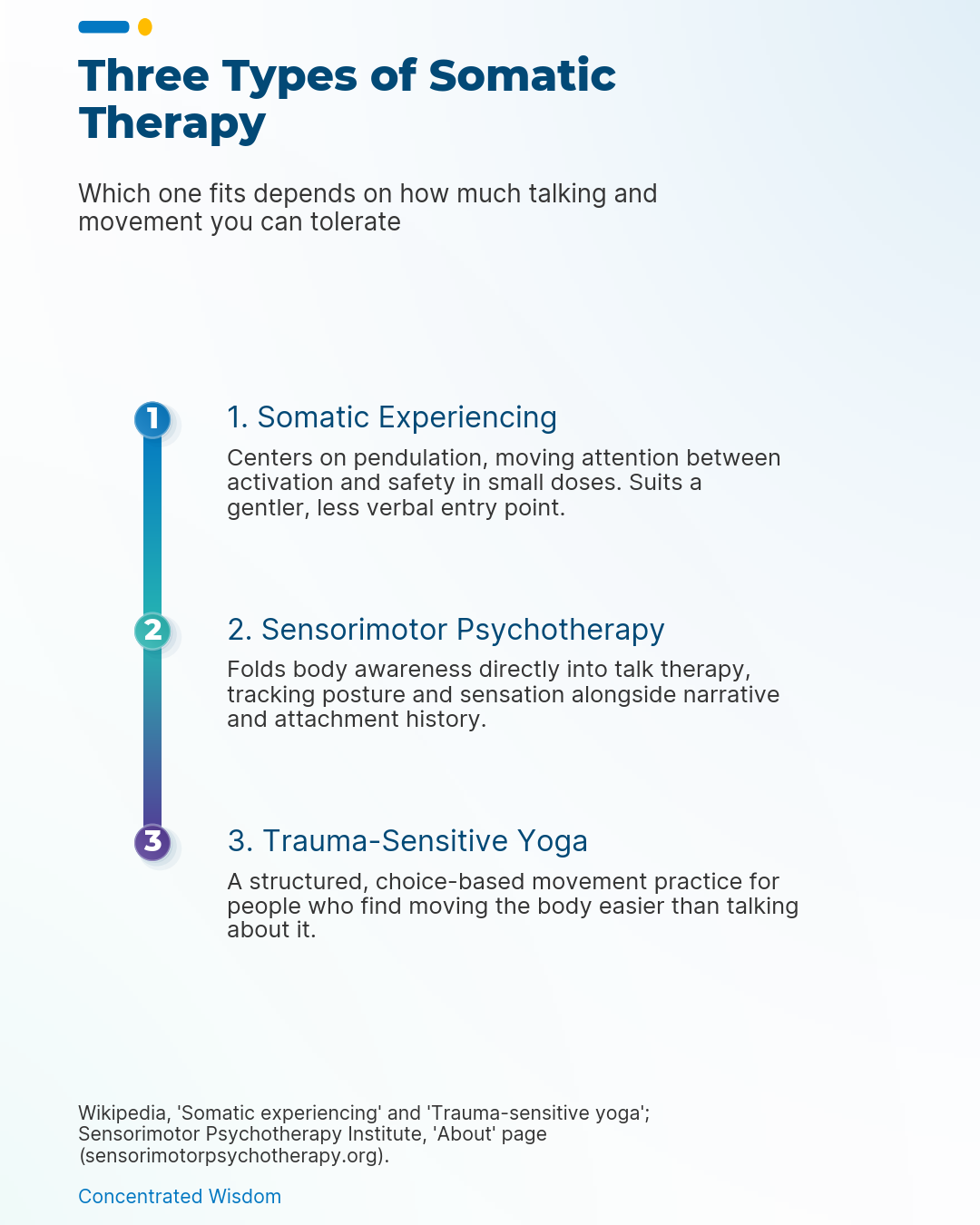
The three most commonly referenced types of somatic therapy are Somatic Experiencing, Sensorimotor Psychotherapy, and trauma-sensitive yoga, and each approaches the body differently. Somatic Experiencing, developed by Peter Levine starting in the 1970s, centers on pendulation, a technique of moving attention back and forth between a distressing sensation and a neutral or resourced one, so the nervous system can discharge activation in small, tolerable doses. Sensorimotor Psychotherapy, developed by Pat Ogden starting in the early 1970s, blends body awareness directly into talk therapy, tracking posture, impulse, and sensation alongside narrative and attachment history. Trauma-sensitive yoga, developed at the Trauma Center in Brookline, Massachusetts in 2002 by David Emerson and colleagues, uses choice-based postures and movement to rebuild a sense of safety and agency in the body, though a 2019 review found the supporting research still needs stronger study designs.
The three main types of somatic therapy are Somatic Experiencing, Sensorimotor Psychotherapy, and trauma-sensitive yoga, and they suit different histories. Which one fits depends on how much verbal processing, structure, and movement a person’s nervous system can currently tolerate.
Somatic Experiencing
Somatic Experiencing was developed by psychologist Peter Levine, who began shaping the approach in the 1970s after observing that wild animals discharge survival-stress activation through movement and rarely show lasting trauma symptoms. The core technique is pendulation, a term Levine coined for the practice of moving attention back and forth between a distressing sensation and a neutral or resourced one, letting the nervous system approach activation in small, tolerable doses rather than all at once.
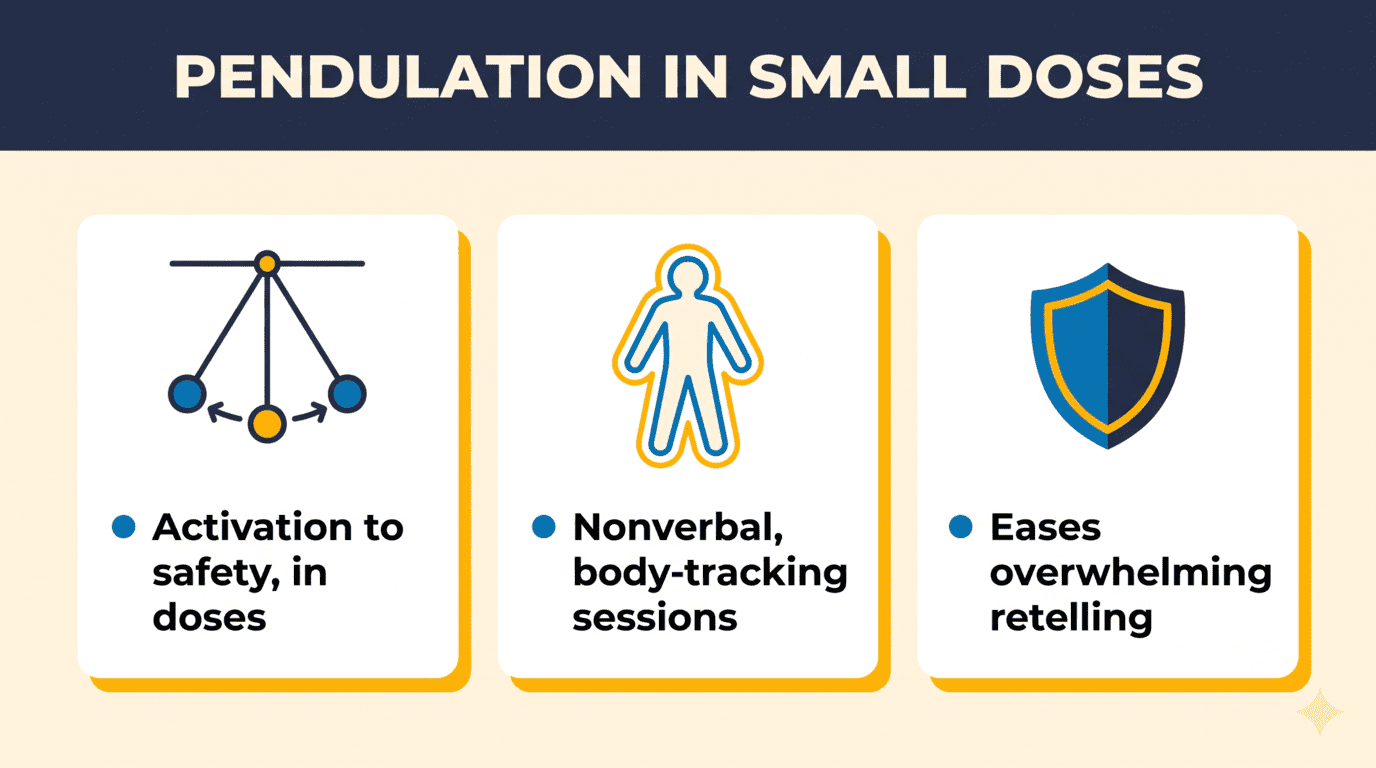
Sessions are largely nonverbal and body-tracking focused, following physical sensation, impulse, and small involuntary movements (trembling, a deep breath, a wave of warmth) rather than retelling the traumatic story in detail.
Best suited for: people who find that talking about a traumatic memory in detail is overwhelming or retraumatizing, and who want an entry point that starts with the body’s sensations rather than the narrative. It also tends to suit people managing single-incident trauma (an accident, a medical event) where the nervous system’s stress response never fully completed.
Sensorimotor Psychotherapy
Sensorimotor Psychotherapy was developed by Pat Ogden,who began forming its foundations in the early 1970s while working as a yoga and movement teacher in a psychiatric hospital,later co-founding her own training institute in 1981.The core technique is tracking the body alongside the conversation, noticing posture, tension, and impulse in real time as a client talks, then working with what the body is doing as directly as what the client is saying.

Unlike Somatic Experiencing, Sensorimotor Psychotherapy keeps narrative and talk therapy in the room, using a three-phase structure, safety and stabilization, processing, integration, that folds body awareness into attachment-focused psychotherapy rather than replacing it.
Best suited for: people who want to keep working with the story of what happened and how it shaped their relationships, but who’ve noticed that talk therapy alone hasn’t fully addressed the physical patterns (bracing, collapse, chronic tension) tied to that history. It tends to suit developmental and relational trauma, not just single incidents.
Body-Based Trauma Yoga
Trauma-sensitive yoga was developed at the Trauma Center in Brookline, Massachusetts,in 2002 by David Emerson and colleagues,working alongside trauma researcher Bessel van der Kolk.The core technique is choice-based, invitational movement, where an instructor offers postures as options rather than instructions (‘you might try,’ not ‘now do’), rebuilding a sense of agency in a body that trauma often made feel unsafe or unowned.

A 2019 systematic review found the existing research promising but not yet rigorous enough to confirm effectiveness, with studies showing meaningful effect sizes but a high risk of bias; the reviewers called for stronger study designs rather than dismissing the approach.
Best suited for: people who find sitting still and talking about internal sensations harder than simply moving, and who want a structured, predictable group or individual practice as either a complement to talk therapy or a gentler starting point before it.
Comparing the Three at a Glance
| Somatic Experiencing | Sensorimotor Psychotherapy | Trauma-Sensitive Yoga | |
|---|---|---|---|
| Core technique | Pendulation between activation and safety | Body tracking woven into talk therapy | Choice-based postures and movement |
| Verbal processing | Minimal | Central | Minimal to none |
| Session format | One-on-one, body-focused | One-on-one, talk plus body | Individual or group class |
| Best fit | Single-incident trauma, retelling feels overwhelming | Developmental or relational trauma, wants to keep the narrative work | Prefers moving the body to talking about it |
Where EMDR and AEDP Fit In
Two other approaches come up constantly in the same conversation and deserve a clear answer for why they aren’t counted among these three. EMDR (Eye Movement Desensitization and Reprocessing) was developed by psychologist Francine Shapiro starting in 1987. Its core mechanism, bilateral stimulation, guided eye movements, tapping, or alternating tones, paired with recalling a target memory, is a distinct technique from the body-tracking, pendulation, and movement-based methods covered above, which is why it’s typically classified on its own rather than folded into the somatic category.
AEDP (Accelerated Experiential Dynamic Psychotherapy), developed by psychologist Diana Fosha and introduced in her 2000 book The Transforming Power of Affect, blends attachment theory and emotion-focused work with moment-to-moment tracking of bodily experience inside an actively supportive therapeutic relationship, closer in spirit to Sensorimotor Psychotherapy’s talk-plus-body integration than to a purely nonverbal approach. Both EMDR and AEDP are legitimate, well-established options worth knowing about, they’re just distinct enough in mechanism from the three body-first modalities above to warrant their own separate conversation rather than a spot on this particular list.
Why the Same History Can Need a Different Fit
Practitioners across all three modalities describe some version of the same pattern: two clients with broadly similar trauma histories can respond very differently to the same approach. One client with a history of childhood neglect might find Sensorimotor Psychotherapy’s talk-plus-body structure grounding, since the conversation itself provides a sense of relational safety they didn’t have growing up. Another client with a similar history might find that same amount of verbal processing activating, and settle more easily into trauma-sensitive yoga’s quieter, movement-first structure instead.
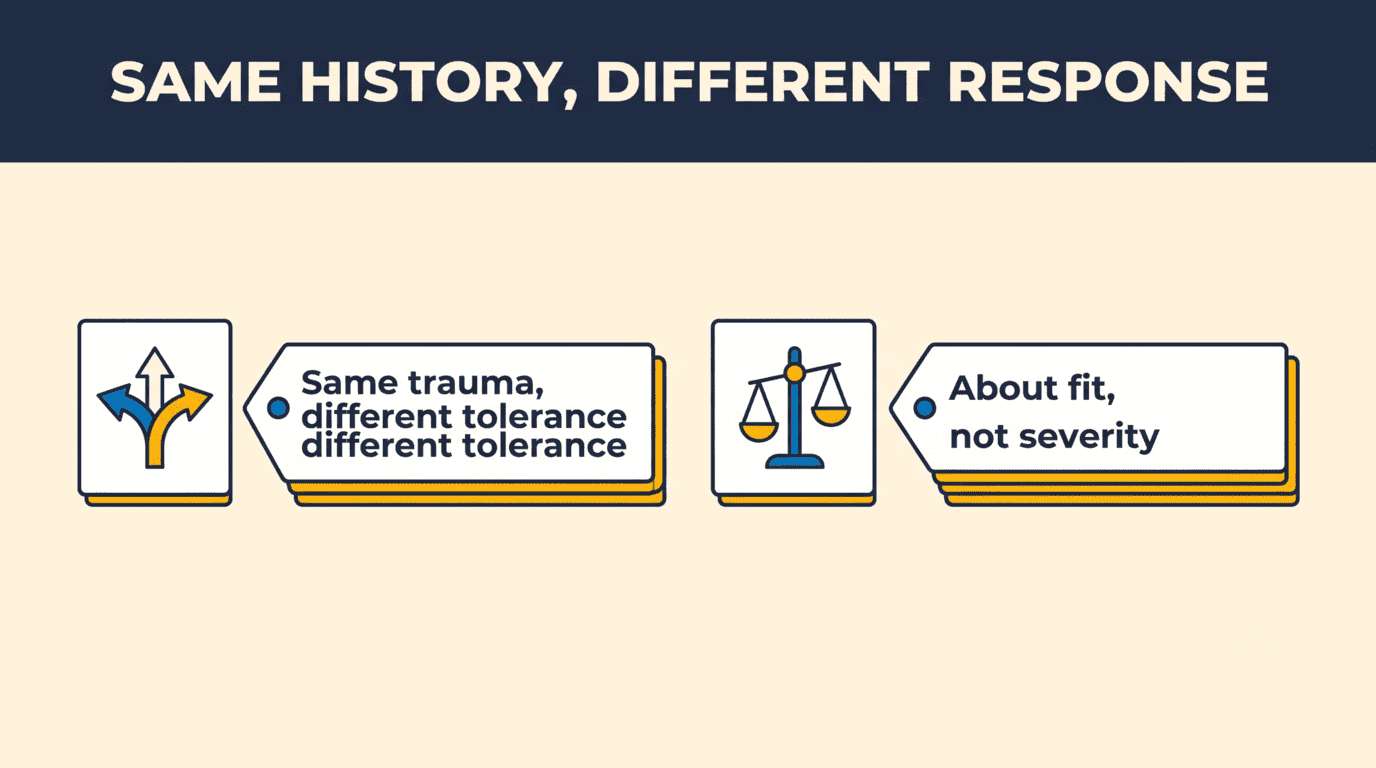
Neither response says anything about which client is doing recovery “correctly.” The mismatch is about tolerance for verbal processing and structure in the moment, not about the severity or type of the original trauma. This composite pattern (illustrative of what shows up across clinical case discussions, not a documented individual case) is the practical reason a single modality rarely gets recommended as universally best.
Related: Pendulation Somatic Experiencing
Related: Somatic Exercises for Nervous System Regulation
Related: Health & Mental Wellbeing
How to Choose a Starting Point
A reasonable starting question: does retelling the story of what happened feel useful or overwhelming right now? If useful, Sensorimotor Psychotherapy’s talk-plus-body structure is worth exploring first. If overwhelming, Somatic Experiencing or trauma-sensitive yoga, both largely nonverbal, are usually the gentler entry points.
It’s also common to move between modalities over time, starting with a nonverbal approach to build a wider window of tolerance, then adding narrative-focused work once the body feels more stable. A trained practitioner in any of the three can help make that call rather than guessing alone.
- Ask what specific training and certification the practitioner holds in the modality, not just general familiarity with somatic language
- Ask how a typical session is structured, since the balance of talking versus body-focused work differs sharply across the three
- Ask how the practitioner handles a session where activation becomes too intense, since a clear plan for that moment matters more than a polished intake pitch
- Ask whether the modality is meant to stand alone or run alongside other treatment, since trauma-sensitive yoga in particular is usually positioned as a complement, not a replacement
What the Research Actually Supports So Far
None of the three modalities has a deep bench of large, rigorously controlled trials yet, which is worth knowing before choosing one based on marketing claims rather than evidence. Trauma-sensitive yoga has the clearest research caveat on record: a 2019 systematic review found real, moderate-to-large effect sizes across existing studies, but rated the studies themselves at high risk of bias and called for stronger designs before drawing firm conclusions.
Somatic Experiencing’s own literature reviews describe a similar pattern, promising preliminary findings on PTSD symptoms and general well-being, alongside an acknowledgment that the overall evidence base is still thin and would benefit from more unbiased, randomized research. Sensorimotor Psychotherapy has the least independent outcome research of the three so far, though several studies are underway at hospitals and clinics internationally.
None of this means the approaches don’t work, it means the confidence level is different from something like cognitive behavioral therapy, which has decades of trials behind it. Treating any of the three as a well-supported complement to established trauma treatment, rather than a proven standalone cure, matches what the current research actually shows.
Frequently Asked Questions
What is the difference between Somatic Experiencing and Sensorimotor Psychotherapy?
Somatic Experiencing is largely nonverbal and tracks physical sensation using pendulation, moving attention between activation and safety in small doses. Sensorimotor Psychotherapy keeps talk therapy central and adds body tracking alongside it, working with posture and impulse while still discussing narrative and attachment history.
Is trauma-sensitive yoga a replacement for therapy?
Generally no. Trauma-sensitive yoga is most often used as a complement to psychotherapy or medication, not a replacement. A 2019 systematic review found the supporting research promising but not yet rigorous enough to confirm effectiveness on its own, so it’s typically positioned alongside evidence-based trauma treatment rather than in place of it.
Can I do more than one type of somatic therapy?
Yes. It’s common to move between modalities over time, or to combine a nonverbal approach like Somatic Experiencing or trauma-sensitive yoga with talk-based work like Sensorimotor Psychotherapy or standard psychotherapy, depending on what the nervous system can tolerate at a given stage of recovery.
How do I find a practitioner trained in one of these modalities?
Each modality maintains its own training and certification path, so searching a practitioner’s credentials for ‘Somatic Experiencing Practitioner,’ ‘Sensorimotor Psychotherapy,’ or a registered trauma-sensitive yoga training is the most reliable way to confirm real training rather than general familiarity with somatic language.