Concentrated Wisdom Editorial Team researches, writes, and fact-checks this guide against primary sources before publication.
This article is for informational purposes only and isn’t a substitute for personalized professional advice.
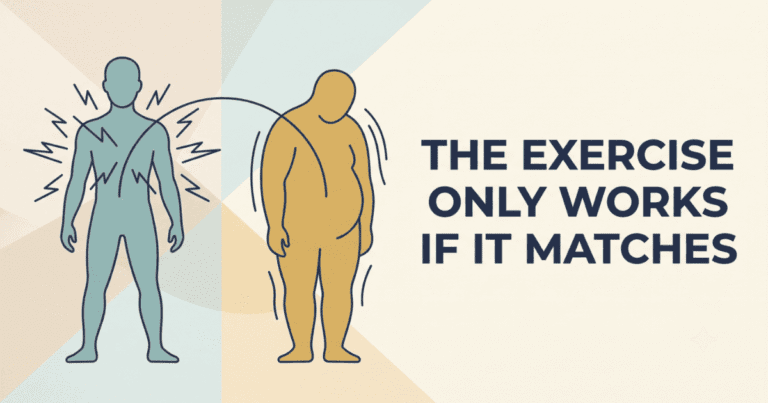
Somatic exercises for nervous system regulation only work when they’re matched to the state a person is actually in, not applied as one generic toolkit. Hyperarousal (fight-or-flight activation) responds to discharge techniques that use up mobilized energy, while hypoarousal (freeze or shutdown) responds to gentle activation that brings the body back online. Using a calming technique during freeze, or a stimulating technique during fight-or-flight, tends to intensify the state a person is trying to leave rather than resolve it.
Somatic exercises for nervous system regulation are body-based techniques that help shift a dysregulated nervous system back toward a calmer baseline, and the right exercise depends on which state a person is actually in. Researcher Stephen Porges’ polyvagal framework describes the nervous system moving between a socially engaged state, a mobilized fight-or-flight state (hyperarousal), and a shut-down freeze state (hypoarousal). Hyperarousal tends to respond to discharge-focused movement, shaking out the hands, stomping, forceful exhales, that helps the body use up stress activation it already generated. Hypoarousal tends to respond to gentle activation, orienting to the room, humming, small deliberate movements, that brings a collapsed system back toward alertness without overwhelming it. Applying a calming technique to a frozen nervous system, or a stimulating technique to an already-activated one, is a common mismatch that tends to make things worse rather than better. Matching the technique to the state is the operative skill, not memorizing a longer list of exercises.
Somatic exercises for nervous system regulation only work when they match the state a person is in. A hyperaroused, fight-or-flight system needs discharge; a hypoaroused, shut-down system needs gentle activation, and the wrong one can make things worse.
Two Nervous System States, Two Different Needs
Every somatic exercise is built to move the nervous system in one of two directions, down from activation, or up from shutdown. Reaching for the wrong direction is the single most common reason a somatic technique feels like it isn’t working.
Hyperarousal Fight or Flight
Hyperarousal is an activated, mobilized state. The body has geared up to fight or flee, whether or not there’s an actual physical threat, and everything about the physiology reflects that, a racing heart, tight muscles, shallow breathing, racing thoughts, irritability, or a jittery sense of urgency.
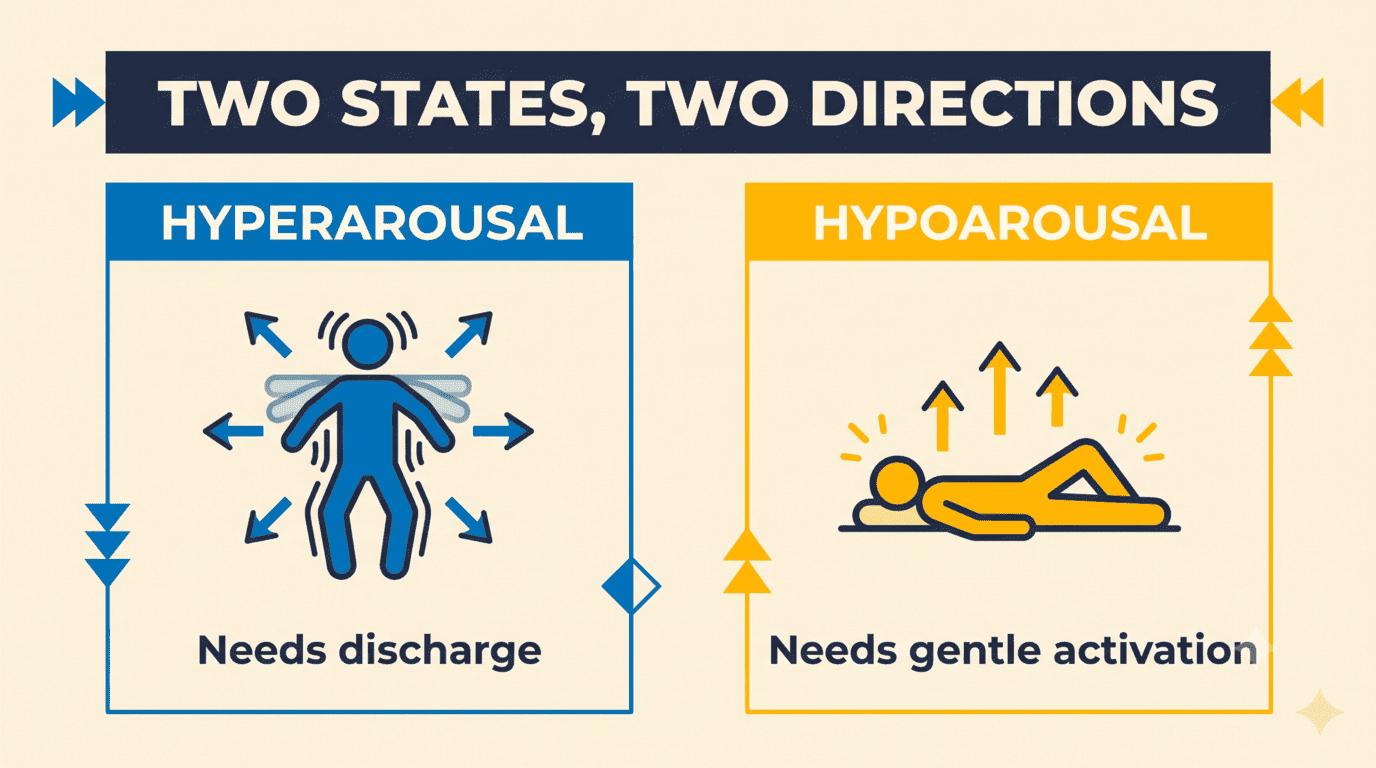
Researcher Stephen Porges’ polyvagal framework describes this as the sympathetic nervous system taking over, one of three broad autonomic states the theory maps out. Some of the framework’s more specific physiological claims are still debated among researchers, but the basic distinction between an activated state and a shut-down one is widely used in clinical settings to decide which kind of exercise might actually help.
Hypoarousal Freeze or Shutdown
Hypoarousal is the opposite direction, a collapsed, numbed, or checked-out state. The nervous system has concluded that fighting or fleeing isn’t an option, so it conserves energy instead, showing up as fog, flat affect, heavy limbs, dissociation, or a sense of watching life from behind glass.
Psychiatrist Dan Siegel’s window of tolerance model describes the workable zone between these two extremes, the range where a person can feel stress without being overtaken by it. A narrower window means it takes less to tip into hyperarousal or hypoarousal, which is common after periods of chronic stress or trauma.
| Hyperarousal | Hypoarousal | |
|---|---|---|
| Feels like | Racing, jittery, on edge | Foggy, heavy, checked out |
| Body signs | Fast heart rate, tight jaw, shallow breath | Slow, flat, heavy limbs |
| Common trigger | Perceived threat, conflict, deadline pressure | Overwhelm the system can’t fight or flee from |
| What helps | Discharge, using up the activation | Gentle activation, coming back online |
A 10-Second State Check Before You Start
Before reaching for an exercise, take 10 seconds to notice one thing: does your body want to move, or does it want to stop moving? A pull toward motion, fidgeting, pacing, clenched hands, usually points to hyperarousal and discharge work. A pull toward stillness, heaviness, or a blank feeling usually points to hypoarousal and gentle activation.
This isn’t a clinical assessment, it’s a fast, practical filter. Skipping it and defaulting to whichever exercise is most familiar is the most common reason people report a somatic technique “not working,” when the real issue is that the technique was aimed at the wrong direction.
Exercises for Hyperarousal
Discharge is the operative goal for hyperarousal. The body has already generated activation energy, and the exercise’s job is to help it complete that cycle rather than suppress it.
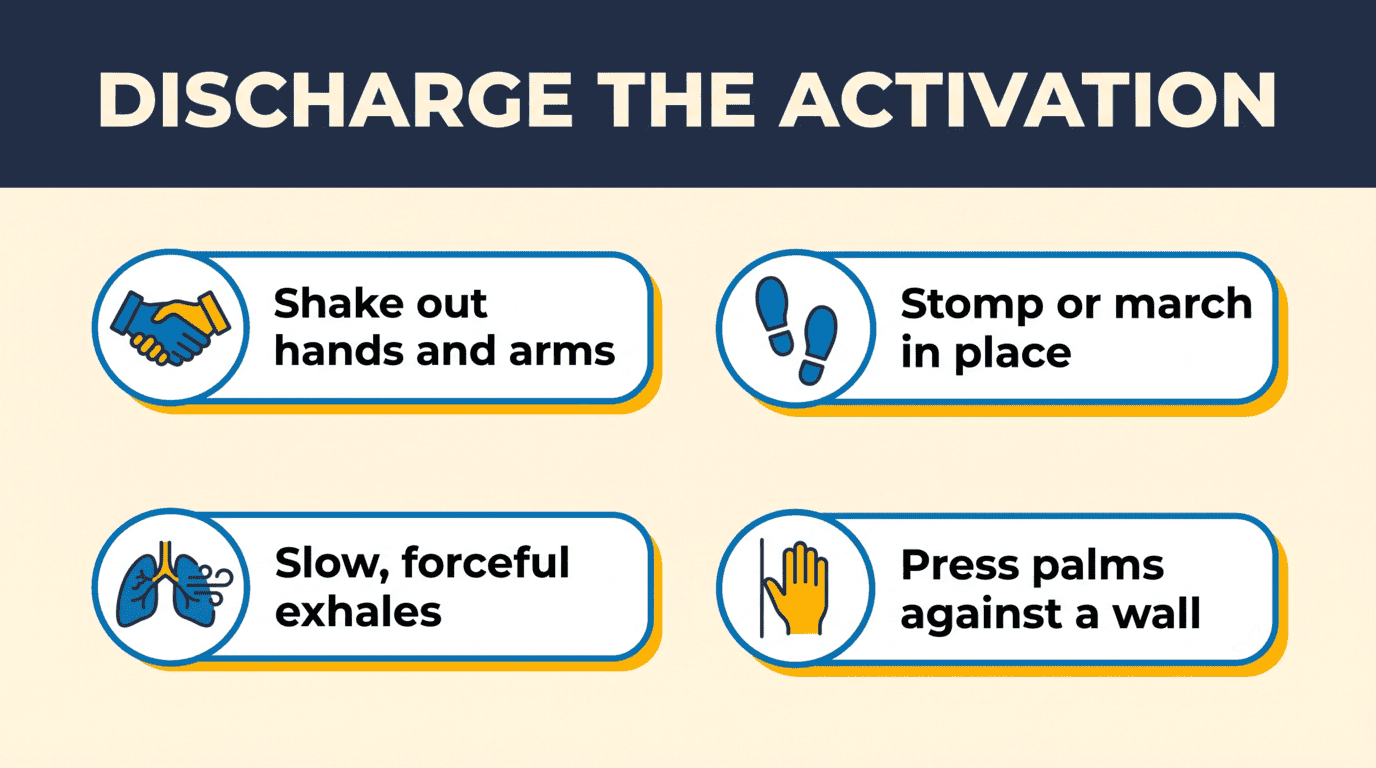
- Shake out the hands and arms for 30 to 60 seconds, letting the movement be loose and slightly exaggerated rather than controlled
- Stomp or march in place for a minute, giving the legs somewhere to send mobilized energy
- Do 3 to 5 slow, forceful exhales through the mouth, letting the inhale happen on its own
- Press both palms hard against a wall for 10 to 15 seconds, then release and notice the sensation that follows
- Do 10 to 15 fast bodyweight squats or jumping jacks if the setting allows it, then stop and let the breathing settle
This idea traces back to Somatic Experiencing, developed by Peter Levine, where discharge, trembling, a deep spontaneous breath, a wave of warmth, is understood as the body completing a fight-or-flight response it didn’t get to finish. The exercise isn’t the point; the completion is.
Exercises for Hypoarousal
Gentle activation is the operative goal for hypoarousal, the opposite instinct from hyperarousal. A collapsed system needs to be coaxed back online, not calmed further down.
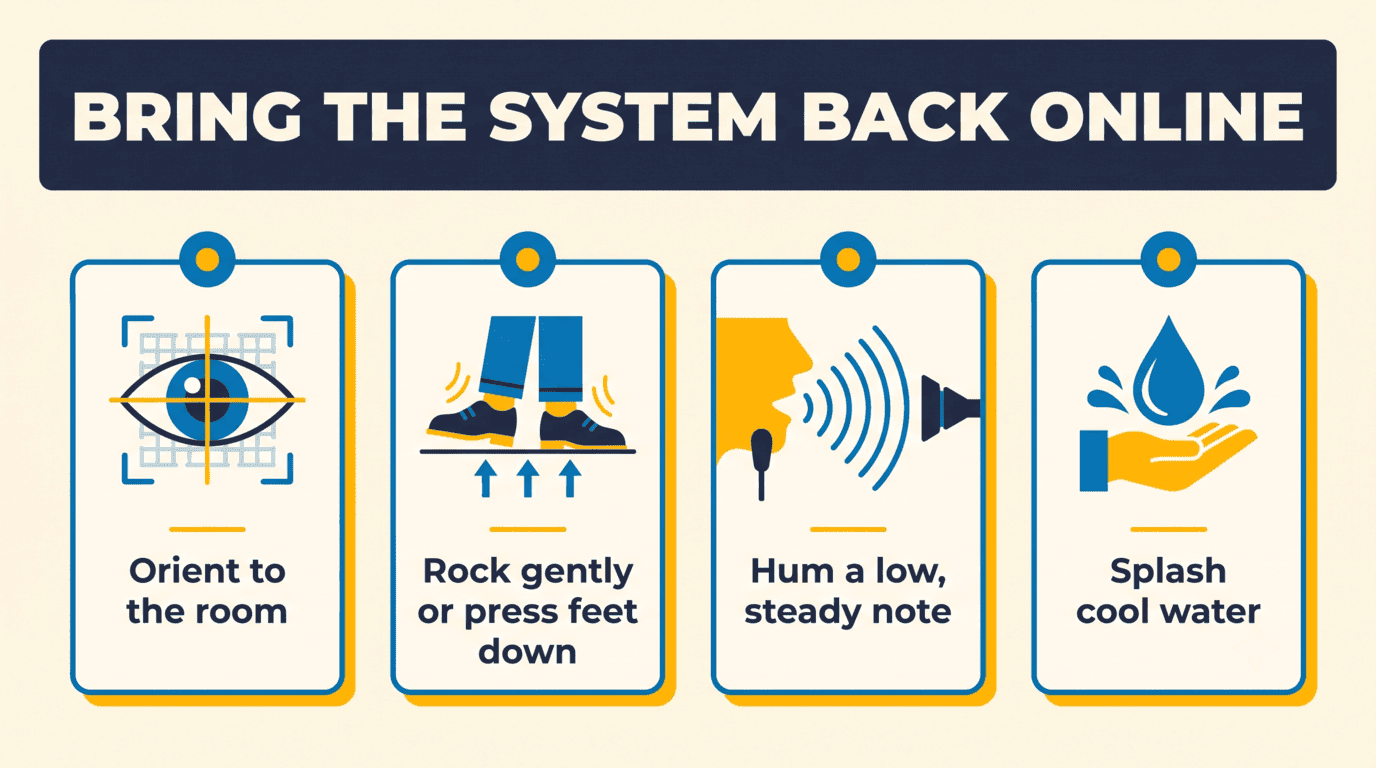
- Orient to the room by slowly naming 5 things you can see, letting your eyes and head actually move to find them
- Rock gently side to side or press your feet into the floor and notice the contact, small rhythmic movement without much effort
- Hum a low, steady note for 20 to 30 seconds, which gives the body something active to do without demanding much energy
- Splash cool water on your hands or face, a mild jolt that’s usually enough to nudge alertness without overwhelming the system
- Stand up and change your position or location, even a few steps, since staying still tends to reinforce the shutdown
These exercises stay small and low-demand on purpose. Asking a shut-down nervous system for a big, energetic exercise usually backfires, since there isn’t enough activation available yet to meet that demand; the goal is a nudge, not a jump-start.
When the Technique Doesn’t Match the State
Somatic-wellness educators who run grounding workshops often see this exact pattern play out. Someone in a shut-down, hypoaroused state reaches for a slow, calming breathing exercise, the kind of technique that’s genuinely useful for hyperarousal, because it’s the one they’ve heard about most. Instead of settling, they report feeling further away, more foggy, harder to reach.
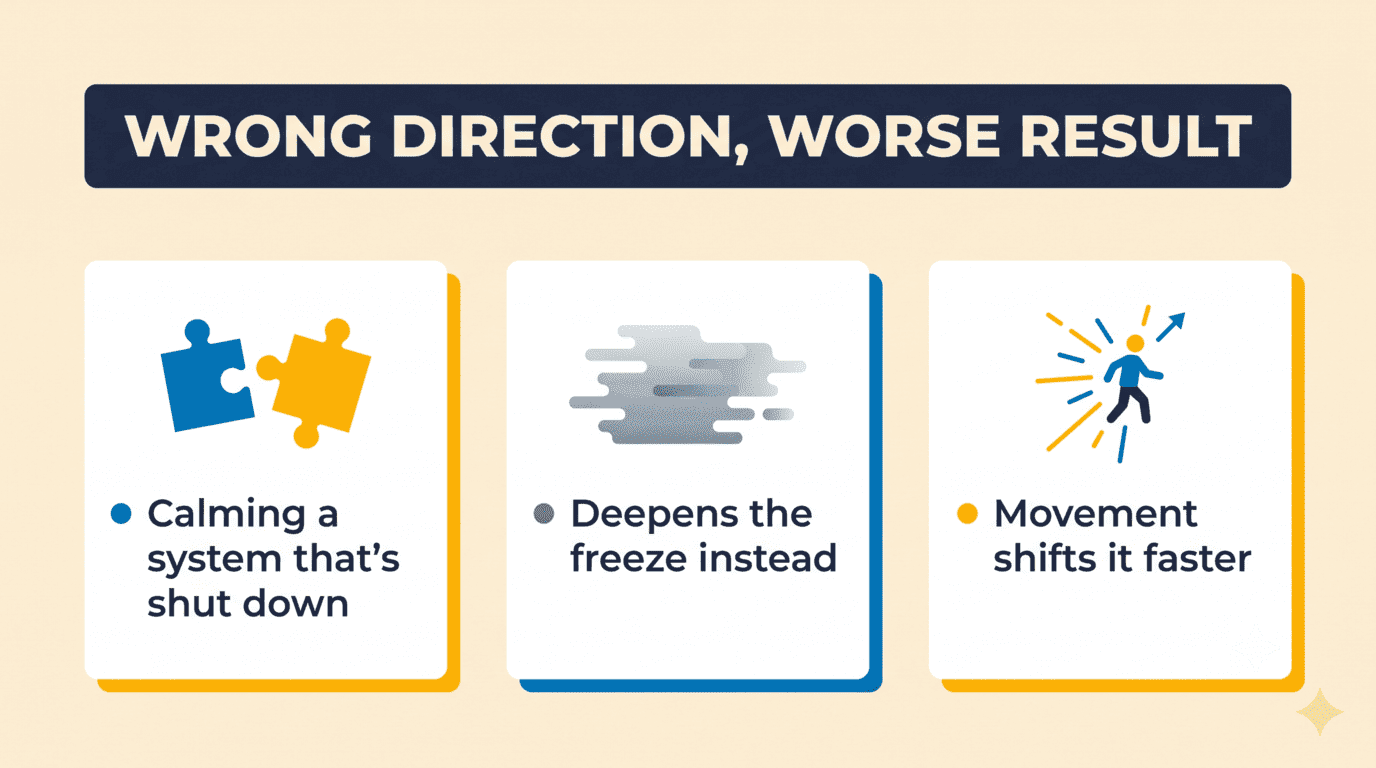
The mismatch makes sense once the direction is named. A slow-breathing technique asks an already-shut-down system to slow down even more, which deepens the freeze rather than resolving it. When the same person switches to something with a small amount of movement and sensory input, orienting around the room, a few seconds of humming, the shift tends to happen within a couple of minutes.
This composite pattern (illustrative of what shows up repeatedly in workshop settings, not a single documented individual) is the clearest argument for learning the two categories before learning any specific exercise. The category tells you which direction to move; the exercise is just the vehicle.
Related: 3 Types of Somatic Therapy
Related: Somatic Dissociation
Related: Health & Mental Wellbeing
When to Get Outside Support
A state that keeps snapping back even after a matched exercise works, hyperarousal that returns within minutes, or hypoarousal that never quite lifts, is useful information rather than a sign the technique failed. It often means the underlying activation is bigger than a single exercise is designed to move, not that the exercise itself was wrong.
These exercises are meant as everyday regulation tools, not a treatment for trauma on their own. If shutdown or activation is frequent, severe, or tied to a trauma history, a therapist trained in a body-based modality can help build a wider window of tolerance in a structured, supported way, something worth pursuing rather than working through alone if it feels too big for daily tools to touch.
Frequently Asked Questions
How do I know if I’m in hyperarousal or hypoarousal?
Hyperarousal usually feels fast, jittery, and on edge, a racing heart, tight muscles, racing thoughts. Hypoarousal usually feels slow, heavy, and distant, fog, flat mood, low energy, or a sense of watching yourself from outside. If you’re not sure, notice whether your body wants to move fast or barely move at all, that’s usually the clearest signal.
Can I do somatic exercises without a therapist?
Yes, for everyday regulation. Simple discharge and gentle activation exercises are commonly used as standalone tools for mild, day-to-day dysregulation. Frequent or severe shutdown and activation, especially tied to a trauma history, is better supported by a therapist trained in a body-based modality.
How long does it take to feel a shift from a somatic exercise?
Often a few minutes, sometimes less. Discharge exercises for hyperarousal frequently produce a noticeable shift, a deeper breath, softer shoulders, within a minute or two. Gentle activation for hypoarousal tends to be more gradual, since the goal is a small nudge rather than a fast change.
What if neither type of exercise seems to help?
That’s worth bringing to a professional rather than troubleshooting alone. It can mean the exercise and the state are still mismatched, that the dysregulation is more severe than a self-directed tool is built to address, or that something else, like an untreated anxiety or mood condition, is part of the picture.