
Concentrated Wisdom Editorial Team researches, writes, and fact-checks this guide against primary sources before publication.
This article is for informational purposes only and isn’t a substitute for personalized professional advice.
Somatic dissociation is the bodily form of dissociation, numbness, feeling outside your body, or reduced pain sensation, distinct from cognitive dissociation, which shows up as derealization, depersonalization, or distorted time. Researchers measure the two with different tools because they don’t always overlap. Generic grounding advice often fails here because a technique built for racing thoughts doesn’t address a body that’s gone numb. This guide matches a specific grounding technique to each common somatic dissociation symptom, and notes when significant or persistent symptoms warrant professional support rather than self-guided grounding alone.
Somatic dissociation refers to the bodily, physical form of dissociation, distinct from cognitive or psychological dissociation. Researchers describe somatoform dissociation as a lack of integration of somatic experience, showing up as numbness, reduced pain sensation (analgesia), motor inhibition, or a sense of being outside or disconnected from the body, while cognitive dissociation shows up as derealization, depersonalization, or distorted time and space. The two are measured with different research tools, the Somatoform Dissociation Questionnaire for bodily symptoms and the Dissociative Experiences Scale for psychological ones, because a person can experience one without the other. Generic grounding advice, like naming objects in a room, is built for cognitive dissociation and often does little for someone whose primary symptom is bodily numbness or reduced pain sensation, since it doesn’t engage the body directly. Matching the grounding technique to the specific symptom, movement and pressure for numbness, orienting the senses for feeling outside the body, temperature and texture for reduced pain sensation, tends to work better than a single generic technique. Significant or persistent somatic dissociation symptoms warrant an evaluation from a licensed mental health professional rather than self-guided grounding alone.
Somatic dissociation is the bodily form of dissociation, numbness, reduced pain sensation, or feeling outside your own body, and it’s measured and treated differently from cognitive dissociation, which shows up as derealization or a distorted sense of time.
Somatic vs Cognitive Dissociation
Dissociation isn’t one experience, it splits into two measurably different categories. Somatoform dissociation refers to a lack of integration of the body’s own experience, showing up as numbness, reduced pain sensation, motor inhibition, or loss of physical sensation, while cognitive dissociation involves mental experiences like derealization and depersonalization.
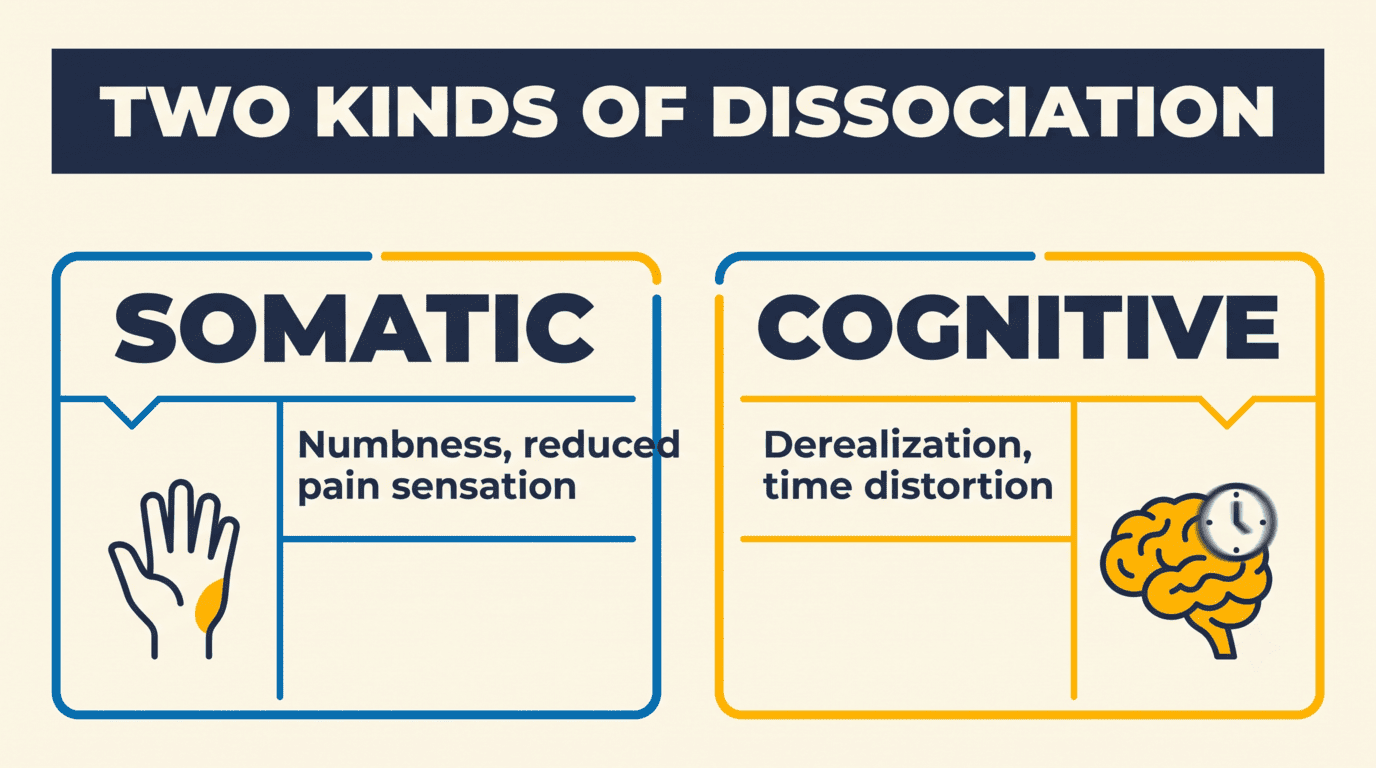
This distinction isn’t just academic. Researchers use different measurement tools for each, the Somatoform Dissociation Questionnaire for bodily symptoms and the Dissociative Experiences Scale for psychological ones, specifically because a person can experience one without the other, and most dissociation research has historically focused on the cognitive side, leaving somatic symptoms under-recognized in both research and everyday grounding advice.
Both forms are commonly linked to overwhelming or prolonged stress, a nervous system that couldn’t fight or flee a threat sometimes disconnects from the body instead, as a way of surviving what it couldn’t otherwise escape. That disconnection can fade once the threat passes, or it can persist as a pattern the body keeps returning to under much smaller amounts of stress, long after the original situation is over.
Why the Body Disconnects in the First Place
The mechanism behind this is the same one behind fight or flight, just a different branch of it. The amygdala, the brain’s threat-detection center, signals danger and normally primes the body to fight or flee. When neither option is available, when the threat is too overwhelming, too prolonged, or impossible to escape, the nervous system can shift into a third pathway instead.
Polyvagal theory describes this third pathway as dorsal vagal shutdown, a primitive survival response that produces collapse, numbness, and dissociation rather than mobilization, the physiological opposite of the racing heart and alertness of fight or flight. It’s the same shift this guide has already pointed to, a nervous system that couldn’t fight or flee disconnecting from the body instead, this is simply the specific circuitry involved. Understanding it as a survival adaptation rather than a malfunction is part of why grounding techniques work: they’re not correcting a broken system, they’re gently signaling to it that the threat has passed and reconnection is safe.
This is why a generic grounding technique built for racing, unreal-feeling thoughts often does little for someone whose main symptom is a body that’s gone quiet or numb, the mismatch is between the technique’s target and the actual symptom, not a sign the technique failed in general.
Common Somatic Dissociation Symptoms
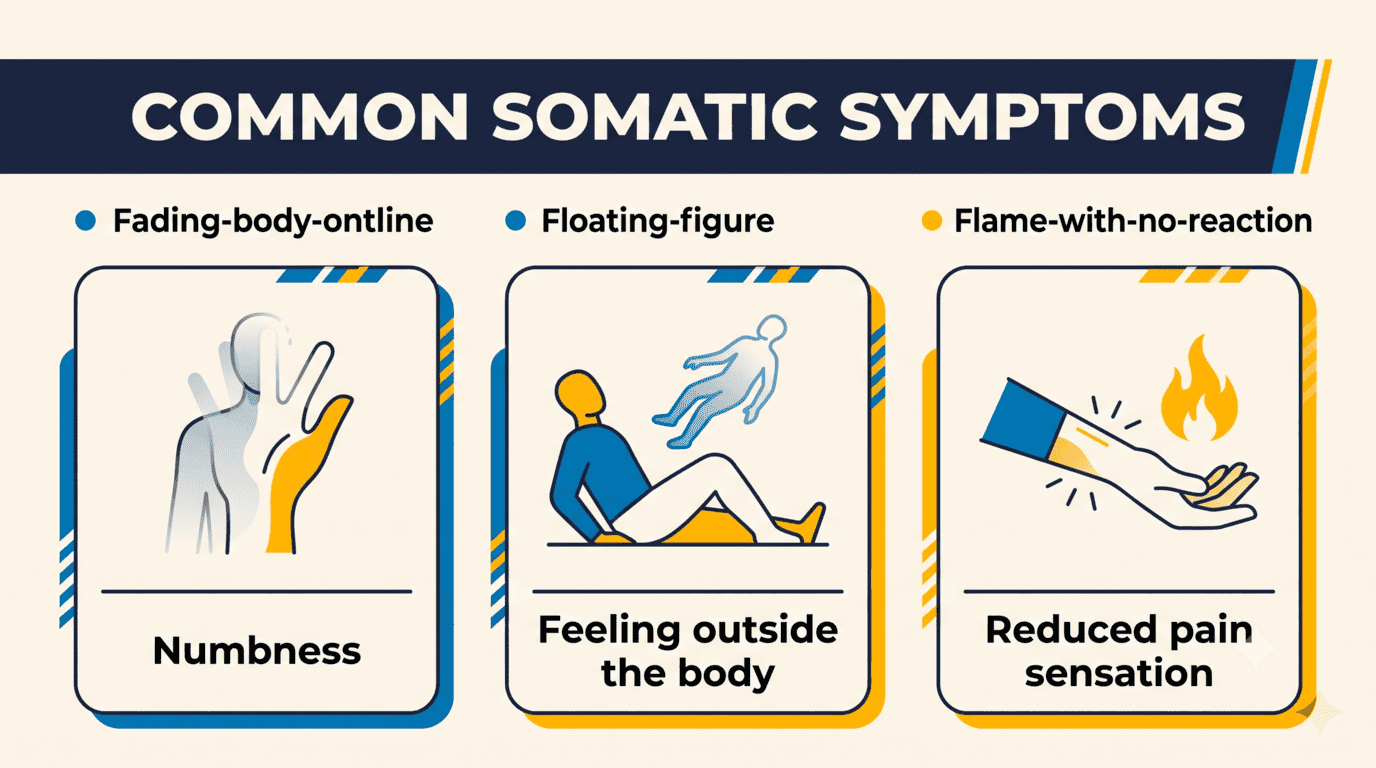
These three symptoms are the ones most consistently described in somatoform dissociation research, and they can appear alone or together, briefly during a single stressful moment or as a recurring pattern. None of them, on their own, mean something is seriously wrong, they’re a signal that the nervous system disconnected from part of the body’s experience, and the goal of grounding is reconnection, not correction.
Numbness
A sense that part or all of the body feels absent, muted, or hard to locate, not the tingling of a limb falling asleep, but a broader sense of the body going quiet or distant. People sometimes describe it as their hands or torso feeling like they belong to someone else, or simply not being there.
Feeling Outside Your Body
A sense of watching yourself from a small distance, above, beside, or behind where you actually are, sometimes described as feeling like a passenger in your own body rather than the one driving it. This can happen briefly during a stressful moment or persist for longer stretches.
Reduced Pain Sensation
Analgesia, not noticing an injury until later, or a touch or temperature that would normally register as sharp or uncomfortable barely registering at all. This is one of the specific symptoms researchers use to distinguish somatoform dissociation from ordinary distraction or high pain tolerance, since it tends to appear alongside other somatic symptoms rather than as an isolated trait.
A Grounding Technique for Each Symptom
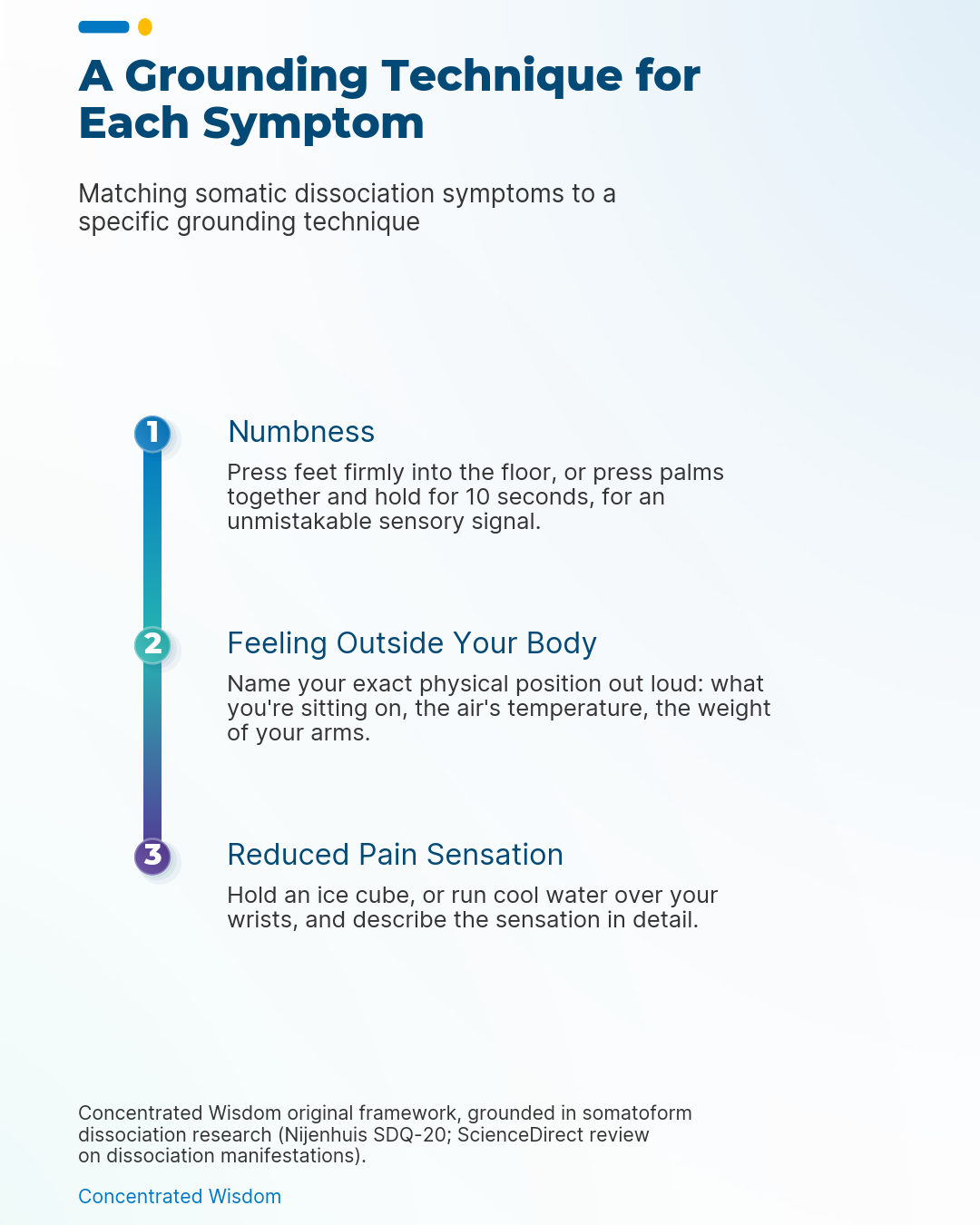
Matching the technique to the specific symptom works better than reaching for one generic method every time, since each symptom disconnects a slightly different part of bodily experience, and the technique that reconnects one doesn’t always reach another. Each of these is a general, low-risk technique meant for everyday grounding, not a clinical protocol.
| Symptom | Grounding Technique | Why It Works |
|---|---|---|
| Numbness | Press feet firmly into the floor, or press palms together and hold for 10 seconds | Deliberate pressure gives the nervous system a strong, unmistakable sensory signal to locate |
| Feeling outside your body | Name your exact physical position out loud: what you’re sitting on, the temperature of the air, the weight of your arms | Orienting to concrete physical details pulls attention back to where the body actually is |
| Reduced pain sensation | Hold an ice cube, or run cool water over your wrists, and describe the sensation in detail | A strong, safe temperature sensation is often easier to register than light touch when pain sensitivity is dampened |
These techniques work best practiced for thirty to sixty seconds at a time, repeated rather than extended, since a longer single attempt doesn’t necessarily work better than a few short ones. If a technique doesn’t shift anything after a few honest tries, that’s useful information, not a failure, and it’s worth trying the technique matched to a different symptom instead.
When more than one symptom shows up at once, start with whichever technique feels most physically accessible in the moment rather than trying all three at once, a single grounded sensation is usually enough to begin loosening the others, since these symptoms tend to ease together once one reconnection point is found.
Related: Somatic Exercises for Nervous System Regulation
Finding the Technique That Actually Fits
People who teach grounding skills in trauma-informed group settings often see the same pattern: someone arrives already having tried the standard five-senses grounding exercise several times without much change. The generic technique wasn’t wrong, it just wasn’t built for their specific symptom, their main experience wasn’t racing or unreal-feeling thoughts, it was a body that had gone quiet and hard to feel. Once they tried a pressure-based technique instead, firm palm presses, feet pressed into the floor, something shifted faster than any amount of naming objects in the room had. The lesson instructors describe passing on isn’t that pressure works for everyone, it’s that identifying the specific symptom first, before picking a technique, saves people from concluding grounding “doesn’t work for them” when the real issue was a mismatch.
When These Symptoms Need Professional Support
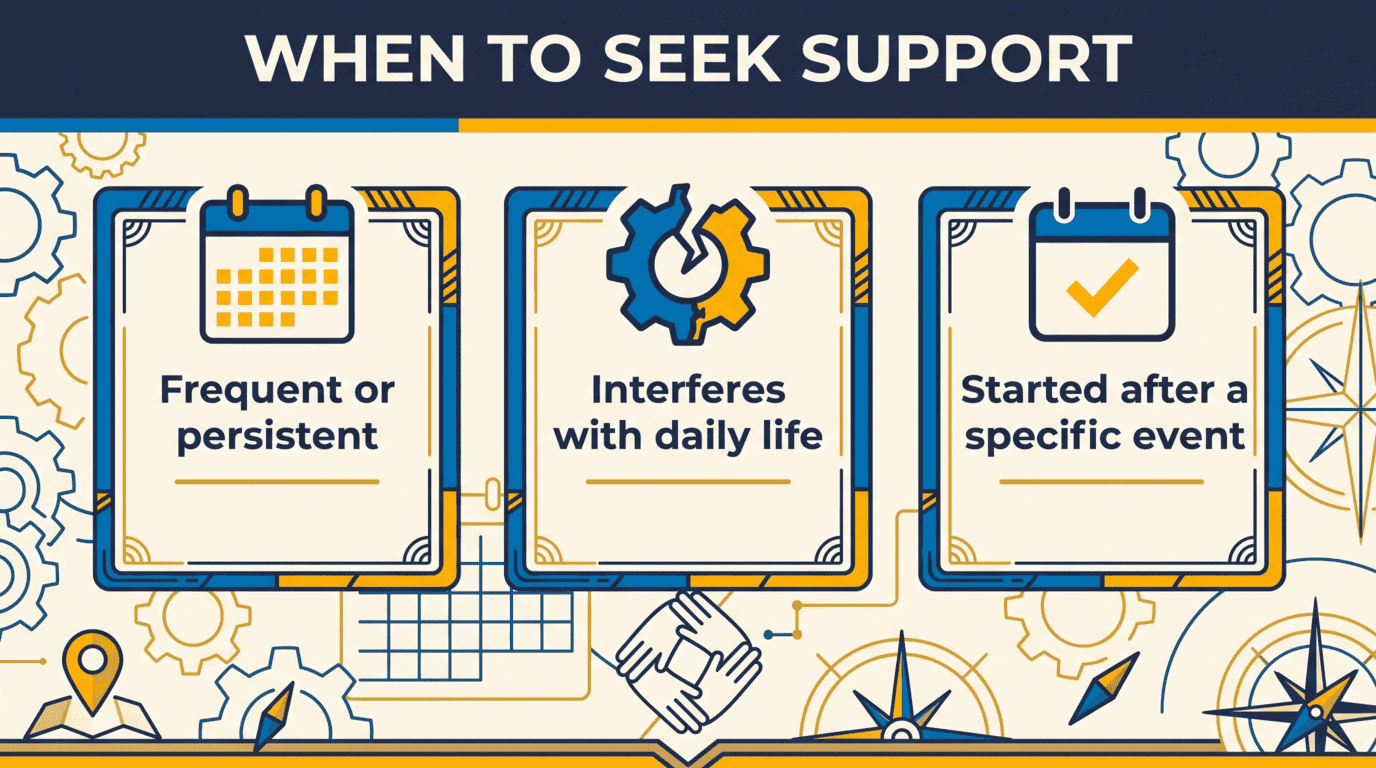
Occasional mild numbness or a brief moment of feeling outside your body during a stressful day is common and not usually a sign of anything serious on its own. Symptoms that are frequent, persistent, interfere with daily functioning, or that grounding techniques don’t reliably ease, are worth bringing to a licensed mental health professional, ideally one with experience in trauma-related or dissociative symptoms specifically.
This article describes general, safe grounding techniques for everyday somatic dissociation. It isn’t a diagnostic tool, and significant or ongoing dissociative symptoms, especially any that involve memory gaps, losing time, or a sense of disconnection that doesn’t resolve, warrant a full evaluation rather than self-guided grounding alone. A licensed professional can also help identify what’s driving the pattern, which matters more for lasting change than any single grounding technique.
Related: Pendulation Somatic Experiencing
Related: Health & Mental Wellbeing
Quick Summary
Somatic dissociation is the bodily form of dissociation, numbness, feeling outside your body, and reduced pain sensation, distinct from cognitive dissociation’s derealization and time distortion. Generic grounding advice is often built for the cognitive kind and misses the somatic kind. Matching the technique to the symptom, pressure for numbness, orienting to physical position for feeling outside the body, temperature for reduced pain sensation, tends to work better than one generic method. Frequent, persistent, or functionally disruptive symptoms warrant an evaluation from a licensed mental health professional rather than self-guided grounding alone.
Frequently Asked Questions
What is somatic dissociation?
Somatic dissociation is the bodily form of dissociation, a lack of integration of physical experience that shows up as numbness, reduced pain sensation, motor inhibition, or a sense of being outside your own body. It’s distinct from cognitive dissociation, which involves mental experiences like derealization and depersonalization.
Why do generic grounding techniques not always help?
Many common grounding techniques, like naming objects you see, were built for cognitive dissociation, racing or unreal-feeling thoughts, and don’t directly engage a body that’s gone numb or hard to feel. Matching the technique to the specific symptom, pressure, orienting, or temperature, tends to work better than one generic method for everyone.
Is somatic dissociation the same as depersonalization?
They overlap but aren’t identical. Depersonalization, feeling detached from your sense of self, is generally classified as a cognitive dissociation symptom, while somatic dissociation refers specifically to bodily symptoms like numbness or reduced pain sensation. A person can experience either one without the other.
When should I see a professional about dissociation symptoms?
If symptoms are frequent, persistent, interfere with daily functioning, or don’t ease with grounding techniques, it’s worth seeing a licensed mental health professional with experience in trauma-related or dissociative symptoms. This is especially true for any symptom involving memory gaps or losing stretches of time.