

Free Download
Morning Journal Prompts for Kids (A Simple Daily Routine)
A print-ready PDF version of this guide. No email required.
Concentrated Wisdom Editorial Team researches, writes, and fact-checks this guide against primary sources before publication.
This article is educational content, not a diagnosis or treatment, and isn’t a substitute for guidance from your child’s teacher or a licensed child development professional. A morning journal habit supports everyday emotional awareness, it is not a clinical intervention.
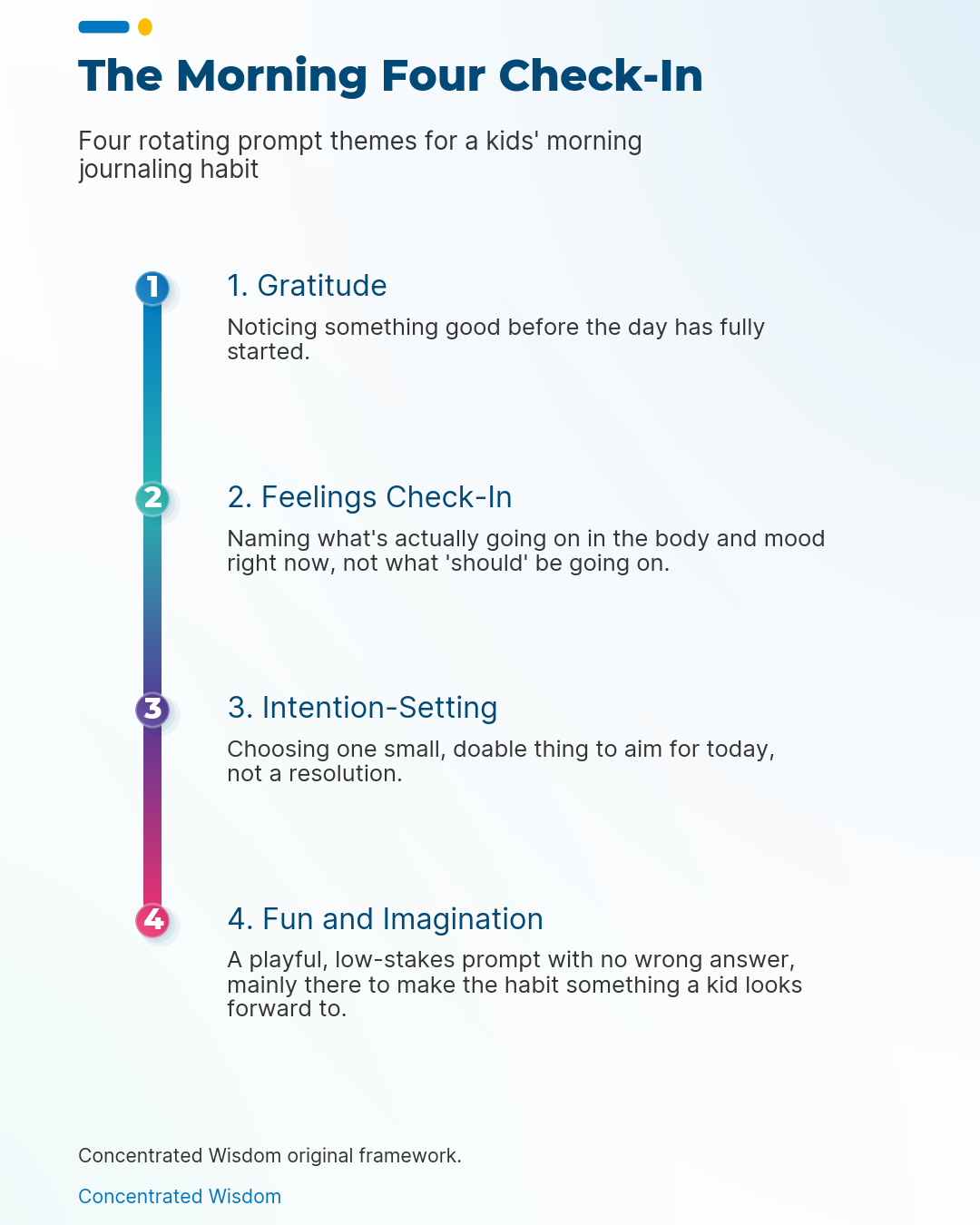
This guide organizes morning journal prompts for kids into what Concentrated Wisdom calls the Morning Four Check-In, a rotating set of gratitude, feelings, intention, and imagination prompts, each answerable in 2 to 5 minutes, built to attach to a routine a family already has, like breakfast. It explains why mornings specifically work well for this habit, grounded in real research on children and daily routines, gives 24 real prompts organized by theme, and covers how to keep the habit low-pressure enough that it actually lasts.
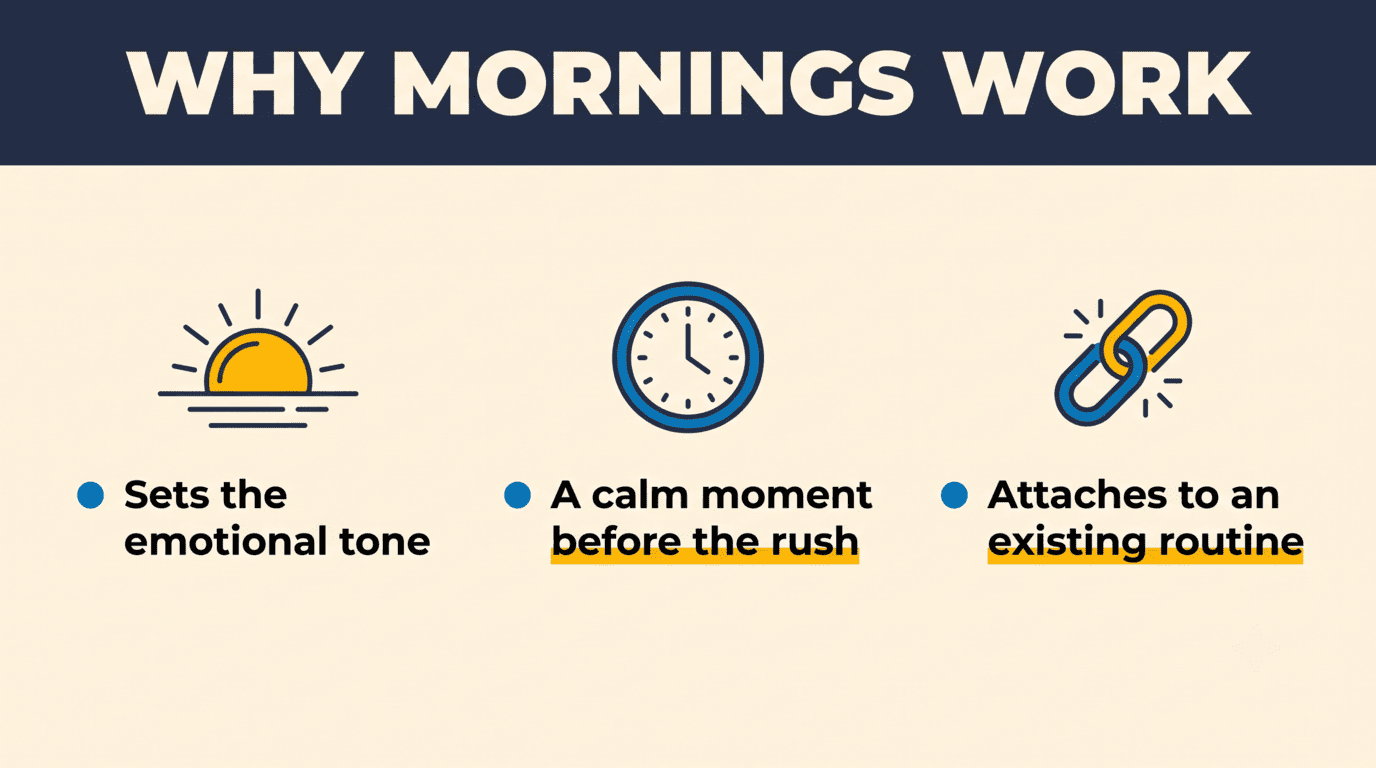
Good morning journal prompts for kids are short, answerable in 2 to 5 minutes, and attached to an existing part of the morning, like breakfast, rather than added as a separate task. They tend to fall into four themes, gratitude, such as what’s one thing you’re excited about today, a feelings check-in, such as how does your body feel this morning, intention-setting, such as what’s one kind thing you could do today, and imagination, such as if today were a color what color would it be and why. Mornings work well for this habit because they set the emotional tone for the rest of the day, offer a predictable calm moment before the rush of school, and are easier to build into a lasting habit when tied to something a family already does every day. A pre-writer can answer with a picture or a single word instead of full sentences, the point is a brief daily moment of reflection, not a writing assignment.
Why Mornings Work Well for a Kids’ Journaling Habit
A morning journal prompt for kids works better as a habit than most other times of day for one simple reason, it happens before the day has a chance to go sideways. A prompt answered at 7:15am shapes how a child walks into the rest of their morning. The same prompt answered at bedtime is really a reflection on a day that’s already over, which is a different and equally valid exercise, just not the one this guide is about.
In practice, families who ask Concentrated Wisdom about journaling habits for kids almost always describe the same failure pattern first, they tried a bedtime journal, the child was too tired to engage, and the habit quietly died within two weeks. Moving the same short prompt to the breakfast table, when a child is naturally more alert and the household already has a fixed few minutes together, tends to outlast the bedtime version by months, not days.
There’s a real developmental reason a predictable morning moment helps beyond just convenience. A 2024 systematic review in the Journal of Family Theory & Review, which examined 170 studies on children and daily routines, found that predictable routines, like set bedtimes, family meals, and daily chores, were linked to better impulse control, attention, and emotional regulation in kids. The review’s plain explanation for why is worth repeating directly, kids are able to manage their feelings because they know what to expect. A two-minute journal prompt at the same point in the morning, every morning, is exactly that kind of small, expected anchor.
Related: Growth Mindset Worksheet for Kids
The third reason is the most practical one, a habit is easier to build when it attaches to something a family already does reliably. This is sometimes called habit stacking, a term popularized by James Clear’s book Atomic Habits, though the underlying idea is older. As Cleveland Clinic psychologist Dr. Lauren Alexander explains, the thinking is that engaging in an already-existing habit cues you to do the new one automatically, without relying on willpower or memory. Breakfast is the natural anchor for most families, it happens daily, at roughly the same time, and a journal or notebook can simply live at the table.
What Makes a Morning Prompt Actually Kid-Friendly
A genuinely kid-friendly morning prompt is short, flexible in format, and asks exactly one thing. It is not a 20-minute writing assignment, and treating it like one is the single most common way parents accidentally kill a journaling habit before it starts.
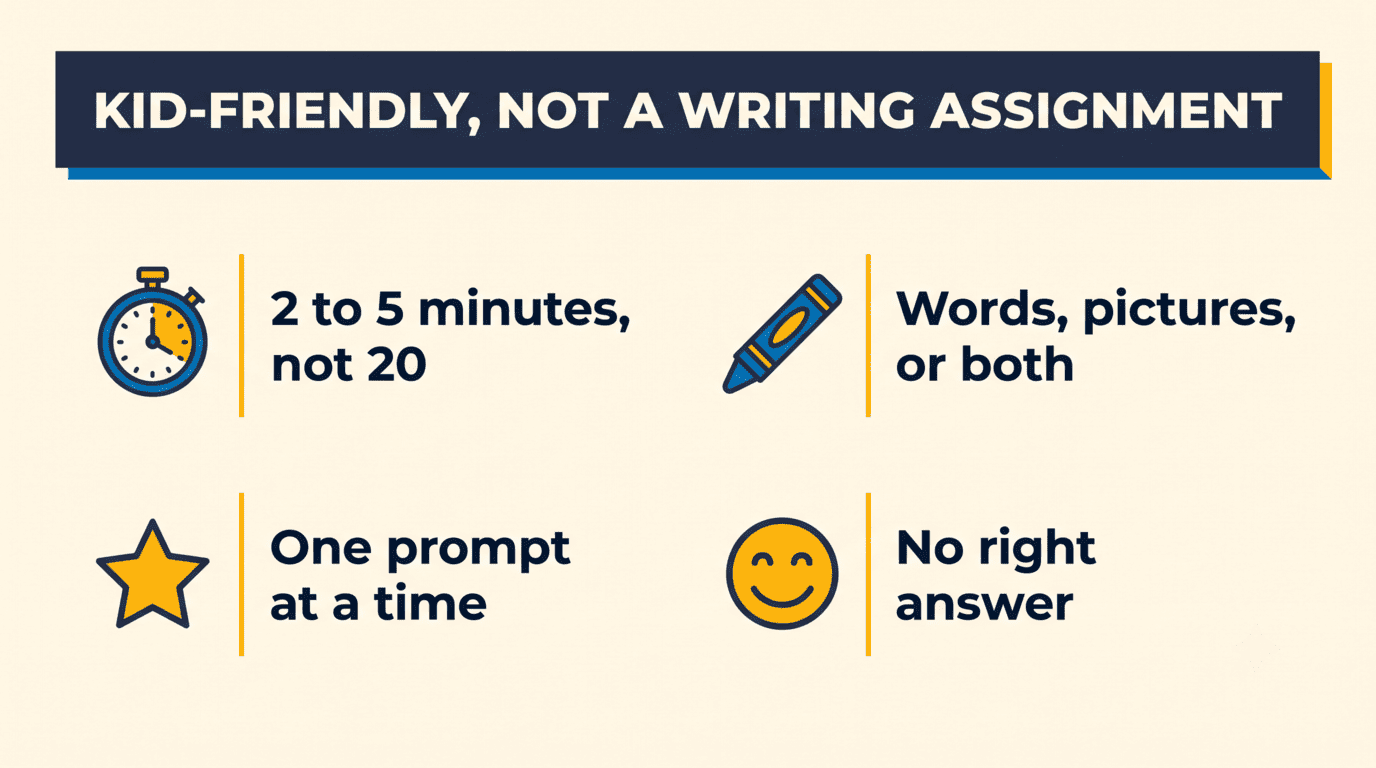
- Answerable in 2 to 5 minutes, not a full writing period
- One question at a time, not a page of prompts to work through
- Open to any format, a sentence, a single word, a drawing, or a sticker on a mood scale
- No spelling, grammar, or handwriting correction in the moment, the point is the reflection, not the writing mechanics
- The same rough time and place every day, so it doesn’t need to be negotiated fresh each morning
- Genuinely optional some mornings, without guilt attached to skipping
For a pre-writer or a reluctant writer, the picture-and-a-word version counts just as much as a full sentence. A four-year-old circling a face on a simple mood scale, or drawing the color they’d pick for the day, is doing the same reflective work as an eight-year-old writing a full paragraph, just in a format that matches their actual skill level. Forcing sentence-writing onto a child who isn’t there yet turns a two-minute reflection into a ten-minute struggle, and that struggle is what gets remembered the next morning.
The Morning Four Check-In, a Simple Way to Rotate Prompts
Concentrated Wisdom calls this rotation the Morning Four Check-In, four prompt themes that cover a genuinely different piece of a child’s inner world each time, so the same handful of questions don’t go stale after a week. Instead of picking one prompt style and repeating it daily, cycle through all four across the week.
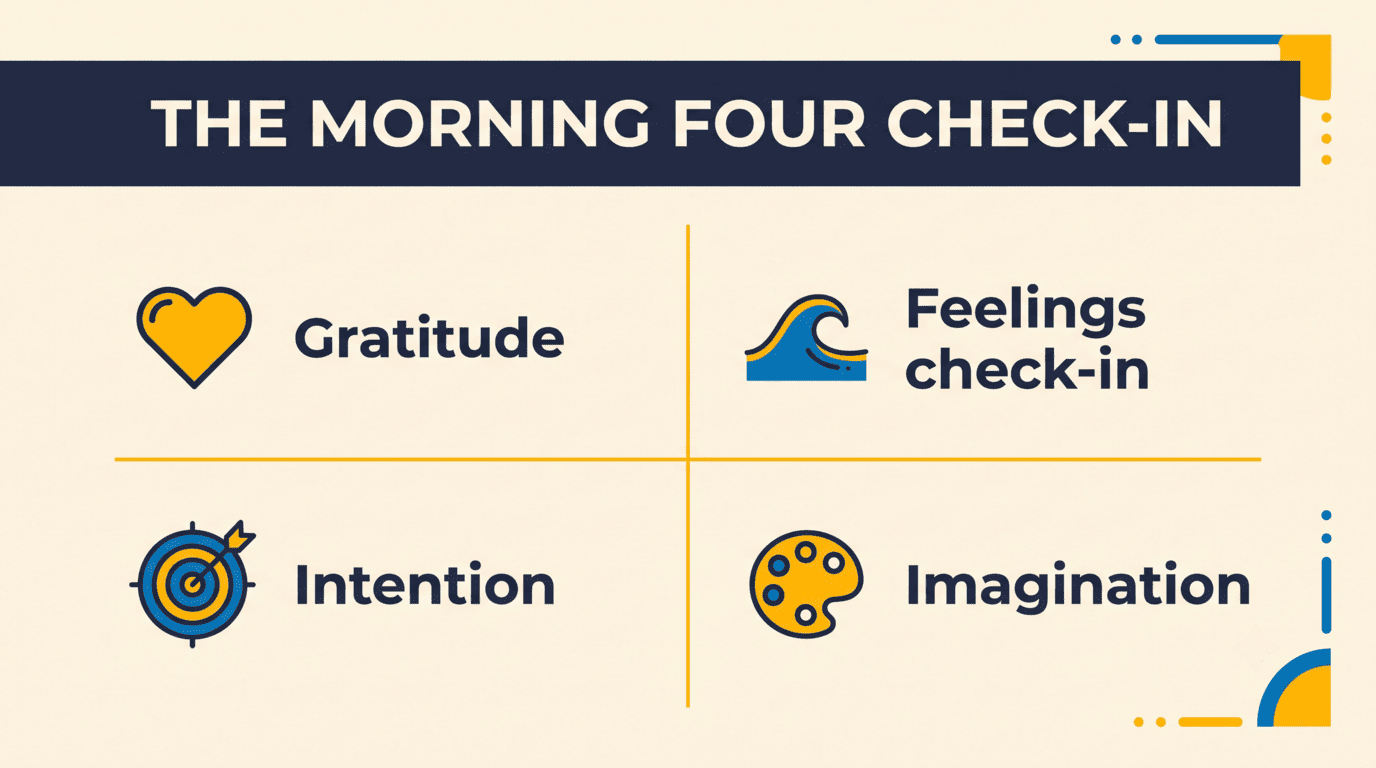
- Gratitude, noticing something good before the day has fully started
- Feelings Check-In, naming what’s actually going on in the body and mood right now, not what “should” be going on
- Intention-Setting, choosing one small, doable thing to aim for today, not a resolution
- Fun and Imagination, a playful, low-stakes prompt with no wrong answer, mainly there to make the habit something a kid looks forward to
The fourth category matters more than it looks like it should. A journaling habit that’s all reflection and no play rarely survives a full school year. The imagination prompts are what keep a seven-year-old actually wanting to open the notebook on a Tuesday.
24 Morning Journal Prompts for Kids, Organized by Theme
Below are 24 real prompts, six per theme, ready to use as they are or read aloud for a child who’d rather answer out loud than write. Pick one a morning, not all six at once.
Gratitude Prompts
- What’s one thing you’re excited about today
- Who is someone that made you smile recently
- What’s a small thing in your room that you’re glad you have
- What’s something about today that you’re looking forward to, even a little
- What’s a food, place, or activity you’re grateful you get to enjoy this week
- What’s one thing about your family that makes you feel lucky
Feelings Check-In Prompts
- How does your body feel this morning
- If your mood this morning were weather, what would it be
- What’s one word for how you feel right now
- Is there anything on your mind that you want to talk about before school
- On a scale of calm to wild, where do you feel like you’re starting today
- What’s something that would help you feel a little more ready for the day
Intention-Setting Prompts
- What’s one kind thing you could do today
- What’s one small goal for today, something you can actually finish
- Who could you be a good friend to today
- What’s one thing you want to try your best at today
- What’s a challenge you might face today, and how could you handle it
- What’s one thing you can do today to make someone else’s day better
Fun and Imagination Prompts
- If today were a color, what color would it be, and why
- If you could have any animal as a sidekick for the day, who would you pick
- If you woke up with a superpower this morning, what would it be
- What’s a silly thing that would make today better
- If today were a song, what kind of song would it be
- What’s one made-up word you’d invent for how you feel right now
Adapting the Prompts for Tweens and Older Kids
The four themes above work from roughly ages 4 to 14, Scholastic’s own recommended range for encouraging a kids’ journaling habit, but a tween often wants a little more identity and self-discovery mixed in, not just gratitude and mood check-ins. A few prompts that go slightly deeper work well layered into the same four-theme rotation once a child is around 10 or older:

- What’s something about yourself that’s changed in the last year
- What’s a value or belief that matters to you, and where do you think it came from
- What’s something you’re proud of that no one else really noticed
- If you could give your future self one piece of advice for today, what would it be
Related: Therapy Worksheets for Kids
How to Make a Morning Journal Habit Actually Stick
A short prompt is easy to write. Getting a child to actually reach for the notebook on a random Wednesday, three months in, is the real challenge, and it comes down to a handful of habits on the adult side more than anything about the prompts themselves.
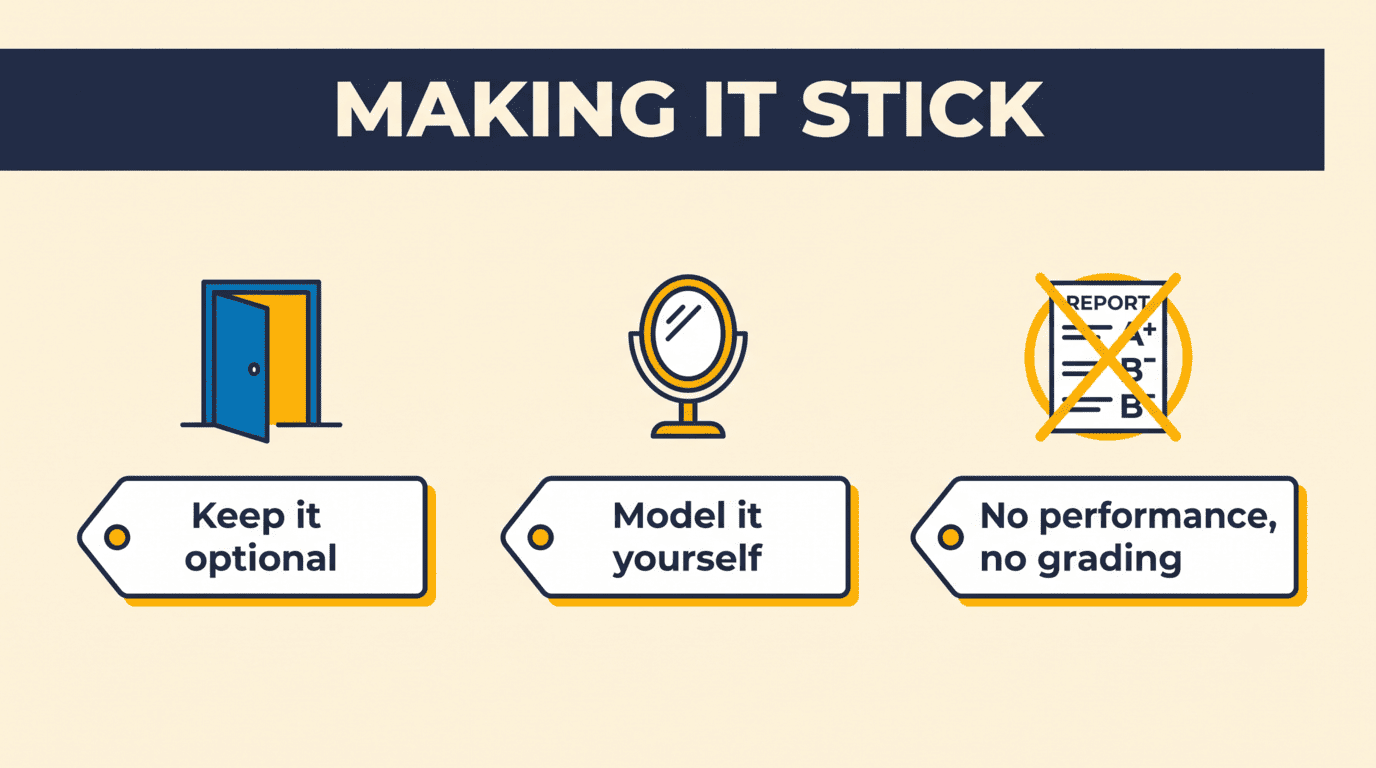
Keep It Optional, Not Mandatory
The fastest way to turn a two-minute habit into a battle is to make it non-negotiable. A missed morning is not a failure, it’s just a morning. Framing it as always available rather than always required is what keeps a child reaching for it voluntarily instead of resenting it.
Model It Yourself
Kids notice whether an activity is something adults actually do or just something adults assign. Filling in your own one-line answer at the same table, out loud or on your own notebook page, does more to keep the habit alive than any reminder or sticker chart. It also quietly models that naming a feeling out loud is a normal, unremarkable thing adults do too.
Don’t Turn It Into a Performance or a Grading Situation
Correcting spelling, pushing for a “better” answer, or reading the entry back critically all send the same message, this notebook is being evaluated. Once a child suspects that, the honest, quick answers disappear and get replaced with whatever answer they think will please the adult reading it, which defeats the entire purpose. Read the answer, respond warmly if it’s shared out loud, and leave it there.
Related: Mental Health Activities for Kids
When a Daily Prompt Isn’t Quite Enough
A loose piece of paper works for a week or two. What tends to fade fastest is not the idea, it’s the logistics, a prompt that has to be found, printed, or invented fresh each morning eventually gets skipped simply because it’s one more thing to locate before the school bus arrives.

The research on journaling more broadly backs up why it’s worth solving that logistics problem rather than letting the habit quietly disappear. According to the Child Mind Institute, writing about emotional experiences, a concept psychologist James Pennebaker calls Emotional Disclosure Theory, helps organize chaotic thoughts and can improve mood, emotional awareness, and stress levels over time. That benefit depends on the habit actually continuing, not on any single morning’s answer.
This is the exact gap Concentrated Wisdom’s Kids’ Self-Reflection and Wellness Journal was built to close, a bound, ready-made place with the Morning Four Check-In themes already built into the layout, so there’s nothing to print, invent, or search for at 7am. It’s a structure that removes the daily friction, not a requirement, the prompts in this guide work perfectly well on any notebook a family already owns.
A morning journal is a support tool, not a research intervention. If your child is dealing with something bigger than everyday morning grumpiness, like ongoing anxiety, a big life change, or a mood that doesn’t lift, a conversation with their teacher or a licensed child development professional matters more than any prompt list.
Related: Parenting & Child Development
Frequently Asked Questions
What is a good morning journal prompt for a young child
A good morning journal prompt for a young child asks one simple question and takes 2 to 5 minutes to answer, in words, a single word, or a picture. Something like what’s one thing you’re excited about today or how does your body feel this morning works well because it doesn’t require full sentences or a right answer.
How long should a kids’ morning journal habit take
Aim for 2 to 5 minutes, not a full writing assignment. The goal is a brief daily moment of reflection attached to something the family already does, like breakfast, not an additional task that competes with getting out the door on time.
Why do mornings work better than evenings for a kids’ journaling habit
Morning journaling shapes how a child walks into the rest of their day, while an evening entry only reflects on a day that’s already over. A 2024 systematic review of 170 studies in the Journal of Family Theory & Review also found predictable daily routines support kids’ impulse control, attention, and emotional regulation, and a short morning check-in works as exactly that kind of predictable anchor. (Source)
What if my child doesn’t want to journal some mornings
Let it be skipped without guilt. Treating the habit as optional rather than mandatory is one of the biggest factors in whether it lasts, a missed morning is not a failed habit, it’s just a morning, and forcing it tends to build resentment toward the entire routine.
What age should kids start journal prompts
According to Scholastic, kids can benefit from journaling roughly between ages 4 and 14, with the format adjusting as they grow. A four-year-old can circle a mood face or draw a picture, while a ten-year-old or tween can handle a short sentence and slightly more identity-focused prompts. There’s no single correct starting age, the right cue is a child showing any interest in drawing, telling, or writing about their day. (Source)
How is this different from classroom morning work worksheets
Classroom morning work, the kind found on teacher resource sites, usually mixes in phonics, math, or vocabulary practice alongside a prompt, since its main goal is academic skill practice. The morning journal habit in this guide has a single purpose, a short daily emotional check-in and reflection, with no academic subject matter or right answer to grade.