Concentrated Wisdom Editorial Team researches, writes, and fact-checks this guide against primary sources before publication.
This article is for informational purposes only and isn’t a substitute for personalized professional advice.
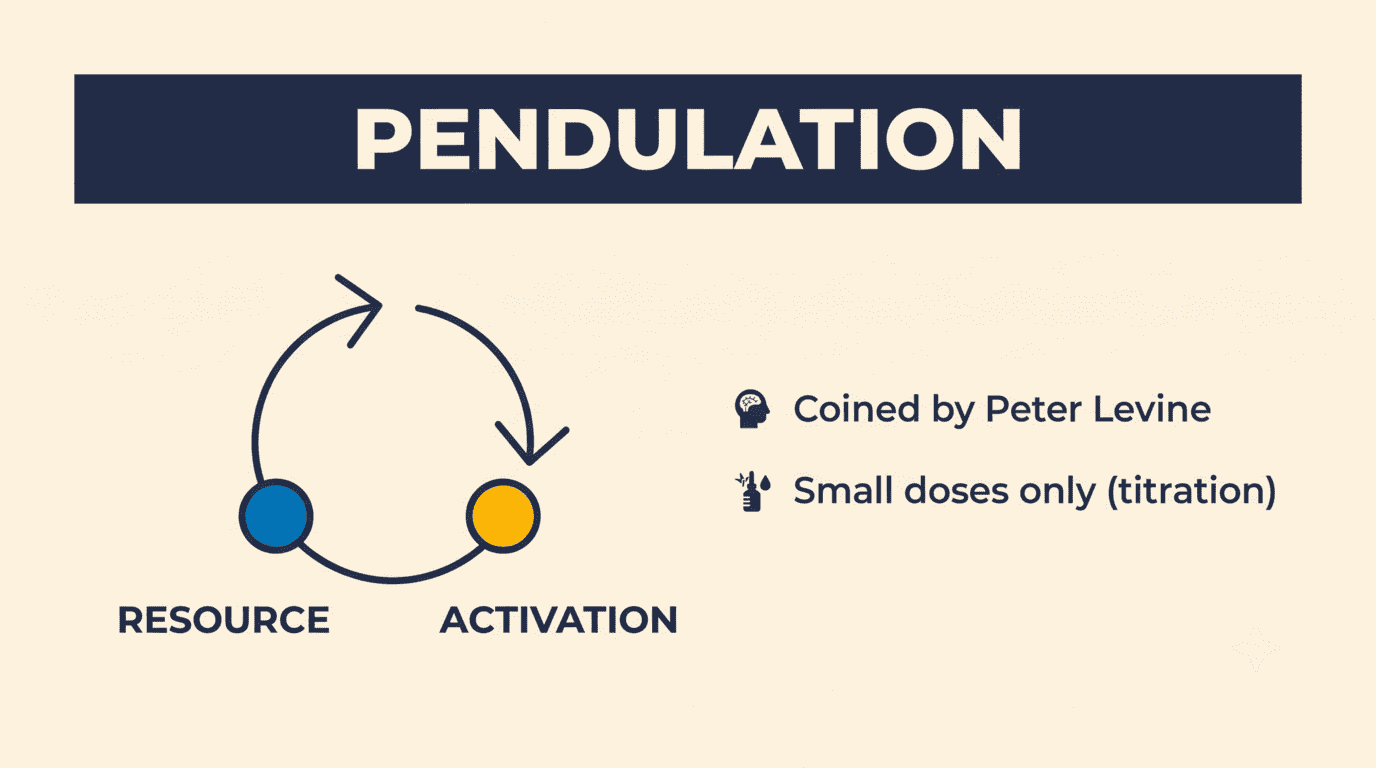
Pendulation is the Somatic Experiencing technique, developed by trauma therapist Peter Levine, of guiding attention back and forth between a settled or neutral body sensation and a mildly activated one, in small enough doses that the nervous system can process stress without being overwhelmed by it. Its underlying principle is titration, working with small pieces of activation rather than the whole charge at once. Self-guided pendulation is useful for everyday stress and mild overwhelm, but significant trauma history calls for a trained practitioner who can track the process directly.
Pendulation in Somatic Experiencing is the practice of shifting attention back and forth between a sensation of relative ease, called a resource, and a sensation connected to stress or activation, in small, manageable amounts. Peter Levine, the founder of Somatic Experiencing, coined the term to describe how the nervous system naturally oscillates between contraction and expansion, and built the technique to help that natural rhythm happen on purpose rather than getting stuck on one side of it. Pendulation works alongside a second principle called titration, which means processing a stressful sensation in small pieces instead of all at once, since flooding the system tends to reinforce shutdown rather than resolve it. A basic self-guided version involves noticing a settled sensation, briefly touching a mildly activated one, and returning to the settled sensation, repeated several times. This can help with everyday stress and mild dysregulation. It is not designed to be a self-administered treatment for significant trauma, where a trained Somatic Experiencing practitioner can track the nervous system’s response directly and adjust pacing in real time.
Pendulation is a Somatic Experiencing technique, developed by trauma therapist Peter Levine, that guides attention back and forth between a sensation of activation or discomfort and a sensation of relative ease, building nervous system capacity without overwhelming it.
What Pendulation Actually Is
Pendulation describes the nervous system’s natural rhythm of moving between contraction and expansion, and the deliberate practice of guiding that rhythm on purpose. Peter Levine,the founder of Somatic Experiencing,coined the term to describe this shifting of body sensations between expansion and contraction, built on the observation that wild animals discharge threat energy through natural movement, while humans often override that same instinct and get stuck partway through it.
The Titration Principle
Pendulation rarely works alone. It’s paired with titration, the practice of processing a stressful sensation in small pieces instead of all at once, a principle Levine describes as letting difficult material arrive in droplets rather than a flood. The two work together: pendulation supplies the back-and-forth motion, titration keeps each pass small enough to actually digest.
This is the opposite of the common advice to “sit with” a hard feeling until it passes. Sitting with an activated sensation for too long can reinforce the freeze or shutdown pattern it’s meant to relieve, which is why pendulation deliberately limits how long attention stays on the activated side before returning to something steadier.
Why the Swing Matters
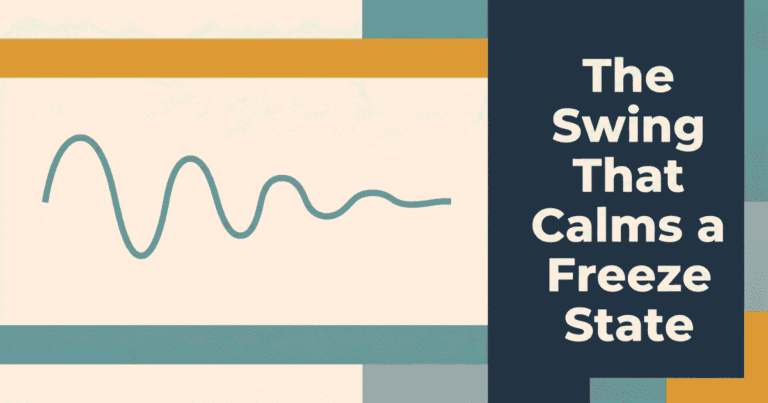
The point of the swing isn’t to avoid the activated sensation, it’s to prove, in small enough steps, that the body can visit discomfort and come back from it. Each successful round is thought to slightly widen a person’s capacity to tolerate activation without shutting down or flooding, which is why the same exercise, practiced repeatedly, tends to feel different over time: the activated sensation often gets easier to touch briefly, and the return to the resource sensation often gets faster.
This is also why speed and effort work against pendulation rather than for it. A slower, smaller swing that actually completes the return teaches the nervous system more than a longer, more intense one that doesn’t, since the return itself, not the activation, is what the practice is training.
A Self-Guided Walkthrough
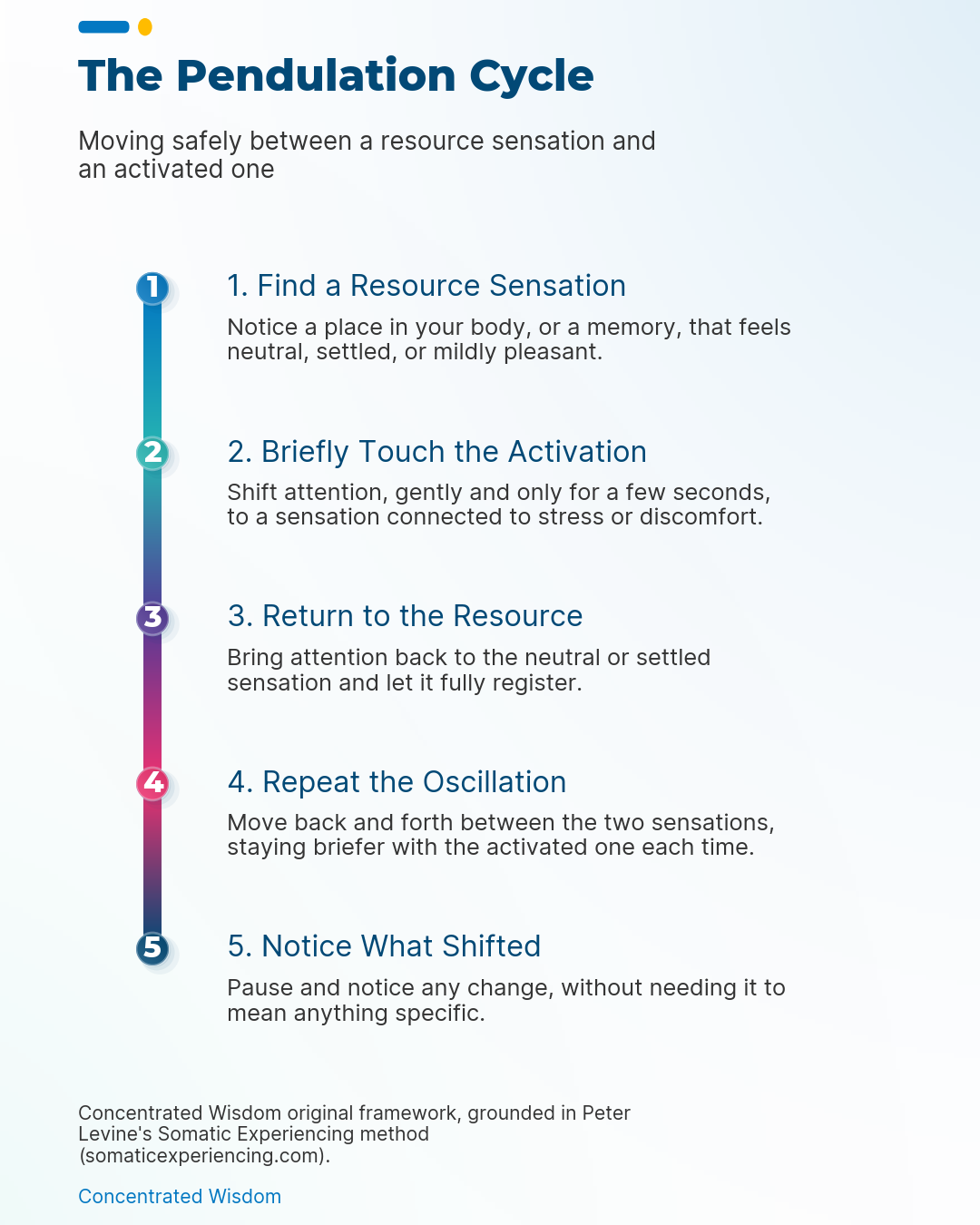
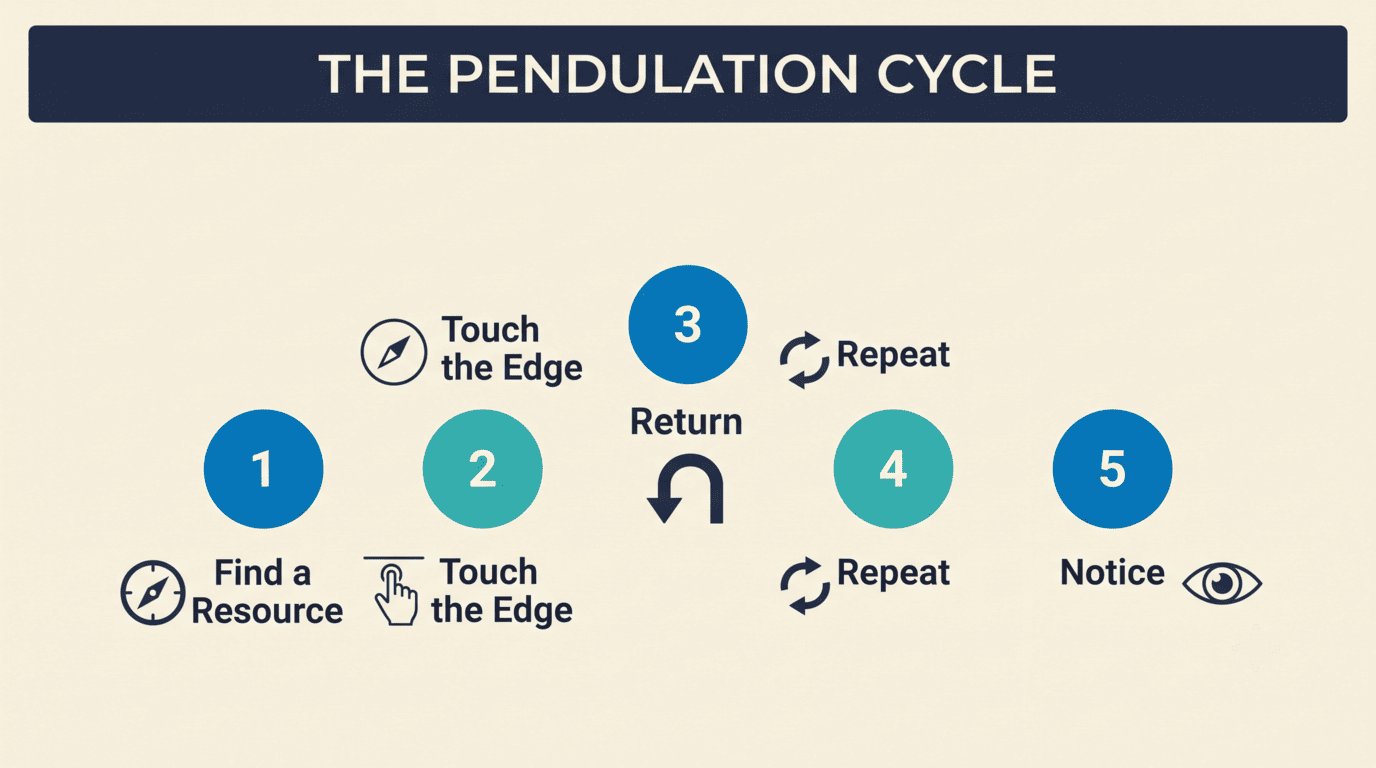
This version is meant for everyday stress and mild overwhelm, not as a stand-in for trauma processing with a trained practitioner. Go slowly, and stop if anything feels like too much rather than pushing through it. A full pass through all five steps usually takes three to five minutes, and there’s no benefit to rushing it.
Step One, Find a Resource Sensation
A resource is any sensation, image, or memory that feels neutral, settled, or mildly pleasant, your feet on the floor, the weight of your back against a chair, a place you feel safe. Let attention rest there for a few slow breaths before moving on. If nothing feels pleasant yet, neutral is enough, a resource doesn’t need to feel good, it only needs to feel steadier than the activated sensation you’re about to visit.
Step Two, Briefly Touch the Activation
Shift attention to a sensation connected to whatever feels stressful, tightness in the chest, a clenched jaw, a knot in the stomach. Stay there for only a few seconds, not until it resolves, and avoid narrating a story about it. The sensation, not the explanation, is what pendulation works with. If a full-blown memory or emotion surfaces instead of a simple body sensation, that’s a sign to shorten this step even further or pause the exercise entirely.
Step Three, Return to the Resource
Bring attention back to the settled sensation from step one and let it fully register. This return is the actual mechanism, not a break between the real steps, it’s what teaches the nervous system that activation doesn’t have to be permanent. Give this step real time, longer than the activation visit, rather than rushing straight back into another swing.
Step Four, Repeat the Swing
Move between the two sensations several more times, keeping each visit to the activated side brief, often briefer than the last. Some people notice the swing naturally slowing and softening on its own after a few passes, three to six rounds is a reasonable range for a single session, more isn’t automatically better.
Step Five, Notice What Shifted
Pause and notice anything that changed, a fuller breath, warmth, a sense of more space in the body, without needing it to mean something specific. A small, quiet shift is a complete result, not a sign the exercise didn’t work. Some people notice nothing the first few times they try this, which is also a normal outcome, not a failure.
What This Can Look Like in Practice
Somatic-wellness educators who run grounding workshops often describe a similar moment: a participant who has been sitting rigid, arms crossed, breath shallow, tries the exercise for the first time and gets stuck on step two. The activated sensation doesn’t move; it just sits there, and the participant assumes they’re doing it wrong. What usually helps isn’t more effort, it’s shortening step two even further, sometimes to a single breath, before deliberately returning to the resource. On a later pass, something small changes, a shoulder drops, the breath deepens, and the rigid posture eases without anyone naming what happened. That’s the pattern educators describe most often: the shift tends to arrive after the person stops trying to force it and simply keeps the swing brief, then trusts the return rather than the activation to do the work.
Related: Somatic Dissociation
When to Work With a Practitioner Instead
Self-guided pendulation has real limits, and knowing them matters more than the technique itself. A trained Somatic Experiencing practitioner can track your nervous system’s response in real time and adjust pacing moment to moment, something a written guide cannot do for you, since titration that looks small on paper can still be too much for a nervous system carrying significant unresolved trauma.
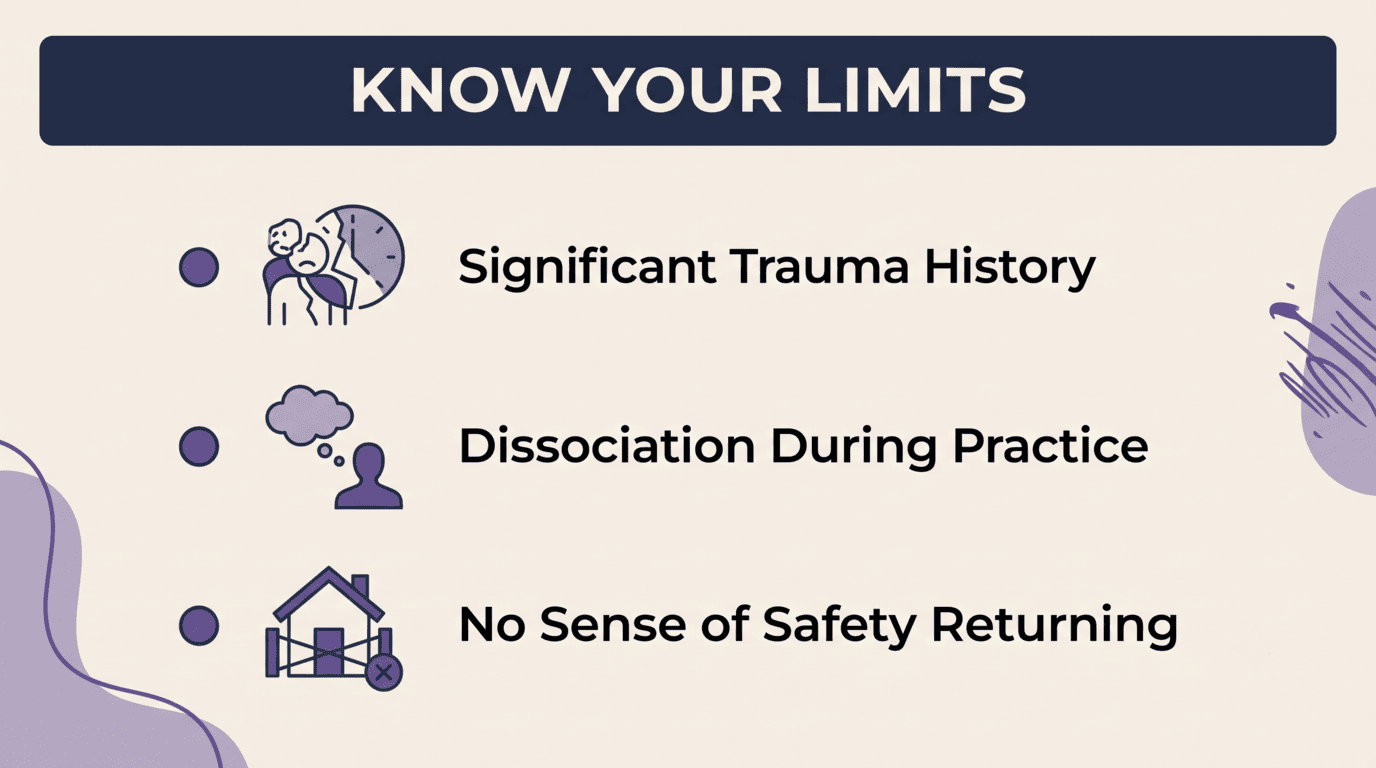
Work with a licensed practitioner rather than practicing alone if any of the following apply: you have a significant trauma history, especially involving prolonged or repeated threat; touching activation ever leads to full dissociation rather than a manageable sensation; or returning to the resource sensation doesn’t bring any sense of settling, even after several tries. None of these mean the technique failed, they mean the process needs a trained person tracking it alongside you.
If practicing on your own ever leaves you feeling more shut down, numb, or unsafe than before you started, stop the exercise and reach out to a licensed mental health professional rather than continuing to work through it alone. A practitioner trained in Somatic Experiencing, or in another body-based trauma approach, can help build the same capacity at a pace your nervous system can actually absorb.
What Pendulation Looks Like in an Actual Therapy Session
A session with a trained Somatic Experiencing practitioner looks different from talk therapy from the first few minutes. A practitioner typically starts by helping a client settle and orient to the room, noticing the support of the chair, taking a few easy breaths, slowly looking around the space, which activates the nervous system’s orienting response and signals that the environment is safe before any activated material is touched at all.
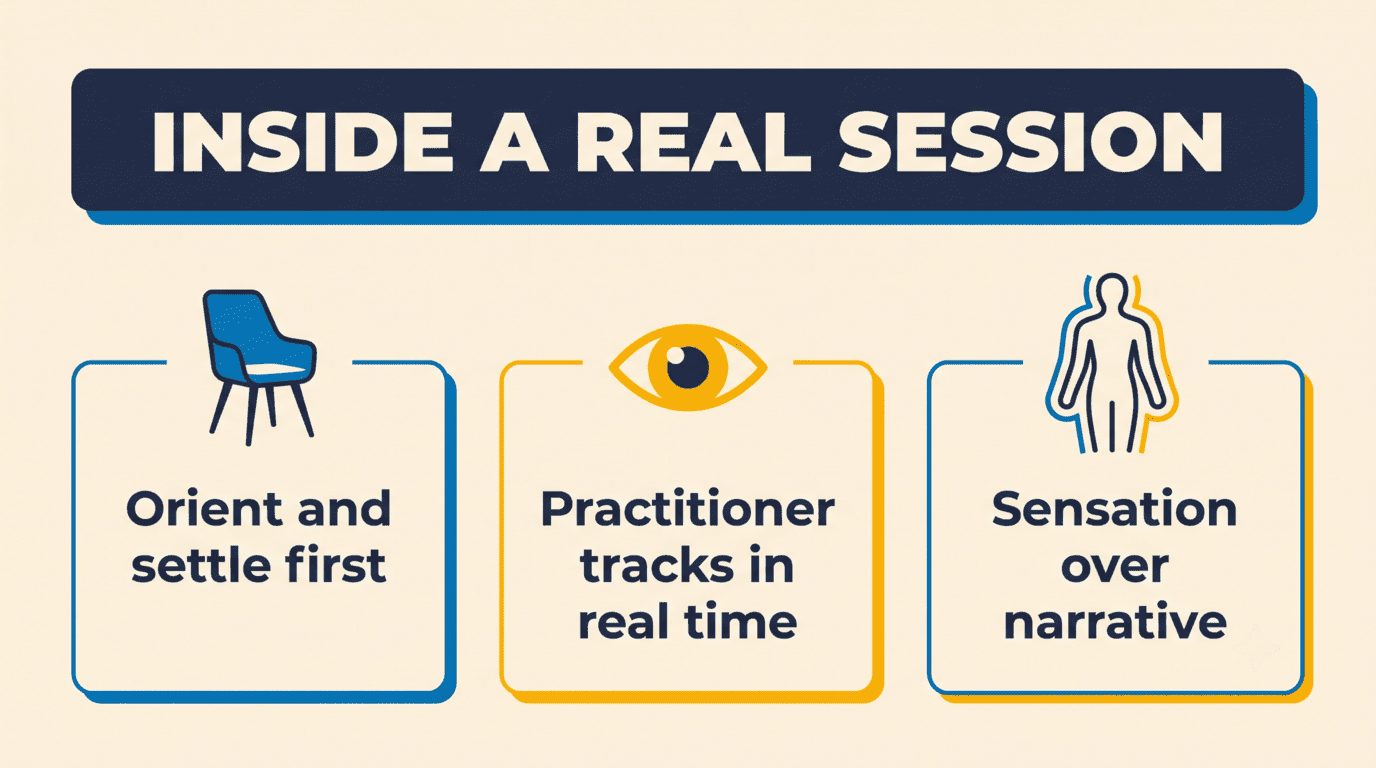
From there, the practitioner guides the same pendulation structure covered above, but with a key difference a self-guided version can’t replicate: the practitioner is watching your nervous system’s response in real time, tracking subtle shifts in breath, color, or posture, and adjusting how long you stay with an activated sensation based on what they observe, not based on a fixed step count.
This is also where Somatic Experiencing separates most clearly from conventional talk therapy. The practitioner directs attention toward physical sensations and body movements rather than primarily discussing the traumatic event itself, on the premise that the nervous system, not the narrative, is what actually needs to complete an interrupted response. A session rarely involves retelling a difficult story in detail; it more often involves noticing what the body is doing while a small piece of that material is briefly present.
Related: 3 Types of Somatic Therapy
Related: Health & Mental Wellbeing
Quick Summary
Pendulation, developed by Peter Levine within Somatic Experiencing, is the practice of shifting attention between a settled resource sensation and a mildly activated one, in doses small enough to process rather than overwhelm. It pairs with titration, working in small pieces rather than all at once. A basic self-guided version, resource, brief activation, return, repeat, notice, can help with everyday stress. A significant trauma history, dissociation during practice, or a resource that never brings settling are all signs to work with a trained practitioner instead of continuing alone.
Frequently Asked Questions
What is pendulation in somatic experiencing?
Pendulation is the practice of guiding attention back and forth between a settled or neutral body sensation and a mildly activated one, in small enough amounts that the nervous system can process the activation instead of shutting down. Peter Levine, the founder of Somatic Experiencing, developed the technique from observing how the body naturally oscillates between contraction and expansion.
Can I practice pendulation on my own?
A basic version can help with everyday stress and mild overwhelm. Significant trauma history, or activation that leads to full dissociation instead of a manageable sensation, calls for a trained Somatic Experiencing practitioner who can track your response and adjust pacing in real time, something a self-guided version can’t do.
How is pendulation different from titration?
Pendulation is the back-and-forth motion between a resource sensation and an activated one. Titration is the related principle of keeping each piece of activation small enough to process rather than flooding the system all at once. The two are typically practiced together, not as separate techniques, one supplies the motion and the other sets the size of each dose.
What should I feel after practicing pendulation?
Often something small and quiet, a fuller breath, warmth, or a sense of more room in the body, rather than a dramatic release. A subtle shift is a complete result. If the activated sensation never eases or practice leaves you feeling more shut down than before, stop and consider working with a licensed practitioner instead.